

Most Christian men today carry a burden they can barely name. Culture hands them one definition of masculinity, the church often hands them another, and Scripture seems to get buried underneath both. The result is confusion. Real confusion. Men who want to walk rightly but aren't sure what that even looks like day to day. This article maps out the biblical definition of masculinity, grounding it in the life and teachings of Jesus Christ. You'll find scriptural foundations, a clear contrast with cultural norms, and practical steps you can begin applying today. The word of God does not leave you guessing.
Table of Contents
- Understanding biblical masculinity: Definitions and context
- Jesus as the model: Servant leadership and strength
- Core traits of biblical masculinity in Scripture
- Practical steps for living out biblical masculinity
- Why biblical masculinity is often misunderstood, and what really works
- Explore resources to strengthen biblical masculinity
- Frequently asked questions
Key Takeaways
| Point | Details |
|---|---|
| Jesus as the model | Biblical masculinity centers on Jesus’ example of strength, humility, and servant leadership. |
| Core traits matter | Integrity, self-control, courage, and responsibility are essential for Christian men. |
| Practice daily | Consistent daily actions like prayer, service, and discipleship shape true biblical masculinity. |
| Emotional integrity | Emotional honesty is a strength, not a weakness, in biblical masculinity. |
| Resources available | Actionable guides and support can help men live out biblical masculinity authentically. |
Understanding biblical masculinity: Definitions and context
The phrase "biblical masculinity" gets used often, but it rarely receives a careful definition. Let's correct that. Biblical masculinity is the set of character qualities, relational responsibilities, and spiritual postures God designed men to embody, as revealed throughout Scripture. It is not a personality type. It is not a cultural artifact. It is a God-given calling rooted in creation, covenant, and redemption.
Genesis 2 establishes that man was formed first and given a charge to work, guard, and name. Ephesians 5:25 commands husbands to love their wives as Christ loved the church, giving Himself for her. First Corinthians 16:13 thunders: "Watch ye, stand fast in the faith, quit you like men, be strong." These are not suggestions. They are directives from the living God.
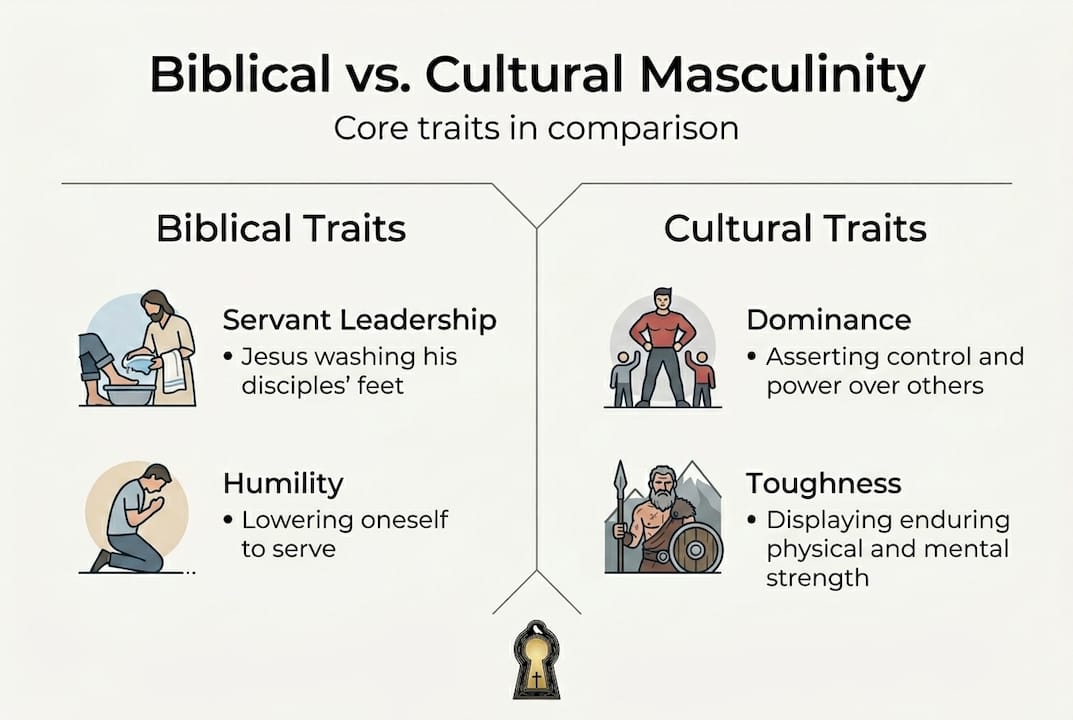
The confusion arises because culture has substituted its own version. Understanding the biblical masculinity definition matters precisely because the counterfeits are so convincing.
| Trait | Biblical masculinity | Cultural masculinity |
|---|---|---|
| Strength | Rooted in the Spirit, exercised through service | Physical dominance, social status |
| Leadership | Servant leadership, accountability before God | Authority for personal gain |
| Emotional expression | Honest, controlled, and courageous | Suppressed or weaponized |
| Identity | Found in Christ | Found in achievement or appearance |
| Responsibility | Covenant obligation to family and church | Optional, situational |
This contrast clarifies what is biblical masculinity versus what the world calls manhood. They are not the same thing. Not even close.
Scripture's model is not passive. It demands active engagement. Here are the foundational traits that emerge consistently from the text:
- Courage: Standing firm under opposition (Joshua 1:9)
- Humility: Placing others above self (Philippians 2:3)
- Integrity: Consistency between private belief and public action (Proverbs 10:9)
- Servant leadership: Authority expressed through sacrifice, not domination
- Responsibility: Owning the outcomes of your household, your word, your spiritual condition
Strength with humility and servant leadership is not a contradiction in Scripture. Jesus proves that. And He proves it repeatedly.
Jesus as the model: Servant leadership and strength
With clear definitions established, let's examine how Jesus embodies these virtues in real life. The Gospels are not abstract theology. They are a living portrait of masculine virtue expressed perfectly in flesh and blood.

Consider these four defining moments:
| Gospel event | Trait demonstrated | Scripture reference |
|---|---|---|
| Washing the disciples' feet | Servant leadership and humility | John 13:4-5 |
| Weeping at Lazarus' tomb | Honest emotional expression | John 11:35 |
| Resisting Satan in the wilderness | Discipline and self-control | Matthew 4:1-11 |
| Driving out the money changers | Righteous courage and protection | John 2:15 |
These are not passive moments. Jesus moved with intention, clarity, and authority in every one of them. Jesus demonstrated servant leadership, humility, discipline, and emotional expression without ever contradicting His strength.
How did Jesus model spiritual leadership? Walk through this step by step:
- He knew His mission. Jesus never drifted. Luke 4:43 records Him saying, "I must preach the kingdom of God to other cities also: for therefore am I sent." Purpose drove Him.
- He served before He commanded. John 13 shows Him kneeling at dirty feet before speaking the deepest truths of that final night. Service came first.
- He told the truth under pressure. Before Pilate, before the Sanhedrin, Jesus did not flinch. He spoke with precision and without apology.
- He protected those under His care. In Gethsemane, when soldiers arrived, Jesus stepped forward and said, "Let these go" (John 18:8). He placed Himself between danger and His disciples.
"But he that is greatest among you shall be your servant." Matthew 23:11
Pro Tip: In any situation demanding both strength and humility, ask first: what did Jesus do here? The Gospels answer almost every scenario a man faces. Discover more through this biblical masculinity resource that maps these principles to practical life.
Scripture reveals a husband's biblical role that mirrors this exact pattern. Lead first by serving. Protect first by being present. Speak truth first in love.
Core traits of biblical masculinity in Scripture
Having seen Jesus' model, now unpack the specific traits Christian men are called to cultivate. These traits are not personality options. They are spiritual obligations.
- Integrity: Proverbs 10:9 says, "He that walketh uprightly walketh surely." A man of integrity is the same in private as in public. He does not perform righteousness; he practices it.
- Courage: Men who fear God do not need to fear men. Joshua 1:9 commands: "Be strong and of a good courage." This applies to spiritual conflict, family decisions, and public witness.
- Self-control: Galatians 5:23 names temperance as a fruit of the Spirit. Self-control is not emotional coldness. It is mastery over impulse, appetite, and reaction.
- Emotional expression: Jesus wept (John 11:35). David sang laments. The Psalms are drenched in honest emotion. Jesus' emotional expression and spiritual leadership demonstrate that feeling deeply is not weakness.
- Responsibility: A man who leads must own the outcome. First Timothy 5:8 is stark: "But if any provide not for his own, and specially for those of his own house, he hath denied the faith."
Pro Tip: Emotional expression is a strength. When you name what you feel and bring it before God and your family honestly, you model the kind of emotional health in families that children remember and spouses trust.
Applied to daily life, these traits look like this: At work, integrity means honoring your word even when it costs you. In your family, courage means having hard conversations instead of retreating. At church, responsibility means showing up, not spiritually drifting into men's spiritual passivity that leaves wives and children without a spiritual anchor.
These traits form a web, not a ladder. You do not master one and move to the next. You grow in all of them simultaneously, through Scripture, prayer, and Spirit-led discipline.
Practical steps for living out biblical masculinity
With traits understood, focus on how to turn insight into daily practice. Knowledge without action is not wisdom. It is just information.
Here are five concrete steps:
- Study Scripture daily. Not devotional snippets. Actual Bible study. Get a plan. Work through books systematically. Know the text. A man cannot lead where he has not gone himself.
- Pray with consistency. Prayer is not a last resort. It is the first movement of a man who knows his dependence on God. Set a time. Guard it. Let nothing replace it.
- Serve your family and church actively. Servant leadership is not a philosophy. It is a practice. Wash the dishes. Show up to serve. Lead by being last, not by demanding first place.
- Lead your household spiritually. Deuteronomy 6:7 charges fathers to teach God's word to their children. Read Scripture with your family. Pray together. Create rhythms of faith in your home.
- Build accountability relationships. Proverbs 27:17 says, "Iron sharpeneth iron." Find a man who will speak truth to you. Not a cheerleader. A sharpener.
Discipling others and resisting temptation are not extras bolted onto the Christian life. They are the core structure of manhood modeled after Christ.
Pro Tip: Consistency beats intensity every time. One hour of daily Scripture and prayer over a year transforms a man more than a weekend retreat ever will. Discipline is a daily craft. Explore our biblical femininity guide alongside this framework to understand how masculine calling strengthens the family structure God designed.
Why biblical masculinity is often misunderstood, and what really works
Here is the uncomfortable truth: most men remain confused about biblical masculinity not because Scripture is unclear, but because the teachers around them have blended two incompatible streams. Cultural masculinity prizes performance. Biblical masculinity prizes obedience. Those are not the same river.
Many church environments celebrate the loud, the decisive, the dominant as naturally masculine. But look again at Jesus. He was quiet before Pilate. He wept publicly. He washed feet. He said the greatest among you shall be your servant. The biblical masculinity definition does not fit the cultural mold, and that friction is precisely why men struggle.
What really works is ruthless honesty about the gap between where you are and what Scripture calls you to. Not self-condemnation. Honest appraisal. Emotional integrity is not optional here. A man who cannot be honest with himself cannot lead anyone else truthfully.
Action is the proof. Not appearance. Not theological correctness alone. The man who studies and never serves has missed the point entirely. Biblical masculinity is visible. It moves. It shows up. Start there.
Explore resources to strengthen biblical masculinity
If the teaching in this article has stirred something in you, that stirring is not accidental. God is calling men to clarity, and Dead Hidden exists to answer that call with rigorous, Scripture-rooted tools built for men who are serious about the word.

Our biblical masculinity resource is a direct, verse-anchored guide designed to take you from concept to conviction to action. Pair it with the decision-making system to sharpen how you lead under pressure, and strengthen your awareness of spiritual opposition through exposing the enemy. These are not inspirational reads. They are weapons for men who intend to fight, lead, and stand.
Frequently asked questions
What does the Bible say are the key qualities of a man?
Biblical masculinity emphasizes humility, servant leadership, courage, integrity, self-control, and responsibility, best personified by Jesus Christ in the Gospels. These are not culturally constructed virtues but Spirit-produced qualities grounded in Scripture.
How can Christian men practice biblical masculinity daily?
Daily practices include prayer, Bible study, serving others, leading your family spiritually, and resisting temptation through discipling others and accountability. Consistency in these rhythms is what actually shapes a man's character over time.
Why is biblical masculinity often confused with cultural masculinity?
Many confuse the two because churches and society often highlight outward strength while overlooking Christ-like humility and servant leadership as equally essential qualities of true manhood.
Does biblical masculinity include emotional expression?
Yes. Jesus openly expressed emotion and demonstrated that healthy masculinity requires emotional honesty, not suppression. Weeping, lamenting, and speaking truth from a place of feeling are all biblical and masculine.
Recommended
- BIBLICAL MASCULINITY | Dead Hidden
- Biblical Masculinity Definition: What the Bible Actually Says a Man Is | Dead Hidden | Dead Hidden Ministries
- What Is Biblical Masculinity? The Definition the Modern Church Is Afraid to Give You | Dead Hidden | Dead Hidden Ministries
- Blog — Biblical Truth, Masculinity & Marriage | Dead Hidden | Dead Hidden Ministries
- Living Like I Know God