

Most Christians sense that something is pressing against their faith, but they cannot name it clearly. They feel the weight of temptation, doctrinal confusion, discouragement, and relentless worldly pressure. Yet they hesitate to call it warfare. Why? Because somewhere along the way, the Church reduced spiritual warfare to dramatic encounters with demons, leaving ordinary believers untrained for the daily battle that Scripture describes plainly and repeatedly. The King James Bible does not leave us guessing. It maps out the conflict, identifies the enemy, describes the weapons, and promises the victory. This guide is built on those pages.
Table of Contents
- What is biblical spiritual warfare?
- Key biblical passages on spiritual warfare
- How spiritual warfare plays out in daily life
- Biblical methods and weapons for victory
- Why most Christians misunderstand spiritual warfare
- Resources to strengthen your spiritual warfare
- Frequently asked questions
Key Takeaways
| Point | Details |
|---|---|
| Spiritual warfare is constant | Every believer faces spiritual battles in daily life, not just in dramatic situations. |
| Scripture reveals our strategy | Key Bible passages outline how to stand firm and resist the enemy. |
| Practical steps matter | Obeying the Word, prayer, and Christian community are essential to victory. |
| Misunderstanding leads to defeat | Many Christians lose ground by ignoring or misunderstanding daily spiritual warfare. |
What is biblical spiritual warfare?
With the confusion addressed, it is crucial to establish what the Bible really means by spiritual warfare, and why it matters for every believer.
Spiritual warfare, in its most precise biblical definition, is the ongoing conflict between the Kingdom of God and the kingdom of darkness, a war that every regenerate believer enters at the moment of salvation. It is not occasional. It is not reserved for missionaries or pastors. It is the constant reality of the challenge of Christian living for every saint who has been quickened by the Spirit and indwelt by God's truth.
Paul writes in Ephesians 6:12 with absolute clarity: "For we wrestle not against flesh and blood, but against principalities, against powers, against the rulers of the darkness of this world, against spiritual wickedness in high places." Notice the verb: wrestle. Not occasionally encounter. Not stumble upon. Wrestle, present tense, continuous action. This is your daily condition as a believer.
The most damaging misconception about spiritual warfare is that it only shows up in spectacular, visible forms. When most Christians think of spiritual warfare, they picture:
- Demonic possession or overt supernatural confrontation
- Sensational spiritual encounters reported in charismatic circles
- Exorcisms performed by specially gifted ministers
- Rare crisis moments that ordinary believers rarely face
This list is almost entirely wrong as a definition of spiritual warfare. While demonic activity is real and Scripture affirms it, the vast majority of warfare against believers operates through subtlety, not spectacle. It advances through doctrinal corruption, persistent temptation, relational strife, and cultural pressure to abandon biblical truth.
"Lest Satan should get an advantage of us: for we are not ignorant of his devices." (2 Corinthians 2:11, KJV)
The word "devices" in the Greek is noema, meaning thoughts, schemes, or mental strategies. Satan's primary warfare is cognitive and theological. He attacks what you believe about God, Scripture, sin, and salvation. Recognizing this is the first step toward standing firm.
Key biblical passages on spiritual warfare
With spiritual warfare defined, the next step is to see what the Bible itself teaches through specific passages.
Three passages form the theological backbone of everything the New Testament teaches about spiritual combat. You must know them. Better yet, you must internalize them.
| Passage | Key teaching | The believer's role |
|---|---|---|
| Ephesians 6:10-18 | The full armor of God | Put on, stand, withstand |
| 2 Corinthians 10:3-5 | Spiritual weapons for pulling down strongholds | Cast down imaginations |
| James 4:7 | Submission and resistance | Submit to God, resist the devil |
Each of these passages reveals something distinct about how God designed the believer for victory.
Ephesians 6:10-18 is the most exhaustive treatment of spiritual armor in all of Scripture. Paul lists seven components: the girdle of truth, the breastplate of righteousness, the gospel of peace as footwear, the shield of faith, the helmet of salvation, the sword of the Spirit, and prayer. Every single element is either doctrinal, devotional, or behavioral. Not one is mystical or reserved for a spiritual elite.
2 Corinthians 10:3-5 strikes at the cognitive battlefield. Paul declares that believers have weapons "mighty through God to the pulling down of strong holds" and that the target is "every high thing that exalteth itself against the knowledge of God." Strongholds, here, are belief systems, philosophies, and thought patterns that contradict Scripture. The weapons that demolish them are doctrinal: the Word rightly divided, prayer, and the mind conformed to truth.
James 4:7 is perhaps the most quoted and least understood verse on warfare. "Resist the devil, and he will flee from you." But notice the condition Paul attaches first: "Submit yourselves therefore to God." Submission precedes resistance. Victory is not achieved by aggressive spiritual techniques. It flows from surrender to God's authority and Word.
Key practices rooted in these passages include:
- Daily, systematic reading of the KJV Bible to renew the mind (Romans 12:2)
- Prayer that is specific, persistent, and Scripture-saturated
- Actively identifying and rejecting beliefs that contradict God's Word
- Standing on doctrinal certainty rather than emotional experience
Pro Tip: Before engaging in any spiritual discipline labeled "warfare," locate the relevant KJV passage first. If a technique cannot be grounded in a specific text, it does not belong in your arsenal. The Warrior's Bible Blueprint provides exactly this kind of verse-by-verse doctrinal structure for building your war strategy from the ground up.
How spiritual warfare plays out in daily life
Knowing the Bible's teaching, Christians often ask how to recognize and respond to spiritual warfare in everyday life.
This is the question that separates doctrine from discipleship. Spiritual warfare is not an event you schedule. It confronts you at breakfast when your mind fills with anxiety. It confronts you at work when compromise feels convenient. It confronts you in your marriage, your finances, and your thought life. The battlefield is everywhere you live.

Consider a concrete scenario. A believer named Thomas has been studying the KJV seriously for three months. He begins to notice doctrinal errors in the sermons at his church. He feels pressure from family members to stop raising questions. His prayer life becomes cold. Doubt creeps in, not about salvation, but about whether truth matters enough to fight for. He starts sleeping in on Sunday mornings. This is spiritual warfare. No demons appeared. No dramatic confrontation occurred. But the enemy gained measurable ground through discouragement, isolation, and doctrinal erosion.
Thomas's path back is precisely what Scripture prescribes:
- Return to the Word daily and specifically. Not general reading, but targeted engagement with the passages that address the doubts attacking him. Faith comes by hearing, and hearing by the Word of God (Romans 10:17).
- Pray according to Scripture. Not improvised emotional prayer, but structured, prayers for crisis that align his petition with God's revealed will.
- Reconnect with doctrinally sound believers. Isolation is a warfare tactic. The enemy knows that a believer standing alone is far more vulnerable than one accountable to the body.
- Identify and name the lie being pressed against him. In Thomas's case, the lie is: "Doctrinal truth is not worth relational conflict." The biblical counter is Matthew 10:34-36, where Christ declares that He came to bring not peace but a sword, specifically in doctrinal allegiance.
- Use Scripture-based prayer as offensive action. The scriptural prayers resource provides this tool directly, giving believers language shaped entirely by the Word.
- Persevere without requiring visible results. Faithfulness itself is a weapon. The enemy wants you to believe that nothing is changing. But "in due season we shall reap, if we faint not" (Galatians 6:9).
"Be sober, be vigilant; because your adversary the devil, as a roaring lion, walketh about, seeking whom he may devour." (1 Peter 5:8, KJV)
Sobriety and vigilance are not emotional states. They are disciplined, informed, ongoing practices. Peter's command is both a warning and a method.
Pro Tip: Build a written prayer journal tied directly to KJV passages. When a specific attack comes, record it, identify the lie behind it, and write the countering Scripture. This practice builds spiritual muscle memory that holds under sustained pressure.
Biblical methods and weapons for victory
Understanding daily spiritual conflict leads to the next question: what resources has God provided for victory, and how can you use them effectively?
The armor of God in Ephesians 6 is not poetic decoration. It is a functional combat manual. Each piece corresponds to a specific category of attack and provides a specific mode of defense or offense.
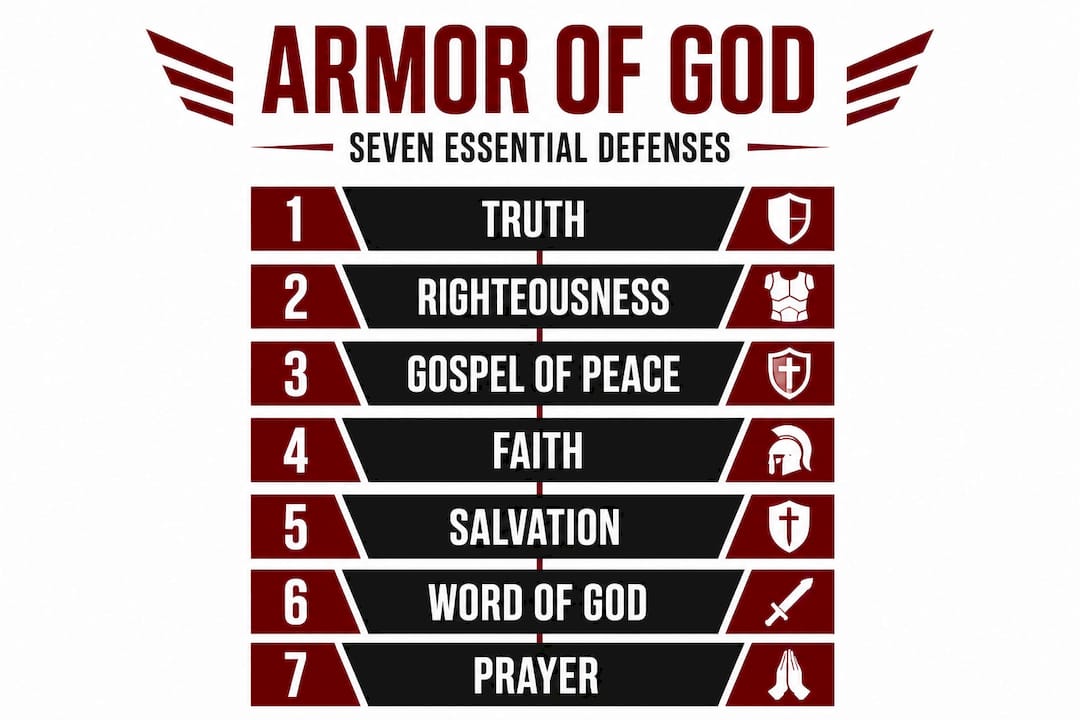
| Weapon/armor piece | KJV term | Practical application | Common attack it counters |
|---|---|---|---|
| Girdle of truth | "having your loins girt about with truth" | Know and live doctrinal truth daily | Deception and false teaching |
| Breastplate of righteousness | "breastplate of righteousness" | Obedience and confession of sin | Guilt, condemnation, moral failure |
| Gospel of peace | "feet shod with the preparation of the gospel" | Readiness to share and stand on the gospel | Anxiety, fear, relational strife |
| Shield of faith | "shield of faith" | Trust in God's Word above circumstances | Fiery darts of doubt and temptation |
| Helmet of salvation | "helmet of salvation" | Assurance of regeneration | Attacks on assurance and identity |
| Sword of the Spirit | "sword of the Spirit, which is the word of God" | Quote, study, and apply KJV Scripture | Every category of spiritual attack |
| Prayer | "praying always with all prayer" | Consistent, Scripture-grounded intercession | Spiritual coldness and unbelief |
The most common pitfalls that leave believers vulnerable and exposed:
- Neglecting the Word. A believer who rarely opens the KJV is a soldier who has abandoned his sword. There is no substitute. None.
- Prayerlessness. Prayer is not optional equipment. Paul commands it with the word "always" in Ephesians 6:18. A prayerless Christian is an unarmed Christian.
- Isolation from biblical community. Ecclesiastes 4:12 declares that "a threefold cord is not quickly broken." The enemy targets solitary believers because they are far more vulnerable.
- Relying on emotional experience over scriptural truth. Feelings fluctuate. The Word of God does not. When feelings contradict Scripture, Scripture wins. Every time.
- Tolerating doctrinal compromise. Subtle error is more dangerous than obvious heresy because it does not trigger alarms. Test every teaching against the KJV text.
The Warrior's Bible Conquest resource addresses each of these vulnerabilities directly, giving you a structured, Scripture-first approach to arming yourself for sustained spiritual conflict.
Why most Christians misunderstand spiritual warfare
With practical tools in hand, it is time to confront why these truths are so often absent from churches and discipleship programs today.
Here is the honest, uncomfortable assessment: most Christians miss the real war because the real war is quiet. It does not announce itself. It does not arrive with dramatic music. It comes dressed as a reasonable thought, a convenient compromise, a subtle theological drift, or a growing preference for comfort over conviction.
The church has been conditioned to look for warfare in the spectacular and dismiss it in the ordinary. This is one of the enemy's most effective strategies, and it is working. We have generations of believers who would recognize a Hollywood-style demonic encounter but cannot identify the erosion happening in their own minds and priorities every single day.
The real battlefield, as 2 Corinthians 10:5 makes plain, is the mind. Every thought that exalts itself against the knowledge of God is an enemy position. And most of those thoughts arrive wearing the clothing of culture, of mainstream Christianity, of convenience. The man who never faces a dramatic spiritual crisis may still be losing the war one passive, unexamined belief at a time.
There is a pattern seen consistently in ministry: the believers who struggle most are not those who face dramatic opposition. They are the ones who slowly drift through spiritual passivity in church, gradually substituting experience for doctrine, emotion for obedience, and comfort for the cross. The battle was never about the dramatic. It was always about the daily.
Victory does not come from learning a new spiritual technique or attending another conference. It comes from the unglamorous, daily faithfulness of opening the KJV, praying with your whole heart, saying no to the lie, and standing in obedience when every circumstance argues against it. That is the warfare the Bible describes. That is the warfare that wins.
Resources to strengthen your spiritual warfare
Having seen what true spiritual warfare involves, here is how you can go deeper and stand firm.
The knowledge you have just walked through is only the beginning. Doctrine must become discipline. Understanding must translate into daily practice. That takes structure, accountability, and resources built on the Word.
Dead Hidden exists to give you exactly that. The Warrior's Bible Blueprint takes the doctrinal foundation of Ephesians 6 and builds it into a practical, verse-by-verse study system designed for believers who are serious about standing in the battle. Every tool on the platform, including the KJV-based study guides, prayer manuals, and downloadable resources, is built to move you from passive churchgoer to equipped, doctrinally grounded soldier. The war is real. The Word is sufficient. The tools are available. The next step is yours.
Frequently asked questions
What is the difference between spiritual warfare and temptation?
Spiritual warfare is the broader battle for your faith and obedience, while temptation is one method the enemy uses within that battle. Temptation targets your behavior; warfare targets your entire relationship with God, truth, and Scripture.
How can I tell if I am facing spiritual warfare or just life's challenges?
If the struggle attacks your faith, truth, or obedience to Scripture, it is a sign of spiritual warfare, as described in passages like Ephesians 6. General hardship becomes warfare when it specifically aims to separate you from God's Word and community.
Should every Christian expect to face spiritual warfare?
Yes, according to the Bible, all believers will encounter spiritual battles until Christ returns. Paul's command to put on the full armor in Ephesians 6 is addressed to every saint, not a special class of spiritual warriors.
What are the most important tools for victory in spiritual warfare?
The Word of God, prayer, faith, and living in biblical community are the believer's most effective spiritual weapons. No single technique replaces these four foundations, and none of them function well in isolation from the others.