

Few topics in Christian life generate more confusion, fear, and outright controversy than biblical submission. Some have been taught that submission means silence and servility. Others have used it as a weapon, distorting Scripture to justify control. Neither reading is faithful to God's Word. The Bible's teaching on submission is carefully ordered, Spirit-led, and anchored in the example of Jesus Christ himself. This article maps out the scriptural definition, the God-ordained purpose, and the practical outworking of submission, so you can walk in clarity rather than confusion, whether in your marriage, your church, or your daily walk with God.
Table of Contents
- Defining biblical submission: What does the Bible actually say?
- The purpose and value of submission in Christian life
- How submission is practiced in personal and church relationships
- Common misconceptions and pitfalls to avoid
- A fresh look at biblical submission: What most conversations miss
- Go deeper with biblical truth
- Frequently asked questions
Key Takeaways
| Point | Details |
|---|---|
| Submission defined biblically | It means willingly yielding to leadership as spiritual service, not forced obedience. |
| Spirit-led, not coerced | True submission is voluntary and always rooted in Christ's example of servanthood. |
| Practical applications matter | Biblical submission shapes marriage, church life, and personal discipleship when applied as Scripture intends. |
| Common myths debunked | Submission does not equal inferiority or silent passivity but instead fosters health and unity. |
Defining biblical submission: What does the Bible actually say?
Having identified widespread confusion, let's start by understanding what the Bible actually teaches about submission.
The word submission comes from the Greek hupotasso, a military term meaning to arrange under or to place oneself under the order of another. This is not the language of defeat. It is the language of willing alignment, of a soldier who understands the chain of command and chooses to honor it. That distinction matters enormously.
Scripture provides direct instructions about submission in Ephesians 5:21-24, Colossians 3:18, and 1 Peter 3:1-7. In each passage, the call to submit is addressed to believers who are free in Christ, not to servants who have no choice. This is a voluntary act of faith, not a structural inferiority.
Ephesians 5:21 opens with mutual submission among all believers: "Submitting yourselves one to another in the fear of God." This lays the foundation before Paul ever addresses wives, husbands, or children. The principle is broader than marriage. It is a posture of the redeemed heart.
Now consider the common myths versus what the Bible actually declares:
| Cultural myth | Biblical truth |
|---|---|
| Submission means a wife has no voice | A wife's godly counsel is valued and sought (Proverbs 31:26) |
| Submission is only for women | All believers submit to one another and to Christ (Ephesians 5:21) |
| Submission enables abuse | Biblical submission never requires obedience to sin or harm |
| Submission implies inferiority | Christ himself submitted to the Father without being less than God |
| Submission silences women in all contexts | Women prayed and prophesied in the early church (1 Corinthians 11:5) |
Understanding biblical headship is inseparable from understanding submission. Headship, as defined in Ephesians 5, is servant leadership modeled after Christ's love for the church. You cannot rightly apply submission without first grasping what the head is called to be.
Pro Tip: Always study submission passages in their full context. The command to wives in Ephesians 5 sits within a broader call to mutual service, Spirit-filling, and Christlike love. Pull it out of that context and you will misread it every time.
The purpose and value of submission in Christian life
With a definition in place, we can now explore why submission holds such significance in the Christian walk.
Submission is not a reluctant concession to social structure. It is a spiritual discipline, one that mirrors the very heart of Jesus. Philippians 2:5-8 declares that Christ, being God, took on the form of a servant and humbled himself even to death on the cross. That is the model. Submission, then, is not weakness. It is Christlikeness in action.
Submission ultimately points believers to Christ, models humility, and fosters unity in the body. When wives submit to loving husbands, they mirror the church's trust in Christ. When believers submit to church leadership, they reflect an ordered body functioning under one Head.
The Greek word hupotasso also appears in descriptions of Jesus submitting to his parents (Luke 2:51) and to the Father (1 Corinthians 15:28). These passages confirm that submission does not imply ontological inferiority. Jesus is no less God because he submitted. A wife is no less a co-heir of grace because she defers to her husband's leadership.
Here are the core benefits and purposes of submission as Scripture presents them:
- Reflects Christ's humility: It models the servant posture of Jesus, who did not grasp for authority but laid it down.
- Builds marital trust: When both husband and wife operate within God's design, security and intimacy deepen.
- Promotes church unity: Submission to godly leadership prevents disorder and division within the local assembly.
- Guards against pride: Choosing to yield is a direct confrontation with the self-exalting nature of the flesh.
- Honors God's design: Submission is not man-made hierarchy; it reflects the eternal order within the Godhead itself.
"Let nothing be done through strife or vainglory; but in lowliness of mind let each esteem other better than themselves." Philippians 2:3 (KJV)
Studying biblical femininity reveals that submission, rightly understood, is a mark of strength, not a limitation. Scripture consistently frames a woman who operates within God's design as someone of great dignity and eternal purpose. For a broader survey of what womanhood expectations look like across Scripture, the testimony is consistent: godly submission is always tied to glory, not shame.
How submission is practiced in personal and church relationships
Understanding the why leads naturally to questions of how, so what does biblical submission look like in action?
In marriage, submission is not passive silence. It is active, relational trust. The wife is called to respect her husband's leadership (Ephesians 5:33), which includes voicing her perspective, her wisdom, and her concerns. What she is not called to do is override or undermine his God-given role. This works only when the husband is doing his part: loving sacrificially, leading humbly, and listening to her as a co-laborer in grace (1 Peter 3:7).

Submission in marriage is balanced with mutual love and respect, not authoritarian control. The husband who demands submission without laying down his life is not modeling Christ. He is modeling Pharaoh.
In the church, submission to spiritual authority means trusting and supporting those whom God has placed in leadership (Hebrews 13:17). It does not mean uncritical acceptance of every teaching. Berean faith (Acts 17:11) demands that you test what you hear against Scripture. But when leadership operates within biblical bounds, submission to that structure is godly and right.
Here is a practical step-by-step guide to practicing submission faithfully:
- Anchor it in prayer. Ask the Lord to reveal areas where pride or fear is blocking your submission.
- Study the structure. Know what Scripture actually says about the authority in your life, whether husband, pastor, or employer.
- Communicate openly. Submission does not mean silence. Speak with clarity and grace, then trust God's design to work.
- Discern the limits. Any instruction that requires you to sin must be refused. Acts 5:29: "We ought to obey God rather than men."
- Walk in it daily. Submission is a habit of the heart, built in small decisions over time.
For women beginning to explore biblical womanhood, this framework provides a starting point, not a rigid formula.
Pro Tip: If you are in a relationship or a church where submission is consistently paired with fear, shame, or manipulation, something is wrong. Healthy biblical submission always operates in an environment of love and accountability.
Common misconceptions and pitfalls to avoid
Practical application can be derailed by misconceptions, so it's crucial to address where many go wrong.
Misinterpretation of submission has led to spiritual abuse and deviation from Christ's example throughout church history. This is not a fringe problem. It has caused real harm, in real homes and real congregations. We must name it clearly.
Here are the top five myths and errors that distort biblical submission:
- Myth 1: Submission means total obedience. Scripture places clear limits. No human authority supersedes God's Word.
- Myth 2: Submission removes a woman's personhood. The Proverbs 31 woman is industrious, vocal, and celebrated. Submission does not erase identity.
- Myth 3: Submission is permanent regardless of conduct. Scripture addresses situations where a wife's behavior may actually win an unbelieving husband (1 Peter 3:1). Context always matters.
- Myth 4: Only wives submit. Every believer is called to submit in various relational contexts. Elders, deacons, and congregation members all operate under ordered accountability.
- Myth 5: Questioning leadership is rebellion. Berean faith is commended. Discernment is not the same as defiance.
| True biblical submission | Distorted submission |
|---|---|
| Willingly chosen, Spirit-led | Coerced or demanded under threat |
| Operates within godly love and safety | Enabled by fear or manipulation |
| Aligned with Scripture above all | Overrides scriptural conscience |
| Preserves dignity and personhood | Erodes identity and voice |
| Corrects leadership when it errs | Silences legitimate concern |
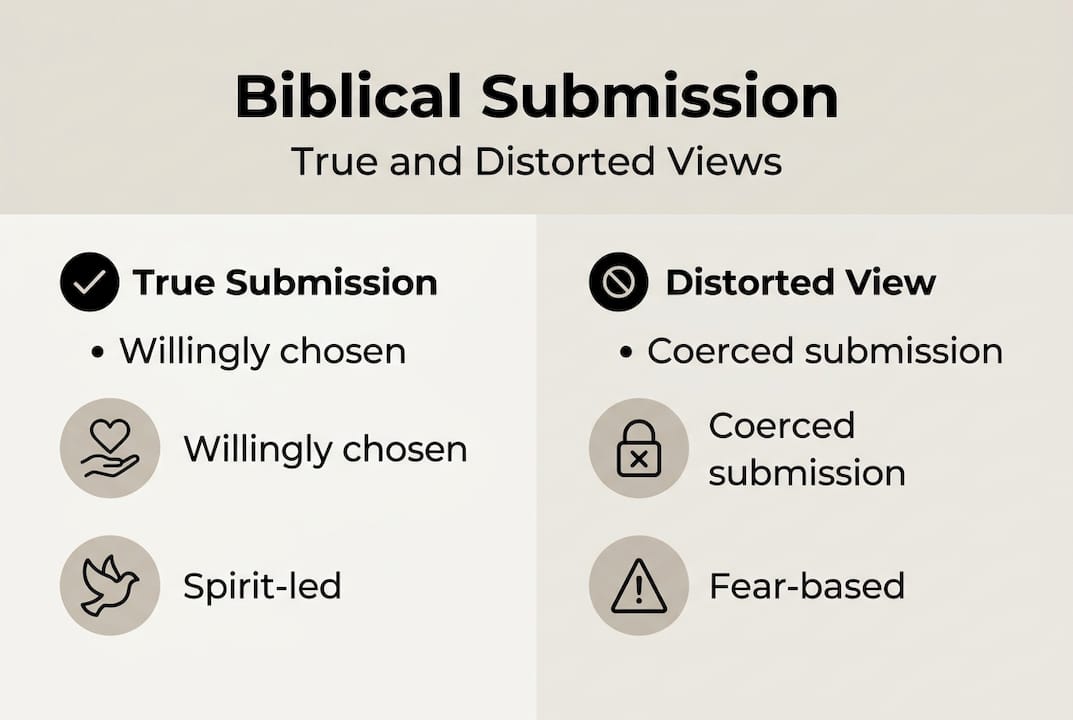
Understanding proper headship teachings is the antidote to these distortions. Where authority is exercised as service, as Christ modeled it, submission becomes natural, even beautiful. Where authority becomes control, the whole structure collapses into something foreign to the New Testament. For further reading on how masculinity and marriage intersect with these principles, the broader conversation is worth your time.
A fresh look at biblical submission: What most conversations miss
With common pitfalls uncovered, it's time to challenge the status quo and reframe the heart of biblical submission.
Most conversations about submission orbit around order: who is in charge, who defers, and who holds final say. That framing misses the deeper reality entirely. Biblical submission is not primarily about structure. It is about the posture of a heart that has been conquered by the grace of God.
Mainstream teaching has, for decades, overemphasized the mechanics of hierarchy and underplayed the freedom and joy found within God's design. When a woman submits to a Christlike husband, she is not diminished. She is protected, cherished, and positioned for flourishing. When a believer submits to a godly pastor, the whole church becomes stronger.
The part that rarely gets said: authority in Scripture is always accountable. Husbands answer to Christ. Pastors answer to Scripture and to the Chief Shepherd. No authority is autonomous. That accountability is what makes submission safe. Strip it away and you have a counterfeit.
This is where womanhood vs. church views often clash. The church sometimes presents submission as a burden. Scripture presents it as a gift. Courageous, Spirit-led, countercultural. That is the biblical vision worth recovering.
Go deeper with biblical truth
If you're ready to pursue a fuller understanding and application of biblical submission, take your next step below.
Dead Hidden Ministries offers carefully crafted tools and verse-by-verse studies designed to equip you for exactly this kind of biblical growth. Whether you are a woman working through God's design for your life or a leader seeking to teach submission with both boldness and balance, the resources here go beyond surface-level devotionals.

Begin with the biblical femininity guide, a study that addresses the most neglected truths about womanhood in the modern church. Browse the women's starting resources page to find where to begin based on where you are spiritually. And for a thorough treatment of womanhood in God's design, the biblical womanhood bundle brings together the most essential materials in one place. The Word is sufficient. Let's treat it that way.
Frequently asked questions
Is biblical submission only for women?
No, submission is taught for all Christians, not only wives. Its expression varies by context, including marriage, church structure, and spiritual leadership.
Can submission be abused or misunderstood?
Yes. Misinterpretations of submission have caused genuine harm, and Scripture never condones coercion or control masquerading as godly authority.
How can I practice submission without being taken advantage of?
Biblical submission must align with Christ's leadership and example, and Scripture never requires obedience that violates conscience, safety, or God's Word.
What if my church teaches an unbiblical view of submission?
Scripture should be the final authority on submission. Compare every teaching to the Word, and seek godly counsel or correction where doctrine strays from biblical truth.
Recommended
- Biblical Headship: What the KJV Actually Teaches (And What Your Church Got Wrong) | Dead Hidden | Dead Hidden Ministries
- Things We Should Contend For: Biblical Femininity | Dead Hidden Ministries
- What Does the Bible Say About a Husband's Role? (The Full Picture) | Dead Hidden | Dead Hidden Ministries
- Biblical Womanhood Expectations: What the Bible Says vs. What the Church Invented | Dead Hidden | Dead Hidden Ministries