

Biblical illiteracy is not a minor inconvenience. It is a doctrinal crisis. Across evangelical churches, believers sit under teaching they cannot verify, accept interpretations they have never tested, and drift toward error simply because they never learned to study Scripture for themselves. Transformation comes through consistent engagement with the Word, not passive attendance. This guide maps out a proven, step-by-step approach to deep Bible study, built from a conservative, dispensationalist foundation. You will walk away with the tools, the method, and the conviction to open your Bible with confidence and come out with clarity.
Table of Contents
- Why deep Bible study is vital for faith and doctrine
- Essential tools and resources for effective Bible study
- The inductive Bible study method: observation, interpretation, application
- Common mistakes and myths: keeping your study biblical
- Making Bible study a life-giving routine
- What most Bible study guides miss: truths from lived experience
- Study the Bible with confidence: resources for your journey
- Frequently asked questions
Key Takeaways
| Point | Details |
|---|---|
| Start with prayer | Always begin Bible study by asking God for wisdom and a teachable heart. |
| Use the inductive method | Study the Bible by observing, interpreting, and applying each passage in its context. |
| Avoid early commentaries | Resist the urge to consult commentaries until after careful personal study. |
| Stay consistent | Transformation comes through daily habits, not occasional effort. |
| Let Scripture interpret Scripture | Cross-reference passages and seek the Bible’s unified message for doctrinal clarity. |
Why deep Bible study is vital for faith and doctrine
Casual reading is not enough. Reading a chapter a day with no method, no observation, and no cross-referencing will not produce doctrinal soundness. It may produce familiarity, but familiarity is not the same as understanding. The difference matters enormously.
"Biblical illiteracy is pervasive, yet transformation comes through consistent engagement with Scripture."
When you do not study deeply, you become vulnerable. False teachers do not announce themselves. They use real verses, real language, and real emotion. Without a thorough grasp of context, grammar, and cross-reference, you will not catch the error. You will feel it is biblical because it sounds biblical.
Deep study protects you. It anchors your doctrine to the text itself, not to a pastor's personality or a trending theological framework. Consider what is at stake without it:
- Doctrinal drift: Slow acceptance of teachings that contradict Scripture
- Cultural compromise: Reinterpreting passages to fit modern sensibilities
- False assurance: Believing you are sound when you are not
- Spiritual immaturity: Remaining on milk when you should be handling meat (Hebrews 5:12)
- Susceptibility to heresy: Lacking the discernment to identify it
Study the Bible with the same rigor you would apply to any serious discipline. Meditation on the Word, careful observation, and consistent application are not optional extras. They are the pathway to transformation. Explore KJV study steps and broader Bible study tips to begin building that foundation today.
Essential tools and resources for effective Bible study
Before you open to Genesis or Romans, you need the right instruments. A carpenter does not frame a house with his bare hands. Neither should you approach Scripture without the tools that sharpen observation and protect interpretation.
Here is what you need:
- A printed Bible: The KJV remains the gold standard for doctrinal precision and textual fidelity. A wide-margin edition gives you room to write observations directly on the page.
- A notebook and pen: Write everything. Observations, questions, cross-references, and patterns. Writing forces clarity.
- A Strong's Concordance: Essential for tracing original Hebrew and Greek words without requiring seminary-level language training.
- Cross-reference tools: A Thompson Chain-Reference Bible or a printed cross-reference guide connects passages thematically and doctrinally.
- Bible software: Logos Bible Software is the most powerful digital platform for serious study, offering original language tools, commentaries, and sermon preparation workflows.
Resources from Precept Ministries, Navigators tools, Moody and Liberty guides, and DTS courses all provide structured frameworks that align with conservative, inductive methodology. These are proven, trustworthy starting points.
| Tool | Purpose | Best for |
|---|---|---|
| KJV Wide-Margin Bible | Primary text and annotation | All study levels |
| Strong's Concordance | Word-level original language study | Intermediate learners |
| Logos Software | Deep research and cross-referencing | Advanced study |
| Precept/Navigators guides | Structured inductive workbooks | Beginners and groups |
Pro Tip: Resist the urge to reach for commentaries first. Read the text yourself, record your own observations, and form your initial interpretation before consulting any outside voice. Commentaries are a confirmation tool, not a starting point. Pair your study with the 2026 KJV reading plan or the Bible reading protocol to stay on track.
The inductive Bible study method: observation, interpretation, application
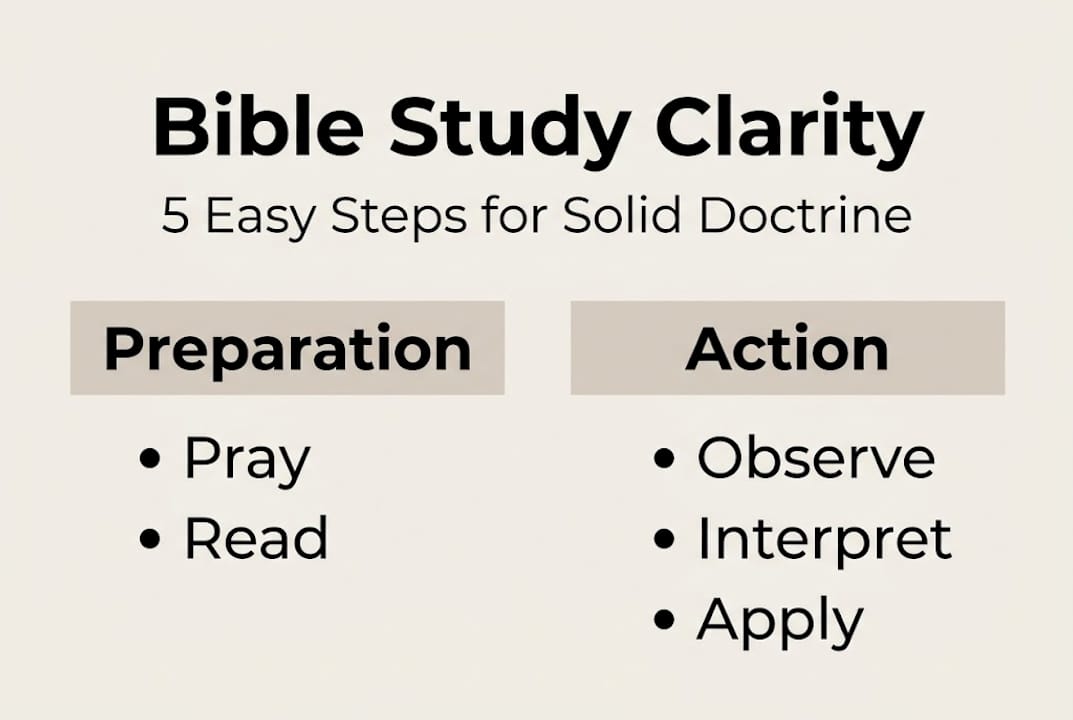
The inductive method is the most reliable framework for accurate, transformative Bible study. It is not complicated. But it requires discipline. Inductive Bible study consists of observation, interpretation, and application, each building on the one before it.
Here is how to work through it:
- Observation: What does it say? Read the passage multiple times. Ask the five W's: Who is speaking? To whom? What is happening? When and where does it occur? Why is this being said? Mark repeated keywords, note contrasts, lists, and commands. Do not interpret yet. Just see.
- Interpretation: What does it mean? Now seek the author's intended meaning. Prioritize the literal, grammatical, historical sense. Cross-reference related passages. Let Scripture interpret Scripture. Context is everything: a verse pulled from its chapter, book, and Testament context can be made to say almost anything.
- Application: How do I live it? As 2 Timothy 3:16-17 declares, all Scripture is profitable for doctrine, reproof, correction, and instruction in righteousness. Ask honestly: what does this passage demand of me? Where does it correct me? What obedience does it require?
| Method | Starting point | Strength | Risk |
|---|---|---|---|
| Inductive | The text itself | Accuracy and objectivity | Requires time and discipline |
| Deductive | A conclusion or doctrine | Speed | Can force the text to confirm bias |
| Devotional | Personal feeling | Emotional engagement | Prone to subjectivity |
Pro Tip: Begin every study session with prayer. Ask the Holy Spirit for illumination before you read a single word. Then let the text speak before you bring your theology to it. For a structured walkthrough of this process, the deep study guide at Dead Hidden is built precisely for this method.

Common mistakes and myths: keeping your study biblical
Even sincere believers fall into traps that undermine their study. Knowing these pitfalls protects you from wasted effort and doctrinal error.
"Pray first, read the whole book, study one book at a time, avoid early commentaries, use context, maintain a God-centered focus."
Here are the top five mistakes and how to correct them:
- Skipping straight to application: You cannot apply what you have not correctly interpreted. Observation and interpretation must come first, every time.
- Ignoring historical and grammatical context: A passage written to first-century Jewish believers may carry different immediate implications than one written to the Church. Context is not optional.
- Over-spiritualizing the text: Not every passage is an allegory. Dispensationalist study insists on a literal, plain reading unless the text itself signals figurative language.
- Depending on commentaries too early: Reading what others think before forming your own observation trains you to be a consumer, not a student.
- Blending theological frameworks carelessly: Covenant theology and progressive theology approach the text with assumptions that differ sharply from dispensationalism, particularly on the Israel and Church distinction and the literal fulfillment of prophecy. Know your framework and why you hold it.
Dispensationalist study is not merely a preference. It is a commitment to letting the text mean what it says, to whom it was written, in the time it was written. The covenant vs. dispensationalist approaches resource at Dead Hidden addresses these distinctions directly and clearly.
Making Bible study a life-giving routine
Knowledge without consistency produces nothing. The goal is not a single powerful study session. It is a life shaped by sustained, daily engagement with Scripture. Consistent study, meditation, and application transform understanding and life over time.
Here is how to build that routine:
- Set a fixed time: Morning study before the day's demands press in is ideal for most. Protect it like an appointment.
- Start with one book: Do not jump around. Work through one book completely before moving to another. Depth beats breadth at this stage.
- Use a reading plan: Structure removes the daily decision of what to read and keeps you moving forward. The women's reading plan and the daily protocol are excellent starting frameworks.
- Connect study to prayer: Do not separate them. What you observe in the Word, bring immediately to God in prayer. Let study and intercession reinforce each other.
- Find accountability: A spouse, a small group, or a trusted friend who asks you what you studied this week is worth more than most study tools.
Pro Tip: When discouragement hits and it will, return to a passage where God previously spoke clearly to you. Remind yourself of past fruit. Then keep going. For women building this habit, Bible study for women at Dead Hidden offers a tailored starting point.
What most Bible study guides miss: truths from lived experience
Most guides focus on method. Method matters. But method alone will not transform you. We have seen believers who master the inductive steps and still remain unchanged, because they approach Scripture to win arguments rather than to be corrected by God.
The uncomfortable truth is this: real transformation happens when you let the text oppose you. When a passage confronts your preferences, your politics, your comfort, and you submit to it anyway, that is when Scripture does its deepest work. It is not academic mastery you are after. It is obedience.
We also want to name the cultural pressure directly. There is a relentless push to reinterpret Scripture through modern lenses, to soften what is plain, to find nuance where the text is blunt. Resist it. The KJV inductive method is built on the conviction that the text means what it says, and that conviction must be your anchor.
Humility is the non-negotiable. Come to the Word as a student, not a critic. Come expecting to be changed, not confirmed.
Study the Bible with confidence: resources for your journey
You now have the framework. The question is whether you will act on it. Deep, doctrinally sound Bible study is not reserved for scholars. It is the inheritance of every believer who is willing to be consistent and humble before the Word.
Dead Hidden has built a set of resources specifically for believers who are serious about this. The definitive Bible study guide walks you through the inductive method with precision and conviction. The 2026 reading protocol gives you a structured daily framework. And the women's KJV plan offers a focused, doctrinally grounded reading path. These are not generic resources. They are built for believers who take the Word seriously.
Frequently asked questions
What is the best order to study the books of the Bible?
Focus on one book at a time, reading it multiple times before moving on. Starting with a gospel like John or a foundational epistle like Romans builds strong context and doctrinal grounding early.
Do I need biblical languages or seminary training to study deeply?
No. Inductive methods are accessible to all believers with prayer, methodical reading, and sound tools like a Strong's Concordance. Seminary training enriches study but is not a prerequisite for depth or accuracy.
How does dispensationalist Bible study differ from other approaches?
Dispensationalist study applies literal interpretation of prophecy, maintains a clear distinction between Israel and the Church, and takes future prophetic passages at face value rather than spiritualizing them.
Why should I use the inductive method for Bible study?
The inductive method: observation, interpretation, application ensures you see what the text actually says before deciding what it means, producing accurate understanding and genuine life transformation rather than confirmation of prior assumptions.
Recommended
- How to Study the Bible in the KJV: A Step-by-Step Method That Actually Works | Dead Hidden | Dead Hidden Ministries
- HOW TO STUDY THE BIBLE LIKE YOUR LIFE DEPENDS ON IT | Dead Hidden
- Blog — Biblical Truth, Masculinity & Marriage | Dead Hidden | Dead Hidden Ministries
- Biblical Headship: What the KJV Actually Teaches (And What Your Church Got Wrong) | Dead Hidden | Dead Hidden Ministries