

The world cannot agree on what a man is. Culture pulls in one direction, the church often whispers where it should thunder, and men are left navigating a fog of competing definitions. Scripture, however, has never been confused on this point. The Bible presents manhood not as a cultural construct but as a divine design, rooted in the character of God and modeled perfectly in the person of Jesus Christ. This article will define scriptural manhood precisely, identify its core traits with chapter-and-verse authority, dismantle the most damaging myths about it, and give you a practical path to walk it out every single day.
Table of Contents
- What is scriptural manhood?
- Key traits of scriptural manhood: A biblical framework
- Common misconceptions about scriptural manhood
- How to live out scriptural manhood today
- The hard truth about scriptural manhood today
- Grow deeper in biblical manhood with practical resources
- Frequently asked questions
Key Takeaways
| Point | Details |
|---|---|
| Clear definition | Scriptural manhood centers on following Christ’s example of leadership, service, and love. |
| Core traits | Traits include responsibility, humility, courage, and sacrificial love, according to Scripture. |
| Debunked myths | True biblical manhood is not about dominance, emotional suppression, or passivity. |
| Action steps | Christian men can grow in scriptural manhood through study, mentorship, and faithful service. |
What is scriptural manhood?
Now that you understand the reason for this confusion, let's define scriptural manhood itself.
Scriptural manhood is not an invention of any culture, era, or religious tradition. It is revealed in the pages of God's Word. At its core, biblical masculinity definition is rooted in the character and example of Christ. That is not a soft statement. It is a radical, demanding standard that most men have never seriously considered.
Christ was not passive. He was not domineering. He was strong enough to overturn tables in the temple and gentle enough to weep at a graveside. He led without lording. He served without surrendering authority. He sacrificed without self-pity. That is the template.
Here is how scriptural manhood compares to what culture typically promotes:
| Dimension | Cultural masculinity | Scriptural manhood |
|---|---|---|
| Source of authority | Social consensus | The Word of God |
| Strength defined as | Dominance, toughness | Servant leadership, courage |
| Emotional expression | Suppressed or performative | Honest, disciplined, Spirit-led |
| Success measured by | Wealth, status, power | Faithfulness, character, fruit |
| Failure response | Hide it or blame others | Repent, rise, and grow |
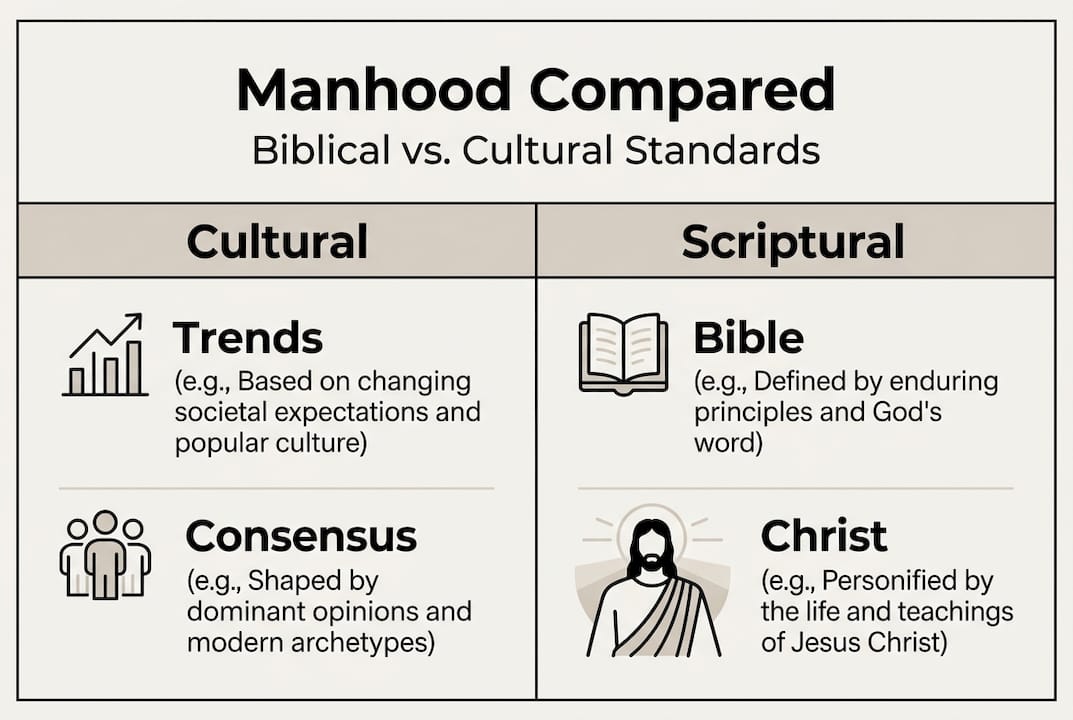
Cultural masculinity often conflicts with biblical standards in ways that most men do not recognize until the damage is already done. That conflict is not accidental. It is the result of a world system that has deliberately inverted God's design.
Scripture speaks plainly. In 1 Corinthians 16:13, Paul commands: "Watch ye, stand fast in the faith, quit you like men, be strong." The phrase "quit you like men" means to conduct yourself with the full bearing of mature manhood. That is a call to action, not a suggestion.
"The man who builds his house on the rock does not merely believe the right things. He hears the sayings of Christ and does them." (Matthew 7:24, paraphrased)
Scriptural manhood is, therefore, not a feeling or an identity label. It is a pattern of conduct, forged in the Word and proven in real life. Why does this foundation matter? Because without it, every other attempt at personal growth, marriage, fatherhood, and community leadership is built on sand.
Key traits of scriptural manhood: A biblical framework
With a definition in hand, let's look at the exact traits that form a scriptural man.
Scriptural manhood involves responsibility, leadership, and sacrificial love. These are not optional add-ons. They are the structural beams of the whole edifice.
Here are the five core traits, each grounded in Scripture:
- Leadership: A scriptural man leads his household as Christ leads the church (Ephesians 5:23). This is not dictatorship. It is sacrificial, accountable headship.
- Responsibility: He owns his decisions. Proverbs 27:23 commands a man to know the state of his flocks. He does not drift or deflect.
- Humility: Micah 6:8 calls men to "walk humbly with thy God." Humility is not weakness. It is accurate self-assessment before a holy God.
- Courage: Joshua 1:9 commands: "Be strong and of a good courage." A scriptural man does not shrink from hard truth, hard conversations, or hard seasons.
- Love: Agape love, the kind described in 1 Corinthians 13, is not sentiment. It is a disciplined, willed commitment to the good of others regardless of personal cost.
Here is how these traits connect to daily life:
| Trait | Scripture | Practical expression |
|---|---|---|
| Leadership | Ephesians 5:23 | Leads family devotions, makes decisions with prayer |
| Responsibility | Proverbs 27:23 | Manages finances, keeps commitments |
| Humility | Micah 6:8 | Receives correction without defensiveness |
| Courage | Joshua 1:9 | Speaks truth when silence would be easier |
| Love | 1 Corinthians 13 | Serves family and community without recognition |
One critical area where these traits are tested is spiritual passivity in men. Passivity is the silent killer of households and churches. It masquerades as peace but produces decay. The scriptures that forge strong men are not decorative. They are weapons for daily warfare.

Pro Tip: Find one other man who will speak plainly into your life. Accountability is not accountability unless it costs something. Proverbs 27:17 says iron sharpens iron. That sharpening is not painless.
Common misconceptions about scriptural manhood
Knowing the traits is important, but first we must clear away some common errors.
Many churches avoid clear, biblical definitions of manhood due to cultural pressure. That avoidance has consequences. It leaves men operating on myths. Here are the three most dangerous ones:
-
Myth: Scriptural manhood is about dominance or aggression. This is perhaps the most common distortion. Men who confuse authority with aggression produce fear, not respect. Christ, who had all authority in heaven and earth (Matthew 28:18), washed his disciples' feet (John 13:5). Dominance is a counterfeit. Servant authority is the real thing.
-
Myth: Men should suppress all emotion. Scripture records that Jesus wept (John 11:35). David poured out grief, fear, and rage in the Psalms. The issue is never whether a man feels. The issue is whether his emotions govern him or whether he governs them through the Spirit. Emotional suppression is not strength. Emotional discipline is.
-
Myth: Real men never fail or doubt. Elijah sat under a juniper tree and asked God to take his life (1 Kings 19:4). Peter denied Christ three times. Thomas doubted the resurrection. These were not disqualified men. They were broken men who returned to God. Failure is not the opposite of scriptural manhood. Unrepentant pride is.
"The LORD is nigh unto them that are of a broken heart; and saveth such as be of a contrite spirit." (Psalm 34:18)
Scriptural manhood does not demand perfection. It demands honesty, repentance, and forward movement. The man who never admits weakness is not strong. He is brittle.
Pro Tip: Do not let cultural stereotypes define your standard. If your definition of manhood came from a movie, a locker room, or a social media feed rather than from Scripture, it needs to be rebuilt from the ground up.
How to live out scriptural manhood today
Having exposed what scriptural manhood is not, let's lay out how you can pursue it every day.
Cultivating scriptural manhood requires intentional community, action, and spiritual discipline. That word "intentional" carries the full weight here. Nothing about scriptural manhood happens by accident.
Here is a practical five-step framework:
- Study: Open your Bible daily with a specific aim. Do not read passively. Study the men of Scripture, their decisions, their failures, their recoveries. Ask what each passage demands of you as a man.
- Pray: Prayer is not a religious formality. It is the act of a man acknowledging that he cannot do this alone. Pray with your family. Pray in private. Pray with urgency.
- Apply: Knowledge without application is vanity. James 1:22 commands men to be doers of the Word, not hearers only. Take one truth each week and build your behavior around it.
- Mentor: Find a man further along the path and submit to his instruction. Then turn around and invest in a younger man. Discipleship is not optional. It is the method Christ chose.
- Serve: Your manhood is not proven in isolation. It is proven in service. Serve your household. Serve your church. Serve your community. Galatians 5:13 is clear: "by love serve one another."
Practical habits that reinforce each step:
- Keep a Scripture journal where you record what each passage requires of you
- Set a weekly accountability call with another man
- Use structured decision-making tools to bring biblical order to your choices
- Read widely from Christian men insights that challenge your thinking
- Consider coaching for personal growth if you need structured support for your development
The man who builds these habits does not become perfect. He becomes consistent. And consistency, over years and decades, produces the kind of character that households, churches, and communities desperately need.
The hard truth about scriptural manhood today
Before we wrap up, consider this perspective on the real challenge ahead.
Scriptural manhood is countercultural. That is not a warning to scare you off. It is a fact you must accept before you can commit to this path. Every major institution in Western society, from entertainment to education to segments of the church itself, is actively working against the biblical definition of manhood.
The church's silence on this issue has not protected men. It has abandoned them. When pastors avoid the word "headship" to spare feelings, they leave men without a blueprint. When spiritual passivity is tolerated in pews and pulpits, families pay the price.
Here is the hard truth: no program, curriculum, or conference will make you a scriptural man. Only personal ownership will. You must decide, before God, that you will be the man Scripture calls you to be, regardless of whether your church preaches it, your culture rewards it, or anyone around you models it. That decision is yours alone. Make it.
Grow deeper in biblical manhood with practical resources
Take the next step toward maturing in scriptural manhood.
If this article has stirred something in you, do not let that conviction fade without action. Dead Hidden Ministries exists precisely for men who are serious about building their lives on the Word of God rather than on cultural noise.

The biblical masculinity study is a verse-by-verse resource designed to take you from confusion to clarity on what God actually says about manhood. The decision-making resources give you a structured, biblical framework for the choices that define your life. Both are available now at Dead Hidden Ministries. Equip yourself. The men around you are waiting for you to lead.
Frequently asked questions
How is scriptural manhood different from cultural masculinity?
Scriptural manhood is defined by biblical standards like servant leadership and sacrifice, not by cultural ideas of dominance or self-interest. Where culture measures a man by power and status, Scripture measures him by faithfulness and character.
What are essential traits of a scriptural man?
A scriptural man shows leadership, responsibility, humility, courage, and love, reflecting the example of Christ. These traits are not personality preferences; they are biblical commands rooted in specific passages of Scripture.
How can I start living out scriptural manhood?
Begin by studying key scriptures, seeking godly mentorship, joining Christian community, and living your faith through service. Intentional spiritual discipline is the non-negotiable starting point for every man serious about this path.
Does scriptural manhood mean being passive or aggressive?
No; true scriptural manhood balances courage and gentleness, modeled after Christ's servant leadership. Many churches avoid this precise balance, but Scripture is not ambiguous about it.
Recommended
- BIBLICAL MASCULINITY | Dead Hidden
- Biblical Masculinity Definition: What the Bible Actually Says a Man Is | Dead Hidden | Dead Hidden Ministries
- What Is Biblical Masculinity? The Definition the Modern Church Is Afraid to Give You | Dead Hidden | Dead Hidden Ministries
- Things We Should Contend For: Biblical Femininity | Dead Hidden Ministries