

Few topics generate more heat inside the church than the question of what the Bible teaches about women and their roles. Some push for full equality in every office. Others swing toward unnecessary restriction, silencing women in ways Scripture never demands. Both extremes miss the mark. This article walks you through the Bible's complete picture: the God-given worth of women, the specific instructions Scripture provides for church order, the remarkable women whose service shaped redemptive history, and practical steps your church can take to honor both truth and the people God has called. Doctrinal clarity, not cultural pressure, is the goal here.
Table of Contents
- Setting the context: How Scripture frames women's value
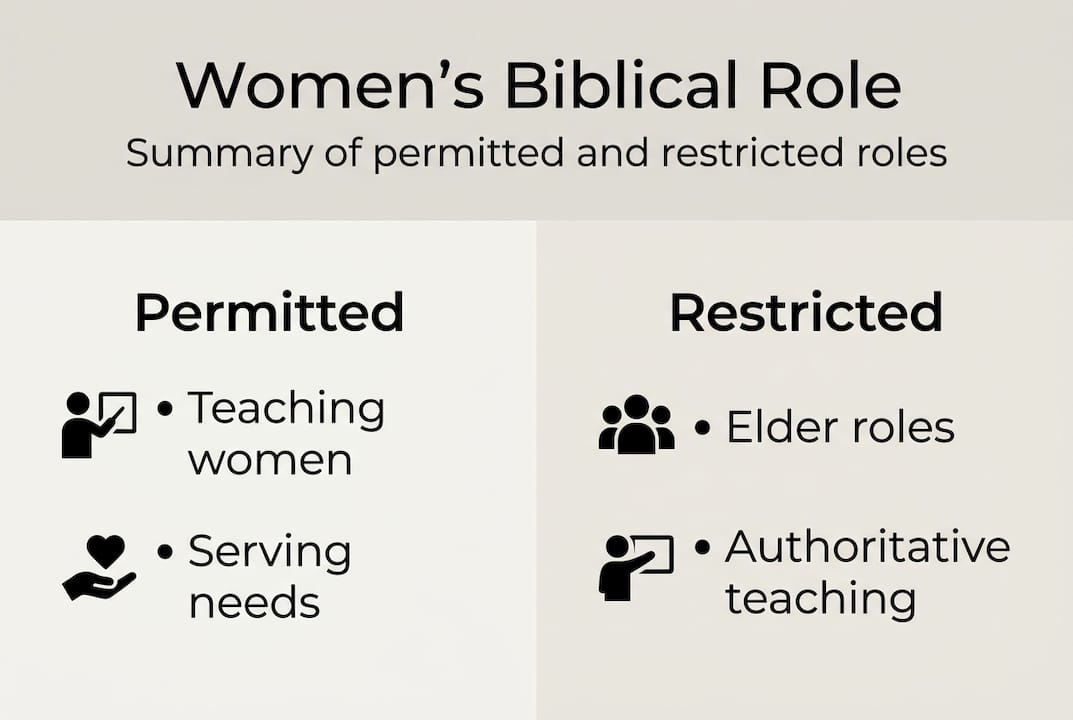
- Core biblical teachings: What women can and cannot do in church
- Biblical examples: Women serving, leading, and influencing
- Application: How today's church can honor biblical boundaries
- Why a high view of Scripture brings both clarity and freedom
- Go deeper: Study biblical womanhood for yourself
- Frequently asked questions
Key Takeaways
| Point | Details |
|---|---|
| Women’s value in Scripture | Women are created with equal dignity and purpose in God’s design. |
| Distinct biblical roles | The Bible assigns some church offices to men but honors many influential roles for women. |
| Scriptural authority, practical honor | Churches thrive when they uphold both biblical boundaries and actively value women’s contributions. |
| Clarity through doctrine | Understanding clear biblical teaching enables unity and spiritual flourishing for all. |
Setting the context: How Scripture frames women's value
Before any conversation about roles, you must establish what the Bible says about worth. Genesis 1:27 is unambiguous: "So God created man in his own image, in the image of God created he him; male and female created he them." Women bear the imago Dei, the image of God, in exactly the same measure as men. This is not a footnote. It is a foundation.
Genesis 2:18-24 deepens the picture. Woman is created as a "help meet" for man, which is far from a diminishment. The Hebrew word ezer (helper) is the same word used of God Himself when He acts as Israel's rescuer and strength. To be called an ezer is to be called something powerful. Creation order establishes foundational roles for men and women, and those roles are complementary, not hierarchical in the sense of value.
Scripture's gallery of faithful women is extraordinary. Consider these biblical womanhood expectations modeled throughout the canon:
- Ruth: Covenant loyalty, sacrificial love, and faithful obedience that landed her in the genealogy of Christ.
- Esther: Courage to stand before a king at the risk of her life to preserve God's people.
- Mary of Nazareth: Chosen above all women to bear the Son of God, her submission and faith are without parallel.
- Priscilla: Alongside her husband Aquila, she instructed Apollos, "an eloquent man, and mighty in the scriptures" (Acts 18:24-26), in the way of God more perfectly.
- Mary Magdalene: Commissioned by the risen Christ Himself to carry the resurrection announcement to the disciples.
"He appeared first to Mary Magdalene" (Mark 16:9). In a first-century culture that dismissed women's testimony in legal settings, Jesus chose a woman to herald the most important news in history. That is a deliberate, countercultural affirmation of women's significance.
None of these women held the office of elder or apostle. Yet their contributions were indispensable. This is the point that both sides of the modern debate often miss: biblical worth is not contingent upon office. A woman who disciples younger women, intercedes faithfully, teaches children, or serves in compassion ministry is doing sacred work. Position does not determine value. For a foundational starting point for women in Scripture, this truth must come first.
Core biblical teachings: What women can and cannot do in church
With the foundation of value established, Scripture does place specific instructions on church order. These are not the inventions of patriarchal culture. They are grounded in creation itself.
Paul writes in 1 Timothy 2:11-15 that a woman is to "learn in silence with all subjection" and that he does not "suffer a woman to teach, nor to usurp authority over the man." He immediately anchors this not in the customs of Ephesus but in Adam being formed first and Eve being deceived. 1 Timothy 2:11-15 grounds these restrictions in creation order, not cultural issues. This matters enormously. If the reasoning were cultural, it would expire with the culture. The reasoning is creational, so it endures.
Titus 1:5-9 lists the qualifications for an elder, using masculine language throughout ("husband of one wife," etc.). 1 Corinthians 14:34-35 instructs women to keep silence in the churches regarding judging of prophecies in the assembly.
| Scripture | Permitted for women | Restricted for women |
|---|---|---|
| 1 Timothy 2:11-15 | Learning, receiving instruction | Teaching with authority over men, eldership |
| Titus 1:5-9 | All ministry and service roles | Holding the office of elder/overseer |
| 1 Corinthians 14:34-35 | Prophesying (1 Cor 11:5), prayer | Judging prophecy in the public assembly |
| Galatians 3:28 | Full spiritual equality in Christ | No restriction on spiritual standing |
Pro Tip: The distinction is not between gifted and ungifted women. It is between the office of elder/overseer (reserved for qualified men per the text) and the broader sphere of spiritual gifts, service, teaching women and children, and ministry engagement, which Scripture affirms for women. Never collapse this distinction in either direction.
Galatians 3:28, "There is neither Jew nor Greek, there is neither bond nor free, there is neither male nor female: for ye are all one in Christ Jesus," addresses spiritual equality before God, not functional sameness in church structure. These two realities co-exist without contradiction. Consult the biblical headship teachings in Scripture to see how both truths are maintained simultaneously. A firm grasp of biblical femininity likewise anchors these distinctions in their proper context.
Biblical examples: Women serving, leading, and influencing
Knowing the office limits, look at the remarkable breadth of service Scripture records for women. This list is not incidental. God documented it for a reason.
- Phoebe (Romans 16:1-2): Paul calls her a "servant" (Greek: diakonos, from which we get deacon) of the church at Cenchrea and a "succourer of many," including Paul himself. She likely delivered the letter to the Romans.
- Priscilla (Acts 18:26): She and Aquila corrected Apollos privately and accurately. Her name often appears before her husband's, an unusual marker of her prominence.
- Deborah (Judges 4-5): A prophetess and judge over Israel in a time when qualified male leadership had collapsed. Her role is descriptive of a particular season, not prescriptive of normal church order.
- Mary Magdalene (John 20:17-18): Sent by Christ to announce the resurrection, she became, in the words of early church tradition, "the apostle to the apostles."
- Junia (Romans 16:7): Described as "of note among the apostles," she was likely a traveling missionary recognized by the apostles, not one of the Twelve.
"Women throughout Scripture served in important but non-elder roles." Their service was real, recognized, and recorded. It was not second-tier work.
The key interpretive insight is this: influence, instruction, and even informal teaching are not the same as holding the office of elder or exercising formal authoritative teaching over the assembled congregation. Priscilla did not stand before the church to overrule Apollos. She and her husband pulled him aside and explained the way of God more accurately. The setting and structure matter.
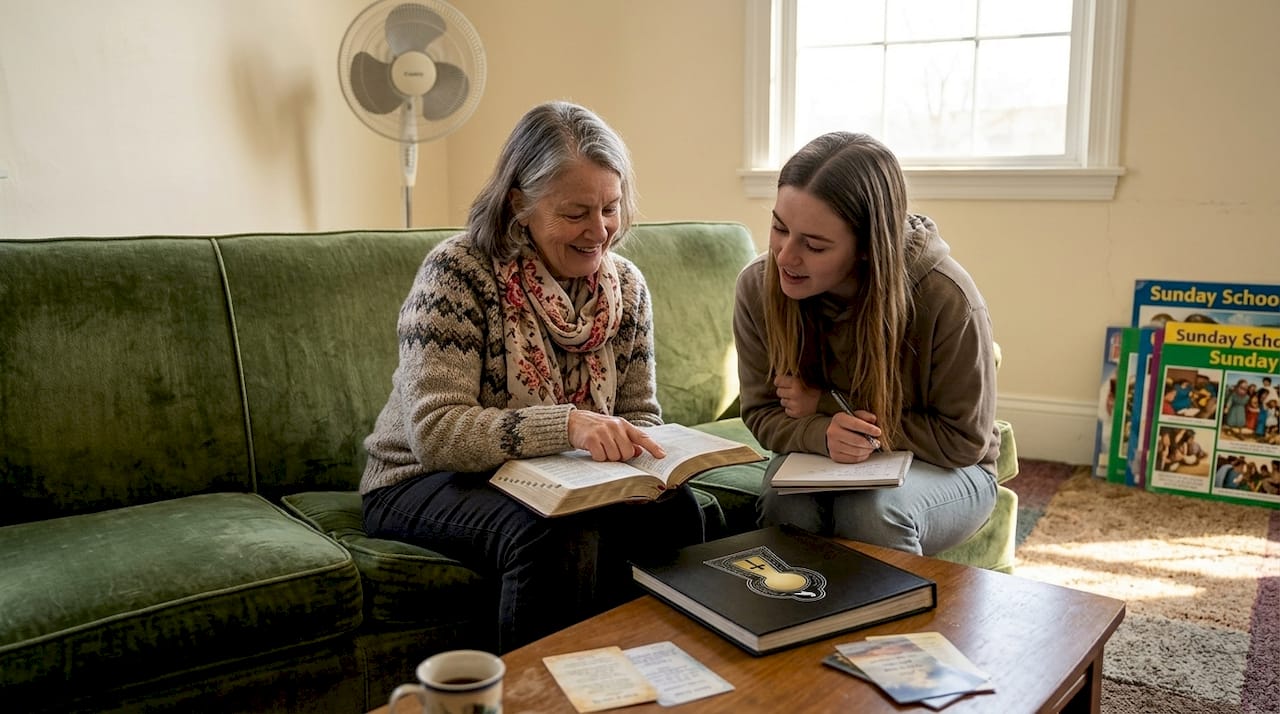
Titus 2:3-5 then opens an entire sphere of ministry for older women: teaching younger women to love their husbands, to be sober, chaste, keepers at home, and good. The Titus 2 older woman's calling is a high and serious calling, not a consolation prize. It is one of the most direct forms of discipleship the New Testament commissions.
Application: How today's church can honor biblical boundaries
Seeing the historic examples, you may rightly ask what this looks like in a local church in 2026. Here is a clear comparison.
| Practices honoring Scripture | Practices that go beyond or undermine Scripture |
|---|---|
| Women leading women's Bible studies | Women serving as senior pastors or elders |
| Women teaching children's ministry | Women delivering authoritative doctrinal sermons to the mixed congregation |
| Women serving as deaconesses in service roles | Women ordaining other leaders with church authority |
| Older women formally discipling younger women | Dismissing or minimizing women's gifts and contributions |
| Women involved in prayer, worship, and outreach | Reducing women to passive, uninvolved observers |
Healthy churches actively and intentionally deploy women's gifts. Consider these biblically grounded avenues:
- Establish formal women's ministry led by gifted, mature women
- Create a Titus 2 mentorship program pairing older women with younger women
- Include women in compassion ministry, counseling women, and service leadership
- Equip women as skilled students of the Word for personal growth and family discipleship
- Celebrate and recognize women's contributions publicly and without condescension
Pro Tip: Churches that suppress women's contributions in areas Scripture permits are not being more conservative. They are being less biblical. The goal is not minimization. It is faithful stewardship of every gift God places in your congregation.
Scripture maintains both value and distinction for women, not erasure. A church that communicates "women don't matter much here" has contradicted the very text it claims to follow. For a thorough resource on this, the Biblical Womanhood Bundle and 60 uncomfortable truths for Christian women are excellent tools for your congregation's growth.
Resolve tensions within your congregation through open, patient dialogue that stays anchored in the text. Not every tension requires a policy statement. Many require a steady pastor, a humble elder board, and a congregation willing to submit to what God actually said.
Why a high view of Scripture brings both clarity and freedom
Here is the perspective that most churches fail to grasp: the traditional view of women's roles is not a cage. It is a design.
The cultural narrative insists that biblical structure suppresses women. But consider what actually suppresses them: churches that either silence gifted women across the board, or churches so desperate to appear progressive that they hand women offices Scripture reserves for men, only to watch them carry burdens God never assigned them.
Only by respecting God's design do churches unlock the fullest flourishing for both women and men.
When a woman is freed to operate fully in her God-given sphere, including teaching, nurturing, serving, prophesying, and discipling, without being pressed into an office that creates unbiblical authority structures, she flourishes. So does the church. Understanding what headship really means reveals that God's order is a gift, not a grievance. Pursue deeper study with humility. The text rewards it.
Go deeper: Study biblical womanhood for yourself
Ready to grow further in living out God's design? The doctrinal clarity you've encountered here is only the beginning.

Dead Hidden has built resources specifically to take you further. The Biblical Woman Field Manual gives you a structured, verse-by-verse guide for understanding God's design in practical terms. The Biblical Womanhood 2026 Reading Plan walks you through key Scripture passages systematically. And for women ready to wrestle with hard truths head-on, 60 uncomfortable truths delivers exactly what the title promises. These are not devotional fluff. They are doctrinal tools built for serious Bible believers.
Frequently asked questions
Does the Bible say women cannot speak in church at all?
No. Women are not forbidden from speaking but are restricted from exercising authoritative teaching or holding elder roles over men, as 1 Timothy 2 defines regarding speaking restrictions, along with 1 Corinthians 14:34-35.
Are women allowed to lead or teach other women and children?
Yes. Scripture actively encourages women to teach and disciple within their biblically defined spheres, particularly among women and children, as Titus 2:3-5 directly instructs.
Why does the Bible limit church authority to men?
The Bible grounds male church leadership in the order of creation itself, not in cultural or temporary circumstances, making it a permanent creational principle rather than a dated social norm.
Does scriptural distinction mean women are less valued?
No. Scripture upholds equal value and dignity for men and women before God, affirming that distinct roles and equal worth exist together without contradiction.
Recommended
- Things We Should Contend For: Biblical Femininity | Dead Hidden Ministries
- Biblical Womanhood Expectations: What the Bible Says vs. What the Church Invented | Dead Hidden | Dead Hidden Ministries
- For Women — Where to Begin | Dead Hidden Ministries
- What Does the Bible Say About a Husband's Role? (The Full Picture) | Dead Hidden | Dead Hidden Ministries
- how do jewish women dress | Fashion & Style Tips | Fashion Feed| Coveti