
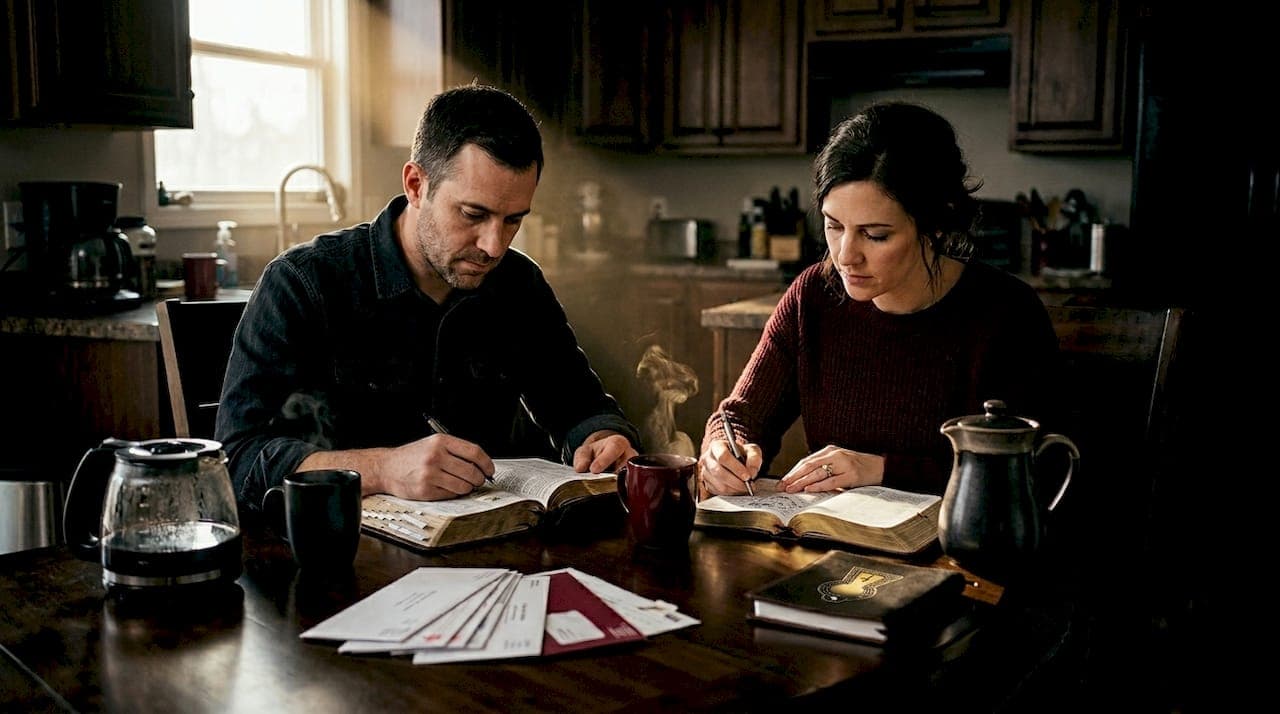
Most people, even sincere believers, have inherited a drastically reduced view of marriage. They treat it as a social custom, a legal arrangement, or a romantic milestone. Scripture says something far more weighty. Biblical marriage is a covenant, a sacred bond ordained by God from the very beginning, carrying theological implications that stretch from Genesis to Revelation. If you want doctrinal clarity on what marriage truly is, what roles it assigns, and how it reflects the glory of Christ and the Church, you have come to the right place.
Table of Contents
- Biblical marriage: More than a contract
- Complementarian roles in biblical marriage
- The practical outworking of biblical marriage
- Historical foundations and changing interpretations
- Our take: What most guides miss about biblical marriage
- Next steps: Resources for biblical marriage
- Frequently asked questions
Key Takeaways
| Point | Details |
|---|---|
| Biblical marriage is a covenant | It is rooted in Scripture, not just a legal or social arrangement. |
| Complementarian roles explained | Marriage involves equal value but differing responsibilities for husband and wife. |
| Scripture as the ultimate guide | Biblical marriage principles are drawn from both Old and New Testaments. |
| Practical application | Christian couples are called to mutual respect, love, and spiritual partnership. |
Biblical marriage: More than a contract
A contract is transactional. Two parties agree to terms, and if either party defaults, the agreement dissolves. Covenant is an entirely different category. When God established marriage in Genesis 2:24, He declared that a man shall "leave his father and his mother, and shall cleave unto his wife: and they shall be one flesh." That is not contract language. That is covenant language, language that speaks of binding, permanence, and union at the deepest level of human existence.
The New Testament makes this even clearer. In Ephesians 5:31-32, Paul quotes Genesis directly and then adds this: "This is a great mystery: but I speak concerning Christ and the church." Marriage is not merely a human institution. It is a living picture of the relationship between Christ and His redeemed people. That changes everything about how we must approach it.
Key doctrinal truths that anchor this covenant framework:
- Marriage is between one man and one woman. Christ Himself confirmed this in Matthew 19:4-6, appealing to creation order rather than Mosaic law.
- Old Testament polygamy is descriptive, not prescriptive. As Christian views on marriage confirm, the polygamy seen in Old Testament narratives was never God's ideal, and the New Testament restores the monogamous, heterosexual design established at creation.
- Marriage reflects a spiritual reality. The husband represents Christ; the wife represents the Church. Every decision, conflict, and act of love within the marriage carries theological weight.
- Permanence is built into the covenant. Jesus explicitly stated in Matthew 19:6, "What therefore God hath joined together, let not man put asunder."
"Marriage is honourable in all, and the bed undefiled: but whoremongers and adulterers God will judge." Hebrews 13:4 (KJV)
Understanding how Scripture in marriage functions as the governing authority over every aspect of the covenant relationship is the starting point. Without that foundation, everything else collapses into personal preference and cultural drift. Marriage is also a primary arena of sanctification in marriage, where God refines both spouses through the daily demands of covenant faithfulness.
Complementarian roles in biblical marriage
Once you accept that biblical marriage is a covenant, the next question becomes: what does that covenant require of each spouse? This is where the complementarian view enters, and it is the dominant position within conservative evangelical Christianity for very good reason. It is not tradition for tradition's sake. It is derived directly from Scripture.
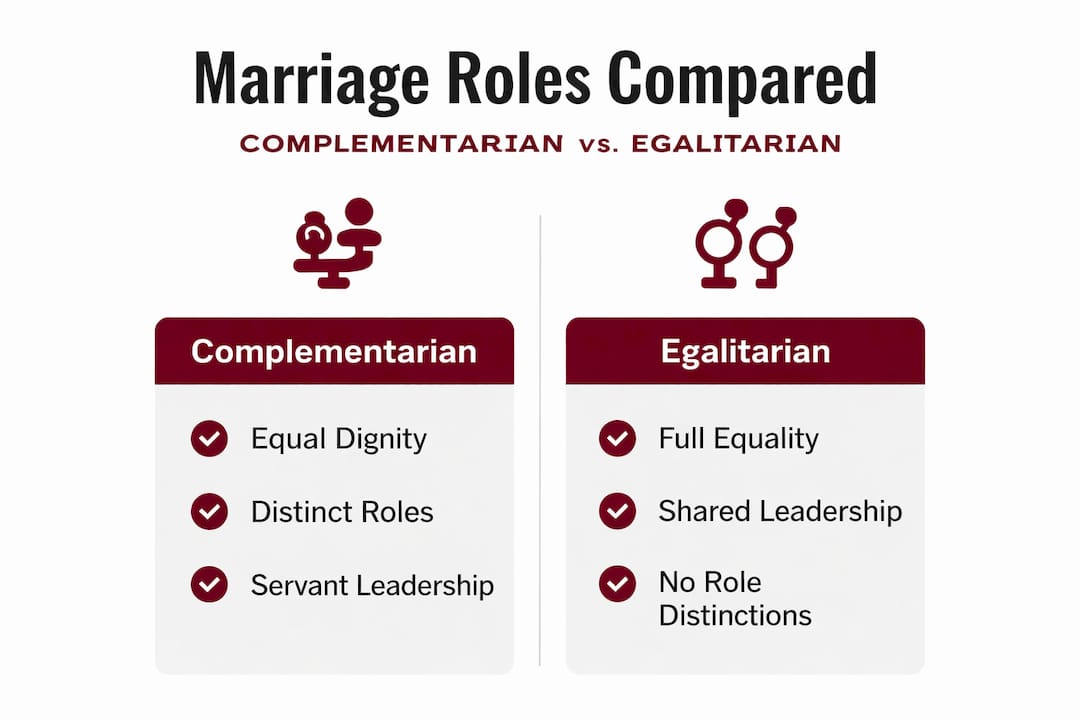
The complementarian view teaches equal dignity alongside distinct roles. Both husband and wife bear the image of God equally (Genesis 1:27). Neither is superior in worth or spiritual standing. But equality of dignity does not erase difference of function. Just as the Father and Son are equal in essence yet distinct in role within the Godhead, so husband and wife are equal in dignity yet distinct in their marital calling.

Here is a clear comparison of the two major positions:
| Feature | Complementarian | Egalitarian |
|---|---|---|
| Core belief | Equal dignity, distinct roles | Full equality in roles and function |
| Scriptural basis | Ephesians 5, 1 Corinthians 11, 1 Timothy 2 | Galatians 3:28, Acts 2 |
| Headship | Husband leads with servant love | Shared or rotating leadership |
| Submission | Wife submits as to the Lord | Mutual submission only |
| Authority structure | Ordered hierarchy under Christ | Flat or egalitarian structure |
| Conservative evangelical status | Dominant view | Minority view |
The husband's role is headship, modeled after Christ's headship over the Church. This is not domineering authority. Ephesians 5:25 commands husbands to love their wives "as Christ also loved the church, and gave himself for it." Sacrificial, servant-hearted, laying down his own comfort for the spiritual flourishing of his household. That is the standard. Anything less is a failure of biblical leadership.
The wife's role is equally glorious. She is called to support and honor her husband's leadership (Ephesians 5:22-24), not because she is inferior, but because God has ordered the home for the protection, peace, and purpose of the family. Understanding the husband's biblical role is essential to making sense of this structure.
Pro Tip: When studying biblical headship, always examine the full context of Ephesians 5, starting from verse 18. Headship is embedded in a passage about being filled with the Spirit, mutual submission (v. 21), and sacrificial love. Ripping verse 22 out of that context creates a distorted view of authority.
Both roles, when lived faithfully, produce a household that honors God and provides a stable, nurturing environment for children and community. Exploring biblical womanhood in its full scriptural depth shows just how honored and vital the wife's calling truly is.
The practical outworking of biblical marriage
Doctrine without application is academic. Biblical marriage must be lived, not just studied. Here is how the covenant framework and complementarian roles translate into the day-to-day reality of Christian family life.
Four practical pillars of biblical marriage in action:
- Mutual respect rooted in Scripture. Love and respect are not optional. Ephesians 5:33 commands the husband to love his wife and the wife to respect her husband. These are not suggestions. They are divine directives, calibrated to the specific emotional needs of men and women.
- Spiritual partnership through prayer and the Word. A biblical marriage is built on shared devotion. Couples who pray together, study Scripture together, and worship together create a spiritual bond that withstands external pressure. First Peter 3:7 instructs husbands to dwell with their wives "according to knowledge," meaning attentiveness to her spiritual and emotional needs is part of his covenant duty.
- Distinct responsibilities carried with faithfulness. The husband leads, provides spiritual covering, and guards the household against worldly and spiritual threats. The wife nurtures, manages the home (Proverbs 31), and supports her husband's leadership. These roles overlap and reinforce each other rather than creating rigid silos.
- Addressing conflict through biblical principle, not cultural compromise. Scripture gives clear guidance on forgiveness (Ephesians 4:32), communication (James 1:19), and restoration. When conflict arises, the Word must govern the response, not emotion or cultural script.
Scripture is also clear that spiritual resistance in marriage is real. The enemy hates biblical marriage precisely because it pictures Christ and the Church. Couples who pursue God's design for their union are walking in territory the enemy actively opposes. Knowing this prepares you to stand.
The call to biblical femininity is not about cultural restriction. It is about aligning with the created order in a way that produces genuine freedom, security, and purpose. Women who embrace this calling often testify to a deep sense of peace and identity that cultural feminism simply cannot offer. There are also dedicated resources for women who want to pursue this path with doctrinal clarity and practical support.
As Christian views on marriage note, the New Testament's emphasis on the monogamous, heterosexual union as articulated in Matthew 19:4-6 represents the culminating standard, and that standard demands active, intentional pursuit by both spouses.
Historical foundations and changing interpretations
Understanding where biblical marriage has been across redemptive history helps us see why the New Testament standard matters so much. The trajectory is not random. It is deliberate.
Old Testament marriage patterns:
- Monogamy was God's original design (Genesis 2:24).
- Polygamy appeared among fallen men after the fall, beginning with Lamech (Genesis 4:19).
- Great men of faith such as Abraham, Jacob, and David practiced polygamy, yet Scripture consistently records the sorrow and strife those arrangements produced.
- Old Testament law regulated polygamy but never endorsed it as ideal.
New Testament restoration:
- Christ returned the standard to creation order in Matthew 19, explicitly citing "from the beginning" as His reference point.
- Paul's qualifications for elders and deacons required that they be "the husband of one wife" (1 Timothy 3:2), setting monogamy as the governing standard for Christian leadership.
- The Epistles develop a rich theology of marriage as a covenant picture of Christ and the Church.
Here is a summary of how marriage doctrines have developed across biblical history:
| Period | Dominant pattern | God's standard |
|---|---|---|
| Pre-fall | Monogamy | Established at creation |
| Post-fall (OT) | Polygamy practiced | Never commanded or endorsed |
| New Testament | Monogamy restored | Explicitly affirmed by Christ |
| Conservative evangelical today | Monogamy, complementarian roles | Grounded in Scripture and creation order |
As Christian views on marriage confirm, polygamy in the Old Testament is descriptive of human practice, not prescriptive of God's design, and the New Testament definitively restores the creation ideal. Modern conservative evangelical interpretation has held this line firmly, refusing to allow cultural pressure to redefine what God ordained.
There are also types of wedding rites across cultures and traditions, but none of them alter the doctrinal substance of what Scripture defines as marriage. The ceremony matters far less than the covenant. Staying rooted in hidden biblical truths about marriage means not allowing ceremony or culture to override the theological substance.
The willingness to stand on contending for biblical femininity and masculinity in the face of cultural revision is not stubbornness. It is faithfulness.
Our take: What most guides miss about biblical marriage
Here is the honest truth. Most popular marriage guides, even those marketed as Christian, make two critical errors. First, they reduce roles to personality types. They say things like, "Whoever is the natural leader in your relationship should lead." That sounds reasonable. It is not biblical. Scripture does not assign headship based on temperament. It assigns headship to husbands, period, regardless of personality. When we make roles contingent on personality, we subtly deny the authority of Scripture.
Second, most guides ignore the spiritual warfare dimension entirely. Marriage is a theater of spiritual conflict. The enemy does not merely tempt you toward infidelity or conflict. He attacks the very structure and witness of the covenant. A couple that reflects Christ and the Church in their marriage is a living proclamation of the gospel. The enemy hates that proclamation and works tirelessly against it. Guides that skip this reality leave couples unprepared for the actual battle.
What doctrinal clarity actually provides is freedom, not restriction. When a husband knows his role is servant-hearted headship, he is liberated from passive abdication. He knows what God requires. When a wife knows her role is honorable support and nurture, she is freed from the exhausting burden of competing for authority that was never meant to be hers. Both are released into purpose.
Understanding how scripture guidance in marriage functions as the primary compass, rather than counseling trends or cultural wisdom, is what separates a biblical marriage from a merely religious one. The difference is enormous. One is built on the Rock. The other shifts with every new wave of cultural theology.
Biblical marriage, when practiced faithfully, is counter-cultural by definition. And that is precisely the point.
Next steps: Resources for biblical marriage
If this article has stirred something in you, that hunger for clarity and conviction about what God designed marriage to be, then the next step is to go deeper into the Word with resources built for exactly that purpose.

Dead Hidden offers field manuals written specifically for men and women who want to pursue biblical marriage with doctrinal seriousness. The Biblical manhood manual equips husbands with a clear, Scripture-grounded understanding of headship, spiritual responsibility, and faithful leadership. The Biblical womanhood manual gives wives a thorough, verse-by-verse foundation for their role, their dignity, and their calling. Both are built from a conservative, dispensationalist perspective that never bends to cultural pressure. You can also begin by exploring teachings on contending for biblical femininity as a starting point for women seeking deeper grounding in God's design.
Frequently asked questions
What is the biblical definition of marriage?
Biblical marriage is a covenant between one man and one woman, ordained by God at creation and confirmed by Christ in Matthew 19:4-6, intended to reflect the relationship between Christ and the Church.
Are husband and wife equal in biblical marriage?
Conservative evangelical teaching holds that both spouses share equal dignity before God while serving in distinct, complementary roles, with the husband in servant-hearted headship and the wife in honored, supportive partnership.
Does the Bible endorse polygamy?
No. Polygamy is described in the Old Testament as a human practice but never commanded or endorsed by God, and the New Testament definitively restores monogamy as the creation ideal through Christ's own words.
What are the main responsibilities in biblical marriage?
Husbands carry the responsibility of sacrificial, servant-hearted leadership, while wives are called to honor their husband's headship through respectful support, together forming a spiritual partnership that reflects Christ and the Church.
Recommended
- What Does the Bible Say About a Husband's Role? (The Full Picture) | Dead Hidden | Dead Hidden Ministries
- How Scripture Strengthens and Guides Christian Marriage
- Biblical Womanhood Expectations: What the Bible Says vs. What the Church Invented | Dead Hidden | Dead Hidden Ministries
- The Devil Hates the Gift of Biblical Marriage | Dead Hidden Ministries