

Most believers have heard Ephesians 6 read aloud from a pulpit. Far fewer have actually put on the armor described within it. That distinction matters enormously. Spiritual armor is not a poetic flourish Paul tucked into the end of a letter. It is a doctrinal command, a divine provision, and an active discipline. When you misread it as purely symbolic, you enter real spiritual battles without real protection. This guide lays out the biblical foundation of the armor of God, shows how it applies to personal and communal life, and gives you practical steps to put it on and keep it on, every single day.
Table of Contents
- What is spiritual armor? Biblical foundation and meaning
- The role of spiritual armor in personal spiritual warfare
- Spiritual armor within the Christian community: Collective defense
- Practical strategies for putting on the armor daily
- Why most Christians misunderstand spiritual armor
- Take your spiritual defense further with Dead Hidden resources
- Frequently asked questions
Key Takeaways
| Point | Details |
|---|---|
| Biblical foundation | Spiritual armor is rooted in Scripture and serves as active defense for Christian life. |
| Personal impact | Putting on armor daily equips believers to resist temptation and spiritual attack. |
| Community strength | Spiritual armor fosters unity and resilience within families and churches. |
| Practical discipline | Routine actions such as prayer, study, and accountability enable believers to apply armor intentionally. |
| Misconceptions addressed | Spiritual armor should not be seen as just symbolic—it is a powerful, practical tool when rightly applied. |
What is spiritual armor? Biblical foundation and meaning
THE TEXT COMES FIRST. Paul writes in Ephesians 6:10-18, "Finally, my brethren, be strong in the Lord, and in the power of his might. Put on the whole armour of God, that ye may be able to stand against the wiles of the devil." This is not an invitation. It is an imperative. The Greek verb translated "put on" is in the aorist middle voice, conveying a decisive, personal action. You are commanded to clothe yourself, deliberately and completely.
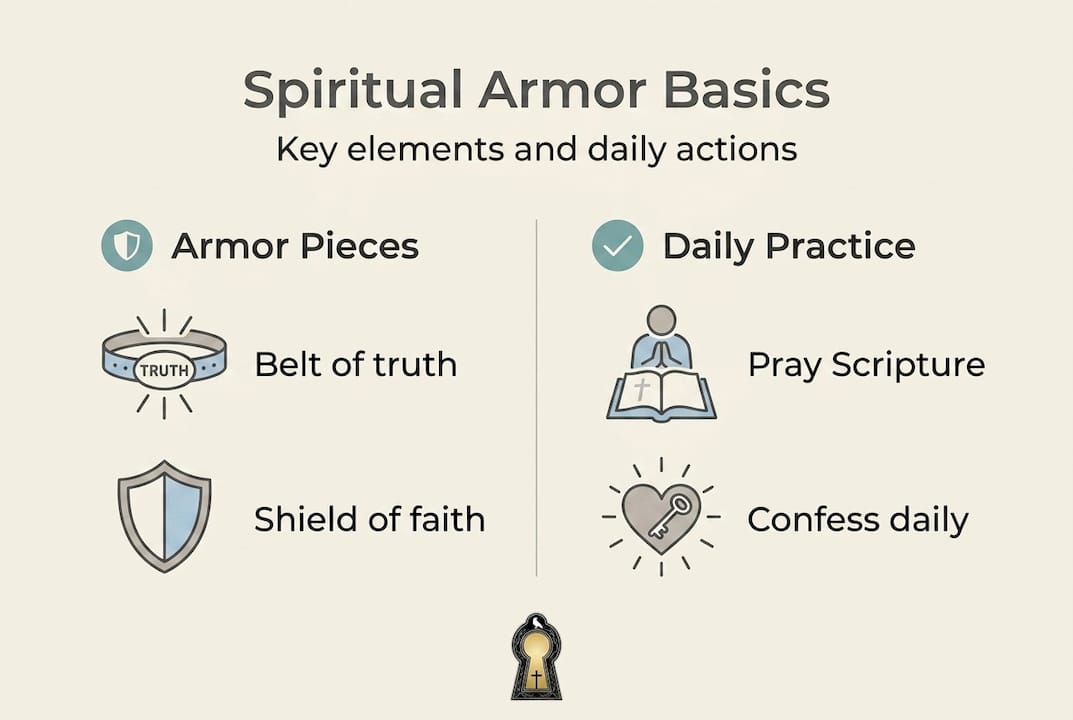
The passage describes six distinct components of spiritual armor. Each one corresponds to both a theological reality and a practical discipline:
- The belt of truth: Truth girds everything. Without doctrinal accuracy, every other piece of armor shifts and loosens. This is a commitment to biblical truth in what you believe and how you live.
- The breastplate of righteousness: This guards your heart, covering your vital spiritual organs. It is the righteousness imputed through Christ and applied in daily conduct.
- The shoes of the gospel of peace: Readiness. You must be positioned and prepared to advance and to stand firm. Immobility in warfare is vulnerability.
- The shield of faith: Paul says this quenches "all the fiery darts of the wicked." Every temptation, every accusation, every doubt, faith intercepts it before it reaches your soul.
- The helmet of salvation: It protects the mind. Assurance of salvation guards against discouragement, spiritual confusion, and the enemy's lies about your standing before God.
- The sword of the Spirit: This is the only offensive weapon listed. It is the Word of God, specific and precise, not vague spiritual sentiment.
"Put on the whole armour of God, that ye may be able to stand against the wiles of the devil." Ephesians 6:11 (KJV)
Now, one critical doctrinal clarification. The theological foundations of spiritual armor are personal AND communal in nature. This concept is not quantifiable in empirical terms, but it is spiritually definitive. Paul does not write to an individual in Ephesians 6. He writes to a church. The plural "brethren" signals collective responsibility. This matters when you consider how the armor functions in families and congregations.
Understanding faith vs works also bears directly on this: the armor of God is not earned through religious performance. It is received through covenant relationship with Christ and actively appropriated through obedience and trust. That distinction reframes everything about how you approach spiritual defense. The armor is not your achievement. It is God's provision. But it must be worn. Understanding this also enriches what Scripture teaches about biblical femininity and how every member of the body, male and female, participates in the spiritual defense of the community.
The role of spiritual armor in personal spiritual warfare
THE DAILY WAR IS REAL. Most Christians sense it. Temptation comes in the morning before you have opened your Bible. Doubt whispers at night when you are tired. Discouragement hits mid-week when the momentum of Sunday has faded. This is not random. The enemy is strategic, and your defense must match his strategy.
The core evangelical view of spiritual armor emphasizes both personal and communal spiritual defense. On the personal level, each piece of armor confronts a specific category of spiritual attack. Here is how each one applies to the battles you face every day:
- Belt of truth: When the enemy brings confusion about your identity in Christ or distorts your understanding of Scripture, the belt of truth holds everything in place. Daily time in the Word keeps this belt buckled.
- Breastplate of righteousness: When guilt and condemnation strike, this is what stands between accusation and your heart. Walking in confessed sin leaves this breastplate removed. Confession restores it.
- Shoes of the gospel of peace: When you are tempted to retreat from spiritual engagement, whether in your family, your church, or your community, these shoes remind you that you are called to advance, not hide.
- Shield of faith: When doubt arises about God's promises, your salvation, or His faithfulness in trial, the shield intercepts those arrows before they sink in. Faith here is not feeling. It is a choice rooted in what the Word has said.
- Helmet of salvation: The mind is the primary battlefield. Assurance of salvation protects you from the paralyzing fear that you are not truly saved, not truly loved, not truly kept.
- Sword of the Spirit: When temptation presents itself, you speak the Word of God against it. Jesus modeled this precisely in Matthew 4, answering every assault from Satan with "It is written."
Praying Scripture is one of the most powerful reinforcements of spiritual armor. When you pray the promises of God back to Him, you are wielding the sword actively. Resources like prayers for crisis offer structured tools for this kind of targeted, Scripture-rooted intercession.

Understanding the deceptions Christian men face is also essential here. One of the most common is believing that spiritual readiness is a state you arrive at, rather than a discipline you practice continuously.
Pro Tip: Spiritual armor is not a one-time declaration. It is a daily decision. Every morning, before engagement with the world begins, go through each piece of armor deliberately in prayer. Name it, claim it, and ask God to activate it in your life that day.
Spiritual armor within the Christian community: Collective defense
THE BODY IS NOT JUST CONNECTED. It is interdependent. Paul's instructions in Ephesians 6 were addressed to the whole church, and that communal dimension is not incidental. It is foundational. When one member of the body is uncovered, the whole body is more vulnerable. Collective spiritual armor is what holds communities together under pressure.
Consider what happens when a family prays together consistently. The belt of truth that one member wears strengthens the doctrinal foundation of the whole household. The shield of faith raised by a praying mother covers her children in ways that go beyond what she can physically provide. This is not sentiment. It is spiritual reality, and understanding spiritual passivity in men reveals how catastrophic it is when the heads of homes abdicate their role in this collective defense.
Communal spiritual armor operates through several key mechanisms:
- Corporate prayer: When believers pray together, they collectively raise shields of faith and activate the sword of the Spirit over the entire congregation.
- Mutual accountability: Truth spoken between brothers and sisters in Christ reinforces the belt of truth for every member involved. Iron sharpens iron.
- Biblical preaching and teaching: The helmet of salvation, worn corporately, guards the collective mind of the church against false doctrine, compromise, and deception.
- Hospitality and care: The shoes of the gospel of peace worn collectively mean the community is always ready to advance into the needs of those around it.
The importance of spiritual care in crisis illustrates how communal support functions as genuine spiritual armor for people facing their most vulnerable moments. This principle extends well beyond hospice settings into every context where believers gather.
Here is a direct comparison of how spiritual armor functions individually versus communally:
| Armor piece | Individual application | Communal application |
|---|---|---|
| Belt of truth | Personal doctrinal study | Corporate biblical teaching and accountability |
| Breastplate of righteousness | Personal confession and holy living | Church discipline and mutual exhortation |
| Shoes of peace | Personal readiness to share the gospel | Church outreach and hospitality |
| Shield of faith | Personal trust during trials | Corporate intercession and encouragement |
| Helmet of salvation | Personal assurance | Unified doctrinal confession of the church |
| Sword of the Spirit | Personal Scripture memorization | Corporate Scripture reading, preaching, and prayer |
The biblical truth blog at Dead Hidden addresses many of these communal dimensions with the depth and doctrinal rigor they deserve. Do not overlook them.
Practical strategies for putting on the armor daily
DISCIPLINE IS NOT OPTIONAL. You cannot stumble into spiritual readiness. The armor of God, as described in Ephesians 6, requires intentional, consistent application. The concept is theological and not empirically quantifiable, but its effects are spiritually real and measurable in the life of a disciplined believer.
Here is a practical daily routine built around the six pieces of armor:
- Morning Scripture reading: Begin with the Word. This is how you buckle the belt of truth and take up the sword of the Spirit before anything else touches your day.
- Confession and alignment: Before you proceed, confess any known sin. This restores the breastplate of righteousness and removes any opening the enemy could exploit.
- Deliberate declaration in prayer: Name each piece of armor in prayer. This is not mysticism. It is covenant engagement. You are reminding yourself and declaring to the spiritual realm that you are covered.
- Meditation on salvation: Spend a few moments each day affirming your position in Christ. This keeps the helmet firmly in place against mental and emotional attacks.
- Faith-building activity: Read a promise of God. Recall a past deliverance. Speak the faithfulness of God aloud. This builds and raises the shield of faith.
- Gospel readiness: Ask God who He wants you to speak to today. Keep your shoes on. Be ready to move.
| Armor element | Daily action | Key Scripture |
|---|---|---|
| Belt of truth | Read one chapter of Scripture | John 17:17 |
| Breastplate of righteousness | Confess and walk in repentance | 1 John 1:9 |
| Shoes of peace | Seek one gospel opportunity | Romans 10:15 |
| Shield of faith | Recall God's past faithfulness | Hebrews 11:6 |
| Helmet of salvation | Affirm your identity in Christ | Romans 8:1 |
| Sword of the Spirit | Memorize or pray one verse | Hebrews 4:12 |
Good Christian decision-making is also a form of putting on armor. Every major decision you make either strengthens or compromises your spiritual posture. When your choices are rooted in Scripture, as explored in resources on Scripture and marriage guidance, you are actively maintaining your armor.
Pro Tip: Find an accountability partner and review your daily armor routine together once a week. Spiritual passivity thrives in isolation. Community increases consistency and guards against the slow spiritual drift that disarms so many believers without them realizing it.
Why most Christians misunderstand spiritual armor
Here is the uncomfortable reality. Most Christians treat Ephesians 6 like a memory verse rather than a marching order. They have heard the sermon, maybe memorized the list, and moved on. But the armor of God was never meant to be information stored in your head. It was meant to be worn on your body, every single day, in active combat.
The theological concept at the core of spiritual armor is personal and communal spiritual defense. Not symbolic appreciation. Not academic familiarity. Defense. That word implies an active enemy, an ongoing threat, and a believer who is either covered or exposed. There is no neutral ground.
What we see missing most often is honest self-reflection. You cannot put on armor you are unwilling to examine. The breastplate of righteousness, for example, requires you to honestly assess where sin has created an opening in your defenses. That demands vulnerability and confession. Many believers skip that step because it is uncomfortable. But an unexamined life is an undefended life. Resources like scriptures for strong faith are designed to bring that kind of rigorous, personal confrontation with Scripture back to the center where it belongs.
Pro Tip: Confession and vulnerability are not signs of weakness in spiritual warfare. They are how you close the gaps in your armor. The enemy exploits what you refuse to bring into the light.
Take your spiritual defense further with Dead Hidden resources
You have walked through the full scope of spiritual armor, from its biblical foundation in Ephesians 6, through personal and communal applications, to daily disciplines that keep you combat-ready. Now the question is: what next?
Dead Hidden offers resources built specifically for believers who want to go deeper than a Sunday sermon. The Warrior's Bible Blueprint gives you a structured, verse-by-verse framework for engaging Scripture as a soldier, not a spectator. And the Christian Soldier's Battle Notes delivers practical, targeted tools for applying every piece of spiritual armor in the real battles of daily life. These are not devotional fluff. They are doctrinal instruments built for serious believers who refuse to stand exposed.
Frequently asked questions
Why is spiritual armor described as both personal and communal?
Spiritual armor protects individuals from temptation and direct spiritual attack, but it also functions within the church body, where each member's defense strengthens the whole congregation's collective spiritual resilience.
Are there practical steps to 'put on' spiritual armor?
Yes. Daily disciplines such as Scripture reading, confession, deliberate prayer over each armor piece, and accountability partnerships are all theologically grounded practices that make the armor real in your daily experience.
Is spiritual armor only a metaphor?
Scripture and evangelical tradition consistently teach it as an active, ongoing discipline with real spiritual effects. While Paul uses the language of physical armor as illustration, the doctrinal function it describes is neither abstract nor optional.
Can spiritual armor protect against modern challenges?
Absolutely. The enemy's strategies shift in form but not in nature. Applying truth, righteousness, faith, the Word, and community engagement equips you to face digital deception, doctrinal compromise, family breakdown, and cultural pressure with spiritual clarity and strength.