

Christian marriage is not what most people think it is. Not even most Christians. The culture has reduced it to romance, legal status, or emotional compatibility. But the Bible presents something far weightier: a covenant ordained by God, designed to mirror the relationship between Christ and His Church, and to forge two souls into instruments of holiness. The numbers confirm what Scripture declares. Practicing evangelicals who attend church regularly show 25 to 50 percent reduced divorce risk compared to the general population. That is not a coincidence. That is the fruit of treating marriage as God intended.
Table of Contents
- Marriage as a sacred covenant
- Biblical roles for husbands and wives
- Marriage as a tool for spiritual growth
- Marriage, divorce, and forgiveness: Navigating edge cases
- What most Christians miss about the role of marriage
- Going deeper: Resources for strengthening Christian marriage
- Frequently asked questions
Key Takeaways
| Point | Details |
|---|---|
| Marriage is a covenant | Christian marriage is a covenant before God with spiritual significance, not just a contract. |
| Distinct biblical roles | Husbands and wives are given Christ-like roles that foster unity, growth, and mutual respect. |
| Spiritual growth context | Marriage is intended to deepen sanctification and reflect Christ’s love and forgiveness daily. |
| Approach to divorce | Divorce is only biblically permitted in serious cases, with restoration as the ideal. |
| Tools for success | Prayer, study, counseling, and church support are key practices for a thriving Christian marriage. |
Marriage as a sacred covenant
Marriage did not originate in a courthouse or a culture. It originated in the garden of Eden, established directly by God before sin ever entered the world. Genesis 2:24 declares: "Therefore shall a man leave his father and his mother, and shall cleave unto his wife: and they shall be one flesh." That word cleave is not casual. It is a binding, permanent, covenantal act.
A covenant is not a contract. A contract is transactional. It says: I will perform if you perform. A covenant is unconditional. It says: I am bound to this regardless. When God established marriage, He did not create a legal arrangement to be dissolved when inconvenient. He created a living picture of His own faithfulness.
Here is what that covenant looks like in practice:
- Faithfulness: Exclusive loyalty, not just physically but emotionally and spiritually
- Unity: Two distinct persons becoming one flesh, one household, one spiritual direction
- Sanctification: The process of being made holy through daily life together, including conflict and sacrifice
- Gospel witness: A visible, public testimony to Christ's love for the Church
"Husbands, love your wives, even as Christ also loved the church, and gave himself for it; That he might sanctify and cleanse it." Ephesians 5:25-26
This is not poetry. This is doctrine. As biblical texts on marriage consistently affirm, husbands are called to sacrificial, Christ-like love, and wives to respectful submission, reflecting headship without domination and promoting mutual sanctification. The covenant is not one-sided. It demands everything from both parties.
Pro Tip: If you want to understand what God is building in your marriage, study sanctification in marriage as a theological category, not just a devotional idea. When you see your spouse as God's primary instrument for your holiness, conflict becomes purposeful rather than threatening.
Biblical roles for husbands and wives
Understanding marriage as a covenant naturally leads to questions about the distinct roles for husbands and wives. This is where the modern church has become confused, compromised, or simply silent.
The two dominant frameworks in evangelical theology are complementarianism and egalitarianism. Conservative evangelicals, rooted in a literal reading of Scripture, hold firmly to complementarianism. As Christian views on marriage note, complementarianism emphasizes distinct but equal roles, while egalitarianism argues for interchangeable roles between spouses.
| Framework | Husband's role | Wife's role | Scriptural basis |
|---|---|---|---|
| Complementarian | Servant leader, sacrificial head | Respectful partner, supportive help | Ephesians 5:22-33 |
| Egalitarian | Mutual authority | Mutual authority | Galatians 3:28 |
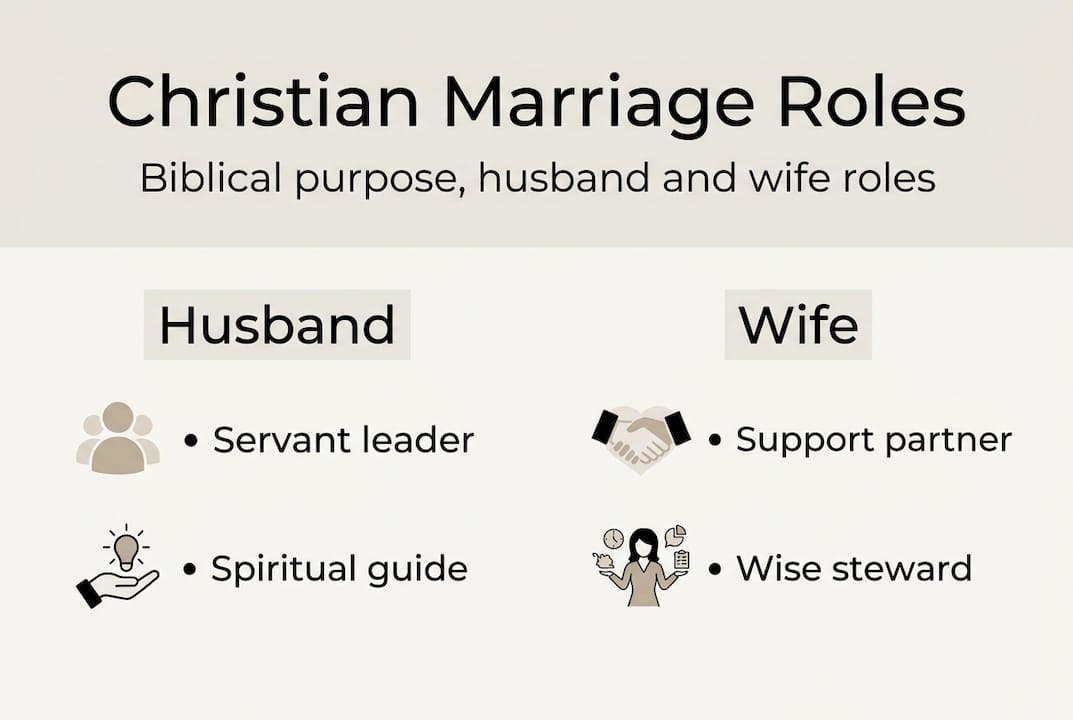
Ephesians 5 is the clearest passage. It does not call husbands to dominate. It calls them to die, just as Christ gave Himself for the Church. That is a harder calling than most men want to accept. And it calls wives to submit, not as inferiors, but as those who trust God's design for order and flourishing.
Here is what the husband's biblical responsibilities actually look like in practice:
- Lead the household in prayer and Scripture
- Provide and protect, physically, spiritually, and emotionally
- Love sacrificially, placing his wife's sanctification above his own comfort
- Model Christ-like humility and servant leadership
For wives, biblical femininity is not weakness. It is strength under authority. The Proverbs 31 woman is industrious, wise, and deeply respected. The womanhood expectations Scripture sets are high, not diminishing.
Pro Tip: Submission is not silence. It is trust. A wife who submits to a husband who loves her as Christ loves the Church is not losing herself. She is participating in a divine design that produces peace, security, and spiritual depth.
Misreading these roles produces either tyranny or chaos. Reading them correctly produces a household that glorifies God.
Marriage as a tool for spiritual growth
With an understanding of roles, it is clear that marriage is about far more than daily function. It is deeply rooted in spiritual growth. In fact, marriage may be the most intensive discipleship environment God ever designed.

You cannot hide in marriage. Every weakness, every selfishness, every unresolved wound surfaces. That is not a flaw in the design. That is the point. God uses the friction of daily covenant life to sand off what does not belong.
The data is striking. Couples who pray together have a divorce rate of less than 1 percent. Premarital counseling reduces divorce risk by 30 percent. Shared devotionals and consistent church involvement are measurable predictors of marital stability and spiritual health.
| Spiritual practice | Impact on marriage |
|---|---|
| Daily prayer together | Less than 1% divorce rate |
| Premarital counseling | 30% reduction in divorce risk |
| Regular church attendance | 25-50% lower divorce rate |
| Shared devotional time | Stronger conflict resolution |
Here is what spiritual growth through marriage actually requires:
- Forgiveness practiced daily, not just in crisis moments
- Patience as a discipline, not a personality trait
- Self-sacrifice as a rhythm, not an occasional gesture
- Shared pursuit of God, through prayer, Scripture, and worship together
For scriptural marriage guidance, the Word of God is not supplemental. It is foundational. Couples who open the Bible together are not just doing a religious activity. They are submitting their marriage to the authority that designed it.
One of the most dangerous threats to this growth is spiritual passivity in marriage, particularly among husbands. When a man abdicates his spiritual leadership, the whole household suffers. Growth requires intentionality. It does not happen by accident.
Marriage, divorce, and forgiveness: Navigating edge cases
Even in the best marriages, challenges arise, sometimes involving separation or divorce, requiring biblically informed wisdom. The church has often swung between two errors: treating divorce as unforgivable, or treating it as casually as a business dissolution. Neither honors Scripture.
Jesus addressed this directly in Matthew 19:9: "And I say unto you, Whosoever shall put away his wife, except it be for fornication, and shall marry another, committeth adultery." The exception clause is real. Adultery breaks the covenant. Paul adds a second ground in 1 Corinthians 7:15, where an unbelieving spouse who departs is permitted to do so, and the believer is not bound.
Most evangelical views on divorce recognize these two grounds: adultery and abandonment. Remarriage after divorce remains debated among conservative theologians, but permanence is always the ideal.
Here is a biblically ordered approach to marital crisis:
- Pursue reconciliation first, always, through prayer, counseling, and repentance
- Involve the local church body when private resolution fails (Matthew 18:15-17)
- Separate temporarily if there is genuine danger, abuse, or ongoing unrepentant sin
- Seek divorce only when the biblical grounds are clearly met and reconciliation is exhausted
"For the LORD, the God of Israel, saith that he hateth putting away." Malachi 2:16
God hates divorce because He loves covenant. But He does not condemn the wounded. Forgiveness, restoration, and grace are available to every believer who has walked through marital failure. The goal of sanctification in hard times is not to condemn the broken but to point them back to the God who redeems.
Pastoral wisdom matters here. No article replaces a godly elder, a sound pastor, or a Spirit-led counselor walking with a family through genuine crisis.
What most Christians miss about the role of marriage
Here is the uncomfortable truth: most Christians approach marriage primarily as a source of personal happiness. They want a companion, a partner, someone to make life better. And when marriage gets hard, when it stops producing happiness, they conclude something has gone wrong.
Nothing has gone wrong. The refining has begun.
The modern church has absorbed a therapeutic view of marriage that Scripture simply does not support. God's primary purpose in marriage is not your happiness. It is your holiness. As scripture's impact on marriage makes plain, the Word of God calls married believers to mutual sanctification, not mutual satisfaction.
This reframe changes everything. Difficulty in marriage is not a sign of failure. It is often a sign of God's faithfulness, pressing two people toward Christlikeness through the most intimate and demanding relationship on earth. A Christ-centered marriage is also a countercultural act of witness. In a world of disposable relationships, a couple who stays, forgives, serves, and grows together preaches the gospel without saying a word.
Going deeper: Resources for strengthening Christian marriage
If these truths have stirred something in you, do not let them stay theoretical. Biblical marriage demands more than good intentions. It requires tools, community, and ongoing instruction rooted in the Word.

At Dead Hidden, you will find resources built specifically for believers who take Scripture seriously. The biblical femininity study equips women with a clear, verse-grounded understanding of their calling. The biblical manhood field manual gives men the doctrinal and practical foundation to lead their households with integrity. For a broader range of teachings on marriage, roles, and spiritual formation, explore more biblical marriage resources across the full platform. These are not self-help tools. They are doctrinal instruments for building a marriage that honors God.
Frequently asked questions
What is the primary purpose of marriage according to the Bible?
Marriage exists to reflect Christ's relationship with the Church and to promote sanctification, unity, and service to God together. As biblical texts confirm, it serves as a mirror of Christ and the Church, driving mutual holiness.
Are there biblical grounds for divorce in Christianity?
Divorce is permitted for adultery and abandonment, but the ideal is permanence, forgiveness, and reconciliation. Evangelical views recognize these two grounds while emphasizing that permanence remains God's design.
How can Christian couples strengthen their marriage?
Regular prayer, shared devotional time, church involvement, and premarital counseling are proven ways to build a durable, spiritual marriage. Couples who pray together have less than a 1 percent divorce rate, and premarital counseling reduces divorce risk by 30 percent.
What are the biblical roles for husbands and wives?
Husbands are called to love sacrificially like Christ; wives are called to respectful, supportive partnership reflecting biblical headship. Scripture is clear that these distinct roles promote mutual sanctification, not hierarchy for its own sake.
Recommended
- How Scripture Strengthens and Guides Christian Marriage
- What Does the Bible Say About a Husband's Role? (The Full Picture) | Dead Hidden | Dead Hidden Ministries
- Letter 2 to my younger self: The Sanctification of Marriage | Dead Hidden Ministries
- Biblical Headship: What the KJV Actually Teaches (And What Your Church Got Wrong) | Dead Hidden | Dead Hidden Ministries