

Many believers quietly assume that picking up a Bible study guide is somehow a concession, as if the Holy Spirit needs a printed framework to work. That assumption deserves a direct challenge. Structured guides do not replace the Spirit's illumination; they create the ordered conditions under which serious doctrinal study can flourish. Proverbs 4:7 commands us to get wisdom, and getting wisdom requires method. This article maps out why guides matter, what types exist, how they sharpen doctrinal clarity in community settings, and how to choose one that actually serves your convictions rather than diluting them.
Table of Contents
- Why guides matter in Bible study
- Types of Bible study guides and their purposes
- How guides facilitate doctrinal clarity and community growth
- Practical application: Choosing and using Bible study guides effectively
- A fresh perspective on guided Bible study
- Where to find Bible study guides that empower scripture engagement
- Frequently asked questions
Key Takeaways
| Point | Details |
|---|---|
| Guides enhance clarity | Structured guides help clarify complex Scriptural doctrine and support faith growth. |
| Guide selection matters | Choosing guides aligned with doctrinal beliefs maximizes their impact for individuals and groups. |
| Community benefits | Guides foster accountability, encourage discussion, and build stronger spiritual communities. |
| Balance structure and spirit | Thoughtful use of guides cultivates both doctrinal accuracy and authentic spiritual engagement. |
Why guides matter in Bible study
Scripture is not a collection of fortune cookie verses. It is a unified, progressive revelation spanning sixty-six books, written across centuries, in three languages, to audiences with specific covenantal contexts. Without a structured approach, even the most earnest believer risks reading passages in isolation, misapplying them, or simply losing the thread entirely. A good guide holds the thread.
Study guides provide a framework for consistent doctrinal exploration, ensuring that each session builds on the last rather than drifting wherever the morning's mood leads. That consistency is not a cage. It is a scaffold. You build upward because the base is secure.
Here is what a well-chosen guide actually does for your study:
- Organizes complex Scripture into sequential, thematic, or book-by-book lessons that prevent fragmented understanding
- Maintains a Christ-centered focus so that Old Testament passages are read in light of their fulfillment and New Testament letters are grounded in their dispensational context
- Builds doctrinal literacy by introducing key theological terms and tracing them across the canon
- Fosters accountability when used in a church or small group, because everyone works from the same material and can hold one another to the text
- Reduces the noise of cultural commentary and keeps your eyes fixed on what the Word actually says
There is also a spiritual warfare dimension here that most people overlook. Distraction is a weapon. Aimless Bible reading, however well-intentioned, is easier to derail than structured study with a clear objective for each session. A guide gives you a target. And a believer with a target is harder to distract.
"The entrance of thy words giveth light; it giveth understanding unto the simple." (Psalm 119:130, KJV)
That light comes more reliably when you approach the Word with order and intention. The Bible study checklist approach and the doctrinal clarity steps framework both reinforce this: preparation precedes illumination.
Pro Tip: Before selecting any guide, write down your top three doctrinal convictions. If the guide contradicts or sidesteps them in the first chapter, set it aside. Alignment matters more than production quality.
Types of Bible study guides and their purposes
Not every guide is built for the same believer or the same season of growth. Understanding the distinctions helps you choose with precision rather than grabbing whatever is on the church resource table.
Different guide types serve distinct growth objectives: doctrinal, devotional, or practical. Each has genuine value. Each also has limitations you need to know.
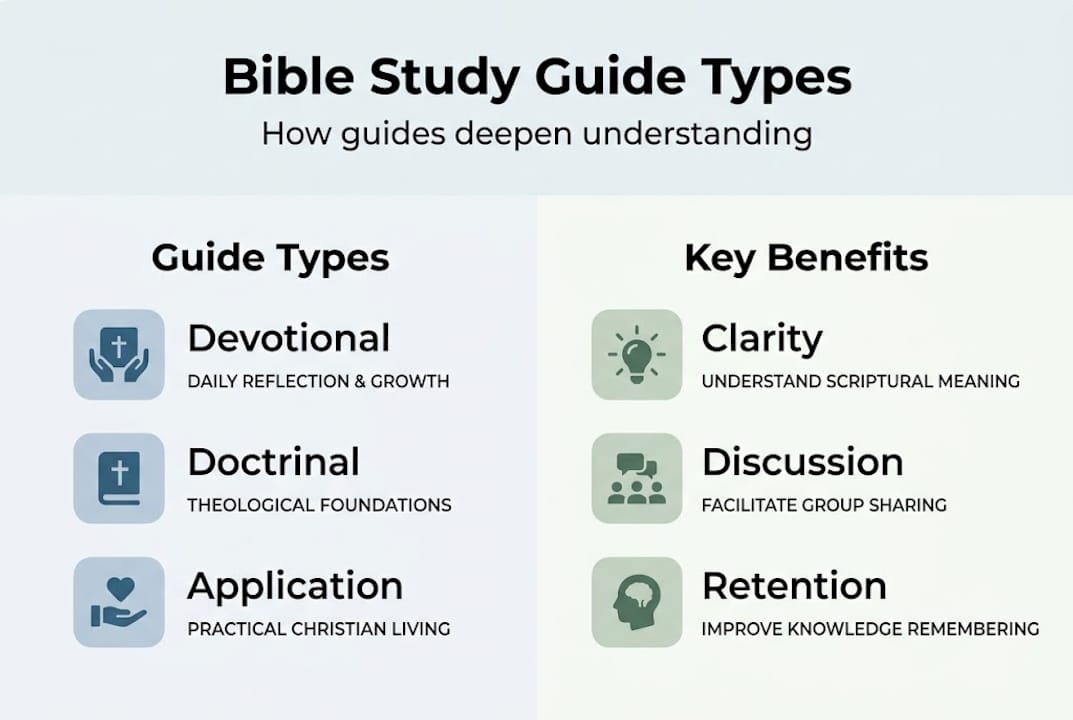
1. Devotional guides focus on personal reflection, emotional connection to Scripture, and daily spiritual rhythms. They are accessible and encourage consistency. The limitation: they can stay shallow if they never push into the theological weight behind a passage.
2. Doctrinal guides dig into theological themes, systematic categories like soteriology or eschatology, and the interpretive principles behind biblical texts. They demand more from the reader but produce more. These are the guides that build the kind of doctrinal literacy that holds up under pressure.
3. Application guides translate Scripture into specific life decisions, relational patterns, and practical obedience. They are strong on the "so what" but can drift into moralism if they lose their exegetical anchor.
| Guide type | Primary focus | Strength | Watch out for |
|---|---|---|---|
| Devotional | Personal reflection | Builds daily habit | Can stay surface-level |
| Doctrinal | Theological themes | Builds deep literacy | Can feel academic without application |
| Application | Practical obedience | Connects Scripture to life | Can drift into moralism |
The KJV study method leans heavily into the doctrinal category, which is where the most durable spiritual formation happens. The clarity steps framework integrates all three types into a sequential process, which is the most balanced approach for serious believers.
A mature study practice rotates across all three types. Start with a doctrinal guide to build your theological foundation. Move into an application guide to test what you have learned against real life. Return to devotional material to keep your heart tender toward the Word. That rotation keeps you from becoming either a cold theologian or an emotionally driven reader without doctrinal roots.
How guides facilitate doctrinal clarity and community growth
Doctrinal clarity is not a luxury for seminary students. It is a survival tool for every believer navigating a culture that actively distorts the gospel. Guides are one of the most practical instruments for building and maintaining that clarity.

When a group of believers works through the same guide together, something significant happens. Guides create shared experiences and improve retention in church or small group settings. The shared vocabulary, the common passage, the unified doctrinal framework: all of these create conditions where genuine theological discussion can replace surface-level conversation.
Consider these key benefits of guided group study:
- Doctrinal clarity: Everyone is reading the same text with the same interpretive framework, reducing the drift that happens when each person brings only their personal impressions
- Participation: A guide with built-in discussion questions draws out quieter members and gives confident members a boundary, preventing one voice from dominating
- Retention: Studies consistently show that structured repetition and discussion dramatically improve long-term retention of biblical content compared to passive listening
- Accountability: When the group knows next week's passage is already assigned, preparation becomes a shared commitment rather than an optional extra
| Study method | Retention rate | Doctrinal depth | Group engagement |
|---|---|---|---|
| Unguided personal reading | Low | Variable | Minimal |
| Guided personal study | Moderate | Consistent | Individual |
| Guided group study | High | Strongest | Maximum |
The deeper understanding checklist maps this out clearly: preparation, observation, interpretation, and application are not optional stages. They are the method. And the Bible reading protocol resource builds that method into a repeatable, year-long practice.
Pro Tip: Use the discussion questions in your guide as the starting point, not the endpoint. Let them open the passage, then let the group press deeper with follow-up questions rooted in the text itself.
Practical application: Choosing and using Bible study guides effectively
Knowing that guides are valuable is one thing. Choosing the right one and actually using it well is another. This is where most believers either excel or stall.
Proper selection and application of guides is crucial for growth. That statement is not a platitude. A misaligned guide can reinforce bad doctrine, create confusion, or simply bore the group into abandoning study altogether. Selection is a serious decision.
Follow these steps to maximize your guide's impact:
- Identify your theological alignment. Know whether you hold to dispensationalism, covenant theology, or another framework before you select a guide. A guide built on incompatible assumptions will create more confusion than clarity.
- Assess the intended audience. Some guides are written for new believers. Others assume years of doctrinal formation. Match the guide's level to your group's actual maturity, not the maturity you wish they had.
- Prepare before each session. Read the assigned passage in your KJV at least twice before the group meets. Come with observations, not just questions.
- Read actively, not passively. Mark the text. Write in the margins. Note every cross-reference the guide provides and look them up.
- Reflect before discussion. Give the passage time to settle before you speak. The best contributions in group study come from people who have sat with the text, not just skimmed it.
- Apply specifically. Do not let application stay general. Name one concrete change or decision the passage demands of you this week.
Here are additional practices that strengthen guide-based study:
- Rotate guides annually to cover different doctrinal categories
- Use gender-specific resources like the 2026 reading plan or the Woman field manual when the group's needs call for focused application
- Pair a doctrinal guide with a relational resource like the Covenant guide to keep theology connected to community life
Pro Tip: Rotate your guides every three to four months. A doctrinal guide followed by an application guide followed by a reading plan keeps your study balanced and prevents the fatigue that comes from staying in one mode too long.
A fresh perspective on guided Bible study
Here is the uncomfortable truth most church groups will not say out loud: the resistance to Bible study guides is often not spiritual. It is pride. There is a subtle assumption that needing a guide signals weakness, as if the truly spiritual believer simply opens the Word and receives instant revelation.
That assumption has no biblical support. Paul instructed Timothy to study, to rightly divide, to give attention to reading. Those are structured, disciplined commands. They describe a method, not a mystical experience.
What we have seen, consistently, is that the believers who resist guides are often the ones with the most surface-level understanding of Scripture. Not because they lack intelligence, but because they lack the stewardship of structure. Guided study is not about controlling the Spirit. It is about honoring the Word enough to approach it with preparation and order.
The study checklist insights framework makes this plain: depth requires method. Spontaneity has its place in personal devotion, but doctrinal formation requires repetition, structure, and accountability. Guideworthiness is stewardship, not restriction.
Where to find Bible study guides that empower scripture engagement
You have seen why guides matter, what types exist, and how to use them well. The next step is finding resources built on the same doctrinal convictions you hold.
Dead Hidden offers a curated library of guides built from a conservative, dispensationalist, KJV-grounded perspective. Whether you need a structured Bible study guide for personal doctrinal formation, the Biblical Woman Field Manual for focused feminine discipleship, or the Hidden Truths starter guides to introduce believers to often-overlooked scriptural realities, the resources are ready. These are not generic church curriculum. They are built for believers who take the Word seriously and want tools that match that seriousness.
Frequently asked questions
What does a Bible study guide do?
A Bible study guide organizes Scripture lessons, encourages reflection, and helps clarify doctrine. As the essential Bible study checklist confirms, guides provide a framework for consistent doctrinal exploration that prevents fragmented or surface-level reading.
How do I choose the right Bible study guide?
Choose a guide aligned with your doctrinal beliefs and group needs for maximum clarity and growth. The 2026 reading plan is one example of a resource built with a specific audience and theological framework in mind, making selection straightforward.
Are guides useful for both individual and group Bible study?
Yes, guides strengthen retention and promote meaningful discussion in both personal and group study settings. Shared guide-based study creates common vocabulary and doctrinal reference points that deepen engagement at every level.
Do Bible study guides hinder spiritual growth?
No, study guides actually open space for deeper engagement and doctrinal integrity. Structured study leads to richer understanding precisely because it creates the ordered conditions where the Spirit's illumination can build on a prepared mind.