

Every believer knows the feeling. The attack comes without warning. A wave of anxiety, a suffocating doubt, a relationship in crisis, a temptation that won't relent. And in that moment, you reach for something to hold onto. The question that matters most is: what is that something, and does it actually work? Scripture does not leave you guessing. The answer is faith, but not the vague, sentimental faith that much of modern Christianity promotes. We are talking about a specific, battle-tested, biblically defined confidence in the living God that Paul calls the shield of faith in Ephesians 6:16.
Table of Contents
- Understanding spiritual battle: The biblical context
- Faith as the shield: What Scripture says
- How faith works in practice during spiritual battles
- Overcoming doubt: Strengthening faith for the ongoing fight
- The overlooked truth: Faith as dependence, not just determination
- Deepen your walk: Tools and resources for spiritual battle
- Frequently asked questions
Key Takeaways
| Point | Details |
|---|---|
| Faith is essential | True faith lays the foundation for overcoming every spiritual attack. |
| Scripture is your arsenal | Knowing and believing God’s Word empowers victorious living. |
| Doubt can build faith | Facing doubts can deepen trust in God if met with Scripture-based responses. |
| Practice daily disciplines | Consistent prayer and Bible study are practical ways to strengthen faith in battle. |
Understanding spiritual battle: The biblical context
Before you can wield any weapon effectively, you must understand the war you are in. Many believers live in defeat simply because no one has told them plainly: you are in a war. Not a metaphor. Not an emotional struggle that a good counselor can resolve. A real, ongoing, unseen conflict with enemies described in Scripture as rulers, powers, and spiritual wickedness in high places (Ephesians 6:12).
Paul's language is military and precise. He uses the Greek word panoplia, meaning the full armor of a Roman soldier, not a piece here or there. The complete arsenal. This is not optional equipment for elite believers. Every born-again Christian is enrolled in this battle the moment they are saved. Spiritual battles are a central reality for every believer according to Scripture, not just pastors, missionaries, or the spiritually mature.
One of the most damaging misconceptions in the church today is that spiritual warfare is a specialty discipline, something reserved for seasoned intercessors or deliverance ministers. That idea is nowhere in Ephesians 6. Paul writes to the entire church at Ephesus: "Put on the whole armour of God, that ye may be able to stand against the wiles of the devil" (Ephesians 6:11). The word "wiles" here, methodeia in Greek, means schemes, strategies, systematic deception. The enemy is not random. He is methodical.
The main battlefields where this war plays out include:
- The mind: 2 Corinthians 10:4-5 identifies the mind as the primary theater of conflict. Strongholds are not physical locations but patterns of thought that resist the knowledge of God.
- The family: Marriage and parenting are under relentless assault. The enemy knows that destroying the family dismantles the church.
- The local church: Division, false doctrine, and moral failure in congregations are rarely accidental. They are targeted operations.
- Culture: The systematic removal of God from public life, the redefinition of truth itself, is spiritual warfare at the macro level.
"For we wrestle not against flesh and blood, but against principalities, against powers, against the rulers of the darkness of this world, against spiritual wickedness in high places." — Ephesians 6:12
Ignoring this reality does not protect you. It simply leaves you unguarded. Resources like exposing the enemy offer serious, scripturally grounded teaching on how the adversary operates so you can recognize his methods. And the work of strengthening faith through Scripture begins with seeing the battle clearly before you can fight it effectively.
Faith as the shield: What Scripture says
Once you understand the war, Ephesians 6:16 hits differently. Paul writes: "Above all, taking the shield of faith, wherewith ye shall be able to quench all the fiery darts of the wicked." Notice: above all. Not as an afterthought. Faith is positioned as the central, overarching piece of armor.
The Roman shield Paul references is the thureos, a large, door-sized shield, roughly four feet tall, designed to cover the entire body. Soldiers locked these shields together in formation to create an impenetrable wall. That is the image Scripture gives us. Faith is described as a shield in Ephesians 6:16, essential for extinguishing the fiery darts of the enemy, and it is meant to be both personal and communal.

Here is a breakdown of key scriptural references and what faith specifically protects against:
| Scripture | What faith defends against |
|---|---|
| Ephesians 6:16 | Fiery darts: lies, temptations, accusations |
| 1 John 5:4 | The world: its systems, values, and corruption |
| 1 Peter 5:9 | The devil: direct satanic opposition and pressure |
| Hebrews 11:1 | Fear and despair: what cannot yet be seen |
| Romans 10:17 | Spiritual ignorance: faith built by hearing the Word |
Notice the pattern. Every threat the enemy deploys, whether it is a lie about your identity, a temptation to sin, fear about your future, or despair in your trial, faith is the scriptural answer. Not technique. Not willpower. Faith.
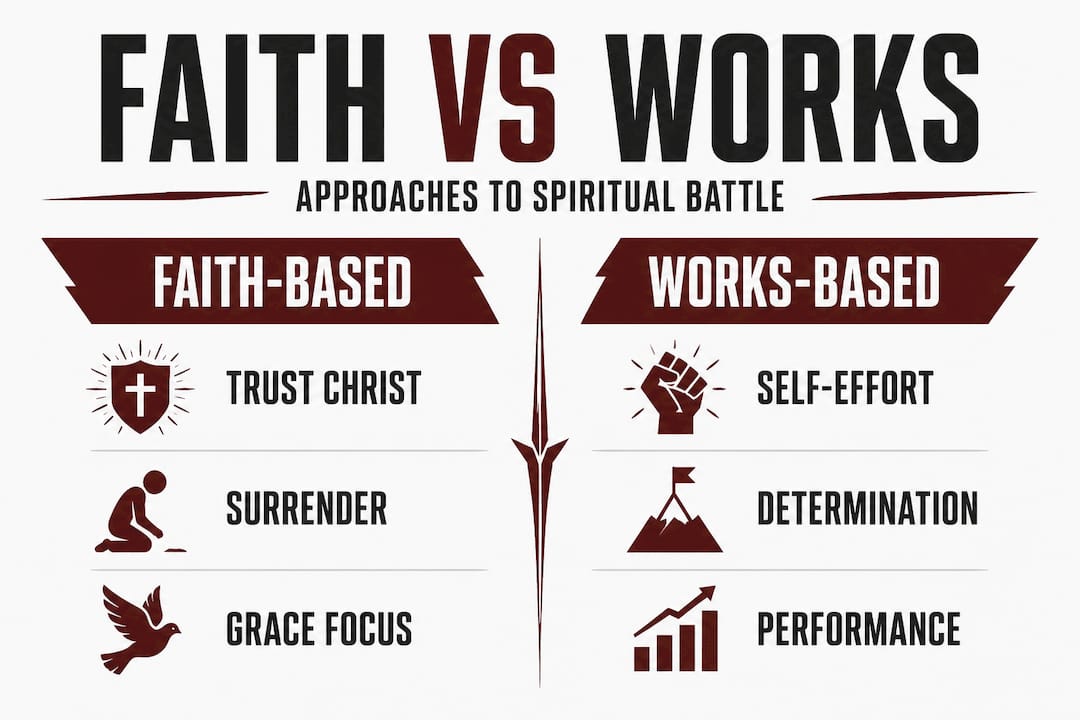
This is where the critical distinction between faith-based and works-based approaches to spiritual battle becomes essential. Works-based approaches say: pray more, fast longer, rebuke louder. Those disciplines have their place. But when you approach spiritual battle as though your effort is what wins, you will eventually exhaust yourself and feel defeated. Faith-based engagement says: I trust in what Christ has already accomplished. I stand on finished ground.
Understanding this distinction is precisely why the study of faith vs works matters so deeply for believers engaged in ongoing warfare. And for those wrestling with whether their faith is sufficient, honest engagement with faith and doubt brings the kind of scriptural clarity that steadies the soul under pressure.
Pro Tip: When you sense a spiritual attack coming, do not immediately try to argue your way through it mentally. Open your Bible to a specific promise, read it aloud, and declare it back to God in prayer. Hebrews 4:12 tells us the Word of God is living and powerful. Let it do its work. This is not superstition. It is strategy.
How faith works in practice during spiritual battles
Doctrine without application leaves believers equipped in theory but defeated in practice. So let's make this concrete. Here is a step-by-step approach to engaging faith when the attack is real and the pressure is intense:
-
Recognize the attack for what it is. Not every hard moment is spiritual warfare, but many are. When your thoughts suddenly spiral into accusation, hopelessness, or obsessive fear, ask yourself: is this consistent with what Scripture says about me? If not, you are being lied to.
-
Stop and name the lie. The enemy works through deception. Jesus called him "the father of lies" in John 8:44. The moment you identify the specific lie being used against you, you strip it of much of its power.
-
Rehearse the corresponding truth. This is not positive thinking. This is theological counterattack. Find the verse, the promise, the doctrinal truth that directly addresses the lie. Speak it. Write it down. Repeat it until it settles.
-
Pray from that position. Do not pray from a place of panic. Pray from a position of authority, based on what Christ has done. Romans 8:37 declares: "We are more than conquerors through him that loved us."
-
Act by faith, not by feeling. Feelings are not the measurement of spiritual reality. Faith acts before the feeling changes. Abraham offered Isaac before he received the answer (Hebrews 11:17-19). Obedience preceded resolution.
-
Stay in community. The Roman thureos shields were locked together in formation. Isolation is one of the enemy's most effective tools. Stay accountable, stay submitted to your local body.
Believers strengthen their faith through prayer, Bible study, and standing on God's promises. This is not a passive process. It requires disciplined, consistent engagement with the Word, especially when the battle is fierce.
When mental and emotional pressure intensifies, specific resources become invaluable. The guide on prayers for crisis faith provides scriptural, targeted prayers for the moments when your own words fail you. And for those facing severe mental attack, overcoming mental torment applies Scripture directly to that specific battlefield.
Pro Tip: Consistency in spiritual disciplines is your long-term defense. It is far easier to maintain a fortified position than to rebuild from rubble. Daily Bible reading, regular prayer, and consistent fellowship are not optional extras. They are what keep the shield raised before the darts arrive.
Overcoming doubt: Strengthening faith for the ongoing fight
Doubt. Every serious believer has faced it. The kind that whispers: Is this real? Is God actually there? Does prayer even matter? And here is something the mainstream church often gets wrong: doubt is not the opposite of faith. Unbelief is. Doubt can actually be the beginning of a deeper, more honest faith if you bring it to Scripture instead of letting it fester in silence.
Common sources of doubt in spiritual battle include:
- Spiritual attack: The enemy directly targets your confidence in God's Word and character. Recognize this as an assault, not a revelation.
- Emotional exhaustion: Prolonged trial depletes the soul. When you are tired, your defenses lower. This is when you need the body of Christ around you most.
- Unanswered prayer: Waiting on God without explanation feels like abandonment. It is not. Hebrews 11 is full of people who died without receiving the promise (Hebrews 11:39).
- Sin and guilt: Unconfessed sin clouds the perception of God's presence. 1 John 1:9 is the remedy. Confess, receive forgiveness, and stand clean.
- Theological confusion: Bad doctrine produces unstable faith. When your understanding of who God is gets distorted, your trust in Him wavers.
Scripture does not shame believers for wrestling with doubt. Jesus did not rebuke Thomas for his doubts. He met him in them (John 20:27). Doubt is a common part of the faith journey, addressed throughout Scripture as a reality that God engages rather than condemns.
The key encouragements from Scripture for seasons of weak faith are powerful and specific:
"But they that wait upon the LORD shall renew their strength; they shall mount up with wings as eagles; they shall run, and not be weary; and they shall walk, and not faint." — Isaiah 40:31
Weakness in faith does not disqualify you. It qualifies you to receive grace. James 1:3 says the testing of your faith produces patience, endurance, the settled confidence that no trial can shake. This is why understanding why men leave the church matters in this context: unresolved doubt, unaddressed in community, drives believers into isolation where the enemy has free reign.
The fighting posture is this: return to the Word. Return to prayer. Return to community. Not as acts of desperation, but as acts of war.
The overlooked truth: Faith as dependence, not just determination
Here is what most teaching on spiritual warfare misses, and it is costing believers their peace and their perseverance. The language of spiritual battle in popular Christianity often sounds like a motivational speech: dig deeper, fight harder, believe stronger. And the believer who is already exhausted hears that and concludes: I am failing because I am not trying hard enough.
That is not the gospel. That is law dressed up in warfare language.
True faith is not the product of your determination. It is the fruit of your surrender. There is a profound difference. Determination says: I will hold on. Surrender says: I am held. Determination focuses on the quality of your grip. Faith focuses on the One you are gripping. And the brutal, liberating truth is that the strength of your faith matters far less than the object of your faith.
A small seed of genuine faith in the all-sufficient Christ accomplishes what a mountain of self-generated religious effort never could (Matthew 17:20). This is why the believer who contends for souls does so not from a place of self-confidence but from a deep, settled confidence in what Christ has already secured.
The freedom found in this truth is staggering. You are not fighting for victory. You are fighting from victory. Christ's resurrection is the declaration that the war's outcome is already determined. Your role is to stand in that reality, hold the shield of faith, and refuse to retreat from ground that has already been won.
This reframes everything. Doubt becomes manageable when you stop treating it as evidence of your failure and start treating it as an opportunity to anchor yourself more firmly in what is objectively true, regardless of your feelings. Suffering becomes bearable when it is not evidence of defeat but of enrollment in a battle whose conclusion is certain.
Deepen your walk: Tools and resources for spiritual battle
Understanding the battle is one thing. Staying equipped for it day after day is another. The resources available through Dead Hidden Ministries are built precisely for believers who take Scripture seriously and refuse to settle for surface-level Christianity.
Whether you are brand new to structured Bible study or looking to sharpen your existing practice, how to study the Bible provides a methodical, verse-by-verse approach that builds the kind of biblical literacy that sustains faith under pressure. When the crisis hits and your own words run dry, prayers for crisis faith gives you Scripture-saturated prayers to stand on. These are not resources for casual browsing. They are tools for people who are serious about standing firm.
Frequently asked questions
What is the most important weapon in spiritual battle?
Faith is described as a shield in Ephesians 6:16, making it the believer's primary defensive and offensive instrument in spiritual warfare, positioned by Paul as the piece of armor worn above all others.
How can I grow stronger in faith during spiritual struggle?
Persist with prayer, Bible study, and rely on God's promises. Believers strengthen faith through consistent spiritual disciplines, especially maintaining them when circumstances make it hardest.
Is doubt a sign of weak faith?
Not necessarily. Doubt is a common part of the faith journey, addressed scripturally as something God meets and uses to produce deeper, more resilient trust in Him.
What should I do when attacked by fear or temptation?
Stand on a specific Scripture, pray from a position of Christ's authority, and act in obedience before your feelings catch up. Faith and prayer help overcome spiritual attacks by anchoring you in objective truth rather than subjective experience.