

Most believers open their Bibles with the best intentions and close them more confused than when they started. The text feels distant, the language feels ancient, and the depth feels reserved for seminary-trained scholars. That assumption is wrong, and it has cost the church dearly. Expository Bible study is the method that strips away that confusion, bringing God's Word into sharp focus, verse by verse, passage by passage, with precision and power. This guide maps out for you exactly how to engage the King James Version through expository study, building doctrinal clarity, spiritual strength, and the kind of faith that holds when the enemy presses hard.
Table of Contents
- What is expository Bible study and why does it matter?
- KJV principles: How expository study deepens biblical clarity
- The expository process: Step-by-step guide for personal growth
- Integrating expository Bible study in group and church settings
- Our take: Why expository study is the spiritual battlefield's secret weapon
- Discover resources for victorious expository study
- Frequently asked questions
Key Takeaways
| Point | Details |
|---|---|
| Expository study clarifies scripture | Verse-by-verse analysis illuminates context and true meaning for personal growth. |
| KJV fuels doctrinal depth | Studying the King James Version strengthens accuracy and faith for spiritual warfare. |
| Practical steps empower victory | Applying structured expository methods helps believers counter daily spiritual attacks. |
| Group study fosters unity | Expository guides used in church settings build stronger, resilient congregations. |
What is expository Bible study and why does it matter?
Expository Bible study is not a church program or a weekend seminar. It is a disciplined, verse-by-verse approach to scripture that allows the text itself to speak, rather than bending the text around a predetermined theme or personal preference. The word "expository" comes from the Latin exponere, meaning to set forth or explain. When you study expositorily, you are setting forth what is already there, not importing what you wish were there.
This matters enormously. Much of what passes for Bible study today is topical. Pick a subject, gather a handful of verses, and build a lesson around them. That approach is not without value, but it carries a serious risk: verses pulled from their context can be made to say almost anything. Expository study eliminates that risk by demanding that you understand the context first and derive your application from it.
The deeper scripture understanding that expository methods produce is not abstract or academic. It is the kind of understanding that answers real questions. Why did Paul write that? What was the church at Ephesus actually facing? How does this passage connect to the broader argument of this letter? Those answers equip you for doctrinal defense and spiritual warfare in ways that topical study simply cannot.
Here is what expository Bible study produces when practiced consistently:
- Doctrinal clarity: You learn what the Bible actually teaches on a given subject, in its own terms, not through a filtered summary.
- Stronger faith: Faith built on the exact words of scripture is more durable than faith built on secondhand paraphrase.
- Practical action: When you understand the context of a command, you know how and why to obey it.
- Spiritual warfare readiness: The enemy attacks through deception and distortion. Knowing scripture in context is your shield.
- Personal accountability: You cannot ignore inconvenient passages when you are working through a book verse by verse.
A common misconception is that only pastors or trained scholars can exposit the Bible. That is simply false. The Bereans in Acts 17:11 were not seminarians. They were laypeople who "searched the scriptures daily" to verify what they were being taught. That is expository habit in its purest form.
Pro Tip: Keep a dedicated bullet journal for your expository study sessions. Record the passage, your observations, key word definitions from a Strong's Concordance, and one actionable application. Over months, this journal becomes a personal doctrinal reference that no commentary can replace.
In 2026, the hunger for KJV-based expository teaching is growing precisely because believers are recognizing that surface-level study leaves them vulnerable, doctrinally thin, and spiritually unprepared for the battles ahead.
An essential Bible study checklist can help you establish the habits that make expository study consistent and productive from the very first session.
KJV principles: How expository study deepens biblical clarity
The King James Version is not merely a stylistic preference. It is a translation philosophy. The KJV translators in 1611 worked from the Textus Receptus, the received Greek text, and the Masoretic Hebrew text, with a formal equivalence approach. That means they prioritized word-for-word accuracy over dynamic readability. The result is a translation where every word carries weight, and where doctrinal clarity steps taken with the KJV yield richer results than many modern alternatives.

Here is a direct comparison of the KJV against modern translations for expository study purposes:
| Feature | KJV | Modern Translations |
|---|---|---|
| Translation philosophy | Formal equivalence (word-for-word) | Dynamic equivalence (thought-for-thought) |
| Textual basis | Textus Receptus / Masoretic | Varies (often Nestle-Aland / Critical Text) |
| Doctrinal precision | High | Variable |
| Vocabulary for expository study | Dense, requiring concordance use | Simplified, reducing study depth |
| Spiritual warfare memorization | Strong cadence aids retention | Paraphrased, harder to retain precisely |
The differences are not cosmetic. When you study a KJV passage expositorily, you are engaging with a translation designed to preserve the structure and weight of the original languages. Using the KJV Bible study method ensures that every word you examine carries the intention of the translators and, beneath them, the original authors quickened by the Holy Spirit.
Here is a step-by-step approach to expository study specifically with the KJV:
- Read the passage aloud. The KJV was designed for oral proclamation. Hearing it activates comprehension in ways silent reading does not.
- Identify the literary context. Is this poetry, prophecy, epistle, or history? The genre shapes how you interpret the language.
- Mark repeated words and phrases. Repetition in scripture is deliberate emphasis. The Spirit is highlighting something.
- Consult a Strong's Concordance. KJV words often carry layered meanings from the Hebrew and Greek originals that the English surface does not reveal.
- Cross-reference within the KJV. Let scripture interpret scripture. Use a Treasury of Scripture Knowledge to trace parallel passages.
- Summarize the author's argument in one sentence. If you cannot do this, you have not yet understood the passage. Keep reading and praying until you can.
Pro Tip: When you find a KJV word that seems archaic, resist the temptation to swap it for a modern substitute. Instead, look it up in the concordance. Words like "quickened," "propitiation," and "sanctification" are theological load-bearing terms, not decorative language. Understanding them precisely is half the battle.
The KJV also serves as an anchor for Scripture memorization, which is itself a weapon of spiritual warfare. Ephesians 6:17 calls the Word of God "the sword of the Spirit." A sword you can quote verbatim, in precise doctrinal language, is far more effective than a sword you can only paraphrase roughly.
The expository process: Step-by-step guide for personal growth
Armed with KJV-specific principles, you are ready to put expository study into action with an accessible, proven process. This is the sequence that transforms passive reading into active, spiritually transformative engagement with God's Word.
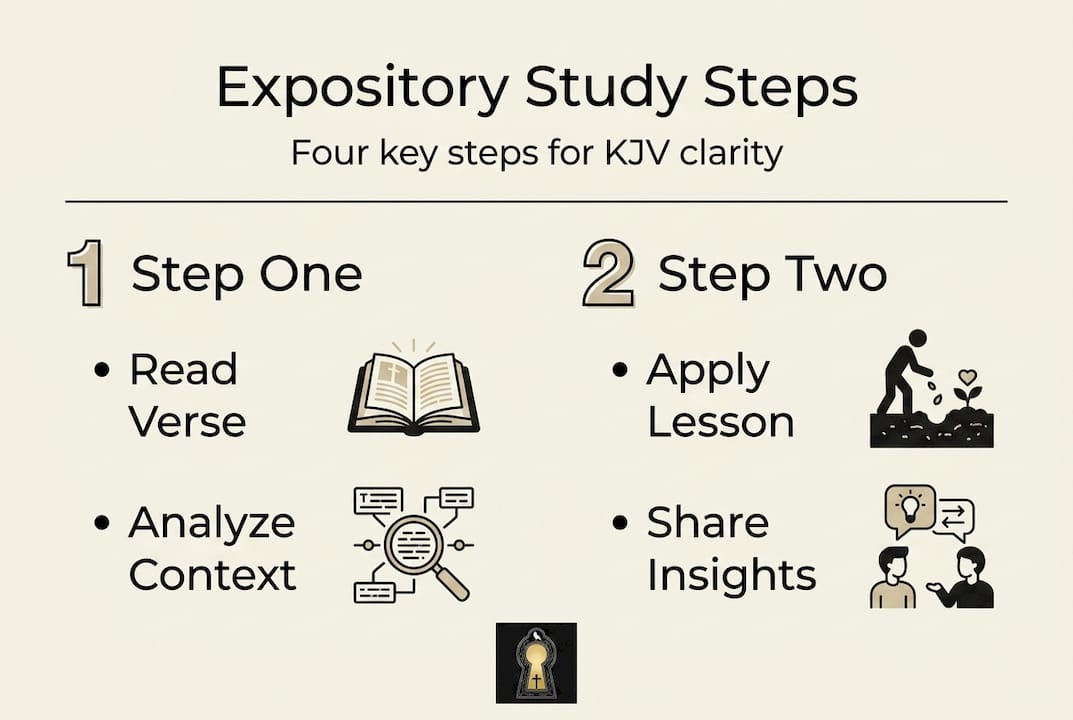
- Observe: Read the passage multiple times. Write down exactly what the text says, with no interpretation yet. Who is speaking? To whom? What is the setting? What words or phrases stand out?
- Interpret: Ask what the text meant to its original audience. Use your concordance, cross-references, and historical context. What was the author's intent? What doctrinal truth is being conveyed?
- Apply: Bring the interpreted meaning into your present circumstances. How does this truth challenge, correct, or confirm your current walk? Be specific. Vague application produces vague growth.
- Pray: Close every study session by praying the passage back to God. Acknowledge what He has shown you. Ask for grace to walk in obedience. This seals the Word in your heart rather than leaving it on the page.
This four-step process, when followed consistently, produces the kind of transformation that the Bible study checklist at Dead Hidden describes as foundational to genuine spiritual victory.
Here is a sample weekly study plan to make this concrete:
| Day | Passage | Key Observation | Actionable Outcome |
|---|---|---|---|
| Monday | Ephesians 6:10-13 | "Whole armour of God" is corporate and individual | Identify one area of spiritual vulnerability to address |
| Tuesday | Ephesians 6:14 | "Loins girt about with truth" is positional doctrine | Review one doctrinal truth to anchor your week |
| Wednesday | Ephesians 6:15 | "Gospel of peace" as preparation | Share the gospel with one person this week |
| Thursday | Ephesians 6:16 | "Shield of faith" quenches fiery darts | Identify one lie you have believed and replace it with scripture |
| Friday | Ephesians 6:17-18 | "Sword of the Spirit" and prayer | Memorize one verse and pray it consistently |
Regular expository engagement at this level produces measurable results. Studies on church website engagement and faith communities consistently show that believers who engage scripture systematically report higher spiritual confidence and doctrinal stability than those who study topically or inconsistently.
Common pitfalls to avoid: surface reading, which treats observation as the final step; skipping context, which isolates verses from their literary and historical surroundings; and neglecting prayer, which reduces Bible study to an intellectual exercise rather than a Spirit-led encounter with the living God.
Expository study also equips you for study for doctrinal clarity when facing real spiritual warfare scenarios. When the enemy whispers doubt, you do not reach for a vague feeling. You reach for a precisely understood passage, interpreted in context, and applied to the specific attack you are facing. That is warfare readiness.
Integrating expository Bible study in group and church settings
Once you have mastered expository study for personal growth, it is time to multiply its impact through church and group settings. A single believer grounded in expository method is powerful. A group of them, moving through scripture together with unity of purpose, is formidable.
Expository group study produces something that topical studies often miss: shared doctrinal foundation. When everyone in a small group has worked through the same passage, observed the same text, and interpreted it together, the unity of mind described in Romans 15:6 becomes tangible and real. Disagreements still arise, but they are resolved by the text, not by personality or tradition.
Here are practical tips for leading or participating in a group expository study:
- Assign the passage in advance. Ask participants to complete the observation step before arriving. This accelerates discussion and deepens engagement.
- Open every session with prayer, specifically requesting the illuminating work of the Holy Spirit. John 16:13 promises that the Spirit guides believers into all truth. Take that seriously.
- Establish a clear purpose for each session. What doctrinal truth are you pursuing? What spiritual battle is this group preparing to face? Purpose shapes participation.
- Use structured guides. The Dead Hidden Ministries resources provide KJV-focused expository guides designed for exactly this kind of purposeful group engagement.
- Encourage every participant to contribute an observation. Expository group study is not a lecture. It is a community of believers mining scripture together.
- Address conflict with the text. When doctrinal differences arise, return to the passage. Let the Word arbitrate.
Pro Tip: Begin each group session with a one-sentence prayer of consecration: "Lord, show us what is here, not what we want to find." That single act of submission transforms group dynamics and keeps the study anchored in revelation rather than opinion.
For women's groups seeking a structured entry point, the women's KJV reading plan at Dead Hidden Ministries provides a thoughtfully organized framework that pairs expository reading with practical application in the areas of biblical femininity and family life.
Spiritually equipped groups also contribute to the physical and emotional security of the congregation. A church where believers know the Word deeply, walk in doctrinal unity, and pray with authority is a church security plan that no external threat can easily penetrate. Resilient congregations are not built on programs. They are built on people who know their God and know His Word.
Our take: Why expository study is the spiritual battlefield's secret weapon
Most churches in 2026 are not failing because of a lack of enthusiasm. They are failing because of a lack of depth. Topical-only preaching and study leaves believers feeling spiritually full on Sunday and doctrinally empty by Wednesday. The enemy knows this. He does not attack you at your strongest moments. He attacks you in the gaps, where your knowledge of scripture is thin and your confidence in its promises is untested.
That is precisely where expository study changes the equation. When you have worked through a passage, observed it carefully, interpreted it faithfully, and applied it personally, it becomes part of you. It is not a quote you borrowed. It is a truth you discovered and owned.
We have seen believers who could recite dozens of topical verses crumble under doctrinal pressure because they did not know the context of those verses. We have also seen believers who had done careful study for doctrinal clarity through even one book of the Bible stand firm under fierce spiritual attack, because they knew not just the words but the living argument of scripture.
Scripture applied through exposition becomes armor for everyday battles.
The contrarian truth is this: topical study, at its best, produces inspiration. Expository study, at its best, produces formation. The church needs both, but it is desperately short on the latter.
Discover resources for victorious expository study
You now have the method, the principles, and the framework. The next step is equipping yourself with tools built specifically for KJV-grounded expository study and spiritual warfare.
At Dead Hidden Ministries, we have built resources that meet you exactly where you are, whether you are a beginner establishing your first consistent study habit or a seasoned believer preparing for deeper doctrinal defense. The how to study the Bible resource gives you a structured entry point grounded in KJV methodology. For those ready to take their study directly into spiritual combat, the Warrior's Bible Blueprint provides a battle-tested framework for applying scripture to real spiritual warfare. And the Christian Soldier's Battle Notes equips you with organized, actionable study notes built for the front lines of faith. These are not decorative resources. They are weapons.
Frequently asked questions
How does expository Bible study differ from other methods?
Expository study focuses on verse-by-verse analysis to reveal context, doctrine, and personal application, while other methods may emphasize topical summaries or devotional thoughts that can disconnect scripture from its original intent.
Why is the King James Version preferred for expository study?
The KJV offers stability, precision, and doctrinal accuracy that many expository teachers and students rely on for faithful interpretation, grounded in the formal equivalence translation philosophy and the Textus Receptus.
How can expository study improve spiritual warfare?
Expository study equips believers with context-rich, actionable scripture that enables spiritual victory by strengthening doctrinal defense and replacing surface-level knowledge with deeply rooted, precisely understood truth.
Can expository Bible study be used in group formats?
Yes, expository study encourages group unity, doctrinal clarity, and spiritual maturity when led with prayer and clear purpose, as supported by faith-based ministry resources designed for both individual and communal scriptural engagement.
Recommended
- How to Study the Bible in the KJV: A Step-by-Step Method That Actually Works | Dead Hidden | Dead Hidden Ministries
- How Bible Study Guides Unlock Deeper Scripture Understanding
- Essential Bible study checklist: steps for deeper understanding
- Blog — Biblical Truth, Masculinity & Marriage | Dead Hidden | Dead Hidden Ministries