

Most believers own a Bible. Far fewer actually study one. There is a critical difference between scanning familiar verses during a quiet moment and engaging Scripture with the focused, prayerful discipline that transforms a soul. Fewer than 1 in 3 churchgoers read the Bible daily among U.S. Protestant churchgoers, and only 31% reach that benchmark at all. That gap between casual contact and genuine study is exactly where spiritual stagnation lives. This article maps out what personal Bible study truly is, which methods produce the deepest fruit, and how to move from mere knowledge to life-altering obedience.
Table of Contents
- What is personal Bible study?
- Core methods: Inductive and alternatives
- Essential tools and preparation
- Pitfalls and best practices
- From study to transformation: Applying scripture personally
- Why self-discovery in Bible study trumps dependence on teachers
- Next steps: Equip your Bible study journey
- Frequently asked questions
Key Takeaways
| Point | Details |
|---|---|
| Personal study defined | Personal Bible study is active, disciplined engagement with Scripture, not just reading. |
| Inductive method matters | The inductive approach—observe, interpret, apply—lays the foundation for deep spiritual growth. |
| Practical tools essential | Translations, notebooks, and concordances support fruitful study when paired with prayer. |
| Avoid common pitfalls | Reading without context or true application leads to error; genre and audience matter. |
| Application transforms life | Measuring growth by obedience—not just knowledge—makes Bible study personally impactful. |
What is personal Bible study?
Personal Bible study is not the same thing as devotional reading, and confusing the two costs believers dearly. Devotional reading has its place, but it is selective, brief, and emotionally driven. Personal Bible study is something altogether different. It is, as one resource defines it, the individual, disciplined engagement with Scripture to hear God speak, understand His character, and apply truths to daily life, distinct from casual reading or group study.
The goals of personal study are threefold:
- Hearing God speak. The Word is living and active (Hebrews 4:12). Personal study creates the conditions for the Holy Spirit to press specific truths into your specific situation.
- Understanding God's character. Doctrine is not dry. Every attribute of God revealed in the text, His holiness, His justice, His mercy, shapes how you worship, how you pray, and how you endure suffering.
- Applying truths to daily life. Study that ends at the notebook page is incomplete. The Word must move from the page to the pavement.
Group study and Sunday sermons are gifts. But they are not substitutes. A pastor preaches to a congregation. The Holy Spirit speaks to a person. Personal study is where that individual encounter happens. If you want to understand the distinction more deeply, the KJV Bible study method offers a rich framework for approaching the text with disciplined reverence.

Core methods: Inductive and alternatives
Knowing what personal Bible study is means nothing without knowing how to do it. Method matters. The wrong approach produces confusion, eisegesis (reading your opinions into the text), and frustration. The right approach produces clarity, conviction, and transformation.
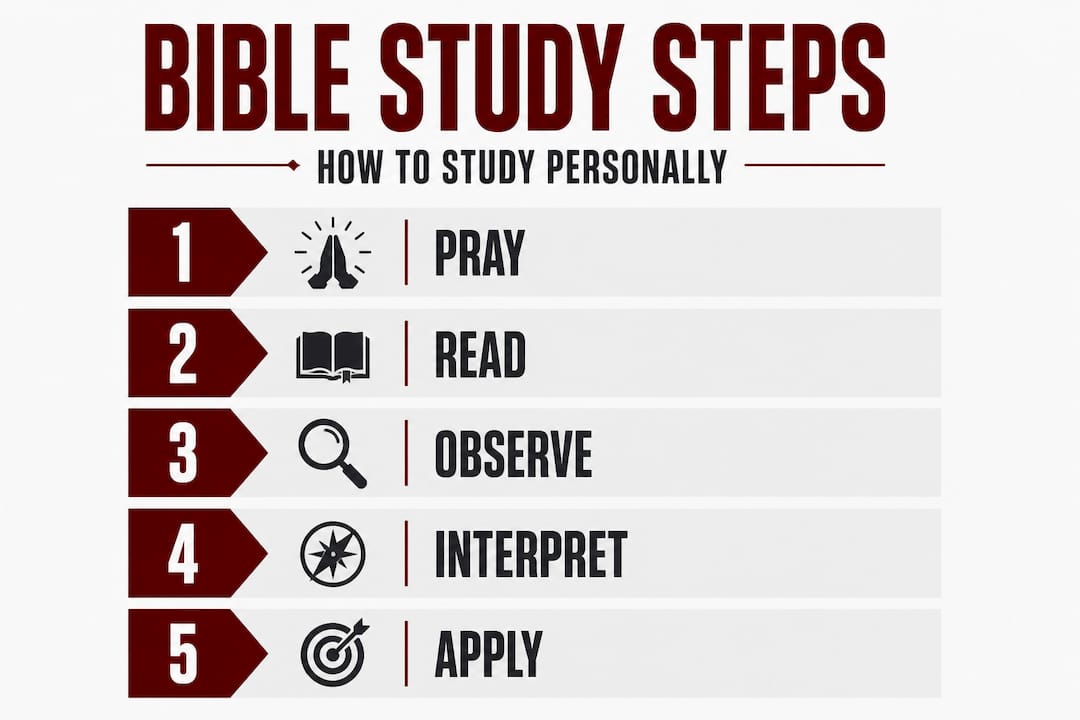
The inductive method: The gold standard
The inductive Bible study method follows a three-step framework known as OIA: Observation, Interpretation, and Application. Here is what each step demands:
- Observation. Ask: What does the text actually say? Read slowly. Mark repeated words, key phrases, commands, and contrasts. Do not bring assumptions. Let the text speak first.
- Interpretation. Ask: What does the text mean? Consider the context, the original audience, the genre, and the surrounding passages. Cross-reference with other Scripture. Meaning is determined by the author's intent, not by your preference.
- Application. Ask: What does this truth require of me? This is where study becomes obedience. Specific, actionable response is the goal.
Inductive vs. deductive: A critical distinction
| Approach | Starting point | Direction | Best use |
|---|---|---|---|
| Inductive | The biblical text | Text leads to conclusions | Personal depth, discovery |
| Deductive | A premise or doctrine | Seeks proof from the text | Teaching, apologetics |
As researchers note, inductive study moves from text to conclusion, while deductive study starts with a premise and seeks proof. Both are useful. But inductive study is foundational for personal depth because it forces the text to speak on its own terms, guarding you against reading your theology into Scripture rather than drawing it out.
Alternative methods worth using
The inductive method is primary. But several complementary approaches serve well depending on your season or goal, as outlined here:
- Devotional method. Read, reflect, and pray over a short passage. Ideal for maintaining consistent daily contact with the Word.
- SOAP method. Scripture, Observation, Application, Prayer. A structured journaling approach that keeps study grounded and personal.
- Topical study. Trace a single theme (e.g., redemption, covenant, faith) across multiple passages and books. Excellent for building theological frameworks.
- Character study. Examine the life of a biblical figure, his calling, failures, obedience, and the lessons God inscribed in his story.
- Book study. Work through an entire book of the Bible, chapter by chapter, preserving authorial intent and narrative flow.
For those wanting to understand doctrinal study steps in greater depth, structured guides build the kind of theological precision that separates informed believers from those perpetually confused by competing interpretations. You can also explore curated Bible study guides that provide additional frameworks for working through Scripture systematically.
Pro Tip: Start with a single book of the Bible using the inductive method before attempting topical or character studies. The discipline of staying in context first trains your interpretive instincts for every other method.
Essential tools and preparation
A soldier does not enter combat without equipment. Neither should you open Scripture without preparing both your tools and your heart.
Your tools
Sound evangelical practice identifies these essentials:
- A reliable translation. The KJV stands as the preserved, doctrinally precise text for the serious Bible student. The ESV is useful for cross-reference. Whatever translation you use, it must be one you trust fully and read consistently.
- A dedicated notebook. Write everything. Observations, questions, insights, and applications. Writing forces precision and slows the mind down enough to actually hear.
- A concordance. Strong's Exhaustive Concordance allows you to trace words back to their original Hebrew or Greek, which regularly illuminates passages that seemed clear but carry deeper meaning.
- Cross-references. The margin references in most study Bibles are worth their weight in gold. Scripture's greatest interpreter is Scripture itself.
- A Bible dictionary. Cultural and historical context resolves confusion faster than almost any other tool. What did "leprosy" represent in Levitical law? What was a "publican"? Context answers these questions.
Preparing your heart
Tools without prayer are just information gathering. Begin every study session with genuine, dependent prayer. Ask the Holy Spirit to illuminate the text (1 Corinthians 2:14). Confess any known sin that might cloud your reception. Approach the Word with the reverence of a servant before his King, not as a scholar auditing a lecture.
The numbers confirm what experience already tells us: only 31% of churchgoers read the Bible daily, with an average engagement score of just 69.8 out of 100. The majority are not studying. That means the tools are available, the time exists, but the discipline and the preparation are missing. Do not let convenience rob you of depth. An essential Bible study checklist can help you organize both your materials and your approach before you even open the text.
Pitfalls and best practices
Even sincere believers fall into interpretive traps that drain the fruit from their study. Naming these pitfalls clearly is not discouraging; it is equipping.
Common errors to avoid
- Reading out of context. Taking a verse in isolation from its chapter, its book, and its broader canonical setting produces distortion every time. Jeremiah 29:11 is not a personal prosperity promise. It was spoken to Israel in captivity.
- No application. James 1:22 commands plainly: "Be ye doers of the word, and not hearers only, deceiving your own selves." Study that produces only intellectual awareness without behavioral change is incomplete at best, self-deceiving at worst.
- Rushing. Fifteen minutes of hurried reading produces little. One focused hour of slow observation produces transformation.
- Ignoring genre. Poetry is not prophecy. Narrative is not prescription. The genre of a passage shapes how it must be read. Psalms express emotional truth. Proverbs state probabilities. Revelation contains apocalyptic symbolism. Inductive study guards against these errors by insisting that the text itself leads the reader, rather than the reader imposing his agenda on the text.
The eisegesis trap
Eisegesis means reading into the text. Exegesis means drawing out of the text. Most interpretive errors trace back to eisegesis. A believer approaches a passage already holding a conclusion and unconsciously finds it there. The inductive method, combined with a genuine fear of God and respect for authorial intent, is the best structural defense against this error.
"Genre matters; Scripture interprets Scripture; original audience intent first." This is sound evangelical hermeneutics, and it must govern every session you sit down with the text.
Pro Tip: Before applying any passage to yourself, ask: "Who was the original audience? What was their situation? What was the author's intent?" Answer those three questions honestly before you draw personal application. You will avoid more interpretive errors than any commentary can correct after the fact.
The Bible study pitfalls page offers additional context on errors that trap even experienced students of the Word.
From study to transformation: Applying scripture personally
Here is where most Bible study plans fail. They teach method and stop short of demanding outcome. Application is not optional. It is the entire point.
How to apply Scripture with precision
Effective application is specific, not vague. "I should trust God more" is not an application. It is a sentiment. Real application sounds like this:
- Obey a command. Identify a direct command in the passage. Decide specifically how you will obey it this week. Write it down. Tell someone accountable.
- Claim a promise. God's promises are conditional or unconditional. Identify which kind, and if the conditions are met, receive that promise in prayer, with faith, and record how you are standing on it.
- Confess and repent. Many passages expose sin. Do not read past the conviction. Stop, confess, and ask the Holy Spirit to produce genuine change in that area.
- Follow a godly example. Biblical characters model obedience, courage, and faith. Identify what they did, why it pleased God, and how that specific behavior applies to your current circumstances.
- Avoid a negative example. Scripture's record of failure is equally instructive. What did this person do wrong? What were the consequences? Where am I tempted to repeat that pattern?
"Pray about X this week" is more spiritually productive than "generally trust God more." Specificity is the engine of growth.
Measuring spiritual maturity by obedience rather than knowledge is the biblical standard. Higher Bible engagement correlates directly with spiritual maturity and retention in faith. The data confirms what James already declared. Doers grow. Hearers stagnate. Additional scripture application tips can help you build practical application habits that stick over time.
Why self-discovery in Bible study trumps dependence on teachers
Here is something mainstream Christian resources rarely say plainly: your dependence on teachers, even good ones, can become a spiritual liability if it replaces your own engagement with the text.
This is not an attack on pastors or theologians. Teaching is a gift from Christ to the church (Ephesians 4:11). But the Reformation recovered a truth that many evangelicals today have quietly abandoned. Sola scriptura, Scripture alone as the final authority, is not just a doctrinal statement. It is a posture. It means you go to the text yourself, not just to the teacher.
The inductive Bible study method, popularized by ministries like the Navigators and Precept Ministries under Kay Arthur, was specifically designed to empower self-discovery over dependency on human teachers. It works. It produces believers who can read a passage, interpret it soundly, and apply it accurately, without waiting for someone to tell them what it means.
The danger of teacher-dependency is real. When your faith rests primarily on what your pastor says rather than on what the text says, you are one sermon series away from serious doctrinal drift. Teachers can be wrong. Movements can err. Traditions can calcify into error. The Word of God does not. The believer who studies the Bible himself with disciplined method and prayerful dependence on the Spirit is the believer who stands firm when teachers fall.
We are not calling you to arrogance. We are calling you to accountability before God's Word. The Bereans were commended precisely because they searched the Scriptures daily to verify what even the Apostle Paul had taught them (Acts 17:11). That is the model. Receive teaching gratefully. Verify it personally. Let the text have the final word.
Next steps: Equip your Bible study journey
You have walked through the definition, the methods, the tools, and the application principles. Now the question is simple: what will you do with it?
At Dead Hidden, we have built practical resources for believers who are serious about going deeper into the Word. The how to study Bible guide provides a structured, verse-by-verse framework for applying everything covered in this article. For those pursuing biblical maturity in every dimension of life, the Biblical Man Field Manual and the Biblical Woman Field Manual extend sound scriptural principles into how you live, lead, and grow. These are not devotionals. They are field manuals built for serious believers who refuse to settle for surface-level Christianity.
Frequently asked questions
How do I start personal Bible study if I've never done it?
Begin with prayer, select a reliable translation such as the KJV or ESV, and apply the inductive method step by step: observe what the text says, interpret what it means in context, and apply it with a specific action this week.
What's the difference between inductive and deductive Bible study?
Inductive study starts with the biblical text and allows it to lead you to conclusions, while deductive study begins with a doctrinal premise and searches the text for supporting evidence. Inductive is foundational for personal depth and doctrinal integrity.
What tools and resources help make Bible study fruitful?
A sound translation, dedicated notebook, concordance, and Bible dictionary are your core tools, but the most important step is beginning with prayer and dependence on the Holy Spirit to illuminate the text before you attempt to analyze it.
How can I avoid misinterpreting or misapplying Scripture?
Always read in context, honor the genre of the passage, and let Scripture interpret Scripture rather than imposing your assumptions. Asking "What did this mean to the original audience?" first protects you from most common interpretive errors.