

Every Christian claims to stand on biblical truth. Yet walk into ten different churches on any given Sunday and you will hear ten conflicting doctrines on baptism, salvation, prophecy, or the roles of men and women. Something is wrong. If the Bible is one book authored by one God, why does it produce such radical disagreement? The answer is not in the scripture itself. It is in how believers define, handle, and apply what it means for something to be "biblical truth." This guide maps out the foundations, the debates, and the practical tools you need to gain genuine doctrinal clarity.
Table of Contents
- What does biblical truth actually mean?
- Biblical inerrancy versus reinterpretation: The core debate
- Why biblical truth matters: Impact in church life and outreach
- Tools and resources for deepening your understanding of biblical truth
- Our perspective: What most guides miss about biblical truth
- Grow deeper: Ministries and study resources for biblical truth
- Frequently asked questions
Key Takeaways
| Point | Details |
|---|---|
| Biblical truth is scriptural inerrancy | For conservative evangelicals, biblical truth comes from the error-free original manuscripts. |
| Interpretive debates shape doctrine | Conflicts between inerrancy and reinterpretation impact church teaching and ethics. |
| Church practice reflects truth convictions | Ministries, outreach, and nonprofit organizations anchor their work in doctrinal clarity. |
| Study guides deepen understanding | Resources like checklists and reading plans help believers clarify and apply biblical truths. |
| Knowledge requires lived application | True biblical truth moves from study to active conviction and community transformation. |
What does biblical truth actually mean?
The phrase "biblical truth" is used everywhere. Sermons, seminars, social media posts, and ministry websites all invoke it. But precision matters. Vague language produces vague faith, and vague faith produces powerless churches.
For conservative evangelical Christians, biblical truth is not a feeling, not a tradition, and not a consensus opinion. It is the authoritative, propositional revelation of God contained in the sixty-six books of the Protestant canon. The scriptures, from Genesis to Revelation, reveal who God is, what He requires, and how man is to be reconciled to Him. That is the foundation.
The cornerstone of this position is the doctrine of inerrancy: the conviction that the original manuscripts of scripture contain no errors in anything they affirm. History, science, ethics, doctrine, all of it is reliable. As the Chicago Statement on Biblical Inerrancy, drafted in 1978 by more than 200 evangelical scholars, affirms: the original manuscripts are without error in all they affirm, including history, science, and doctrine.
This is not a peripheral issue. Inerrancy is the load-bearing wall of evangelical theology. If it falls, the entire structure shifts.
Here is how conservative evangelical positions on biblical truth contrast with other common viewpoints:
| Viewpoint | Position on scripture | Foundation of authority |
|---|---|---|
| Conservative evangelical | Fully inerrant and infallible | Scripture alone (Sola Scriptura) |
| Mainline Protestant | Inspired but contains human error | Scripture and tradition |
| Progressive Christian | Culturally shaped, requires reinterpretation | Human experience and reason |
| Roman Catholic | Inspired, interpreted through Magisterium | Scripture and Church teaching |
The differences are not minor. They determine everything: what a church preaches, how it disciplines members, what it considers sin, and how it approaches mission.
What biblical truth demands from you, practically, includes:
- Treating scripture as the final authority, not the starting point you negotiate away from
- Reading the text in its plain, grammatical, historical sense before seeking symbolic meaning
- Refusing to override clear biblical statements with cultural pressure or emotional discomfort
- Applying doctrinal standards consistently, not selectively
"All scripture is given by inspiration of God, and is profitable for doctrine, for reproof, for correction, for instruction in righteousness." (2 Timothy 3:16, KJV)
That verse is not a suggestion. It is a declaration. Every word of scripture is "God-breathed," which means every word carries divine authority. This is where conservative evangelicals plant their flag, and it is where this discussion must begin.
Biblical inerrancy versus reinterpretation: The core debate
The most defining fault line in contemporary Christianity is not between denominations. It is between those who uphold inerrancy and those who allow for reinterpretation. Understanding this debate clearly will protect you from doctrinal drift and equip you to give an answer to those who challenge your convictions.
Conservative vs. Progressive Christianity represents a fundamental disagreement: progressive Christians view the Bible as inspired but not inerrant, subject to cultural reinterpretation, while conservatives uphold its absolute authority against cultural relativism.
Progressive reinterpretation typically follows a predictable pattern:
- Acknowledge inspiration in broad terms, affirming that the Bible "contains" God's word
- Introduce cultural context as a lens that qualifies or limits a passage's application
- Elevate human experience as a co-equal interpretive authority alongside scripture
- Redefine terms such as "love," "justice," or "sin" to fit contemporary sensibilities
- Marginalize or dismiss passages that resist reinterpretation
This is not a straw man. This is the actual hermeneutical (interpretive) method that has reshaped mainline denominations, altered church positions on gender roles and sexuality, and produced doctrinal confusion that has left entire congregations spiritually unmoored.
Conservative inerrancy, by contrast, insists that the text means what it says. Context matters. Grammar matters. History matters. But none of those tools exist to overturn the plain meaning of a passage. They exist to clarify it.
This debate is directly relevant to issues like biblical womanhood debates, where progressive reinterpretation has been used to deconstruct what Paul wrote in 1 Timothy 2 and 1 Corinthians 11. The same method is used to dismiss commands on church order, marriage, and spiritual authority. Once you accept the interpretive framework, the specific doctrines follow automatically. This is why the method itself must be challenged first.
It is also worth noting that the impact of this debate extends beyond theology. It shapes the way faith is presented publicly, including in faith-based entertainment and cultural engagement. When biblical truth is compromised in the pulpit, it is eventually compromised in every sphere of influence.
Pro Tip: When evaluating any teaching or resource, ask one question first: "What does this source believe about the inerrancy of scripture?" The answer to that single question will tell you more about its reliability than any other factor.
Why biblical truth matters: Impact in church life and outreach
Doctrine is not abstract. It produces concrete outcomes in the lives of believers, in church communities, and in the world. Biblical truth, faithfully held and faithfully taught, is not just a theological position. It is the engine of genuine, lasting ministry.
Churches that are contending for biblical truth demonstrate a measurable pattern: they produce consistent discipleship, they maintain doctrinal coherence across generations, and they are equipped to engage the world with clarity rather than compromise. These are not coincidences. They are the fruit of a settled conviction about what the scripture is and what it demands.
Here is how biblical truth shapes different dimensions of church life:
- Preaching and teaching: Expository preaching, which works through scripture verse by verse, is only possible when you believe every verse is authoritative and worth explaining
- Church discipline: Matthew 18 and 1 Corinthians 5 set clear biblical standards for church accountability. Inerrancy is what makes those standards binding, not optional
- Marriage and family: The biblical design for marriage as a covenant between one man and one woman (Genesis 2:24, Ephesians 5:22-33) stands only if the text that defines it is authoritative
- Missions and evangelism: The Great Commission in Matthew 28:19-20 is urgent and literal. A church that believes it carries divine weight will prioritize global outreach
- Ethics and social engagement: Biblical truth provides a fixed moral standard for addressing injustice, poverty, and human dignity without surrendering to ideological frameworks
Nonprofit organizations and ministries that anchor their work in doctrinal clarity tend to accomplish more coherent, lasting good. When an organization's statement of faith is not merely ceremonial but operationally binding, it ensures that service, evangelism, and discipleship all point in the same direction.
Consider what real-world ministry examples consistently demonstrate: communities built on verse-by-verse teaching and doctrinal accountability produce believers who can articulate their faith, stand under pressure, and reproduce that faith in others. That is biblical outreach. Not marketing. Not cultural relevance strategies. Scripture, believed and declared.

| Area of church life | Effect of inerrancy | Effect of reinterpretation |
|---|---|---|
| Preaching | Expository, authoritative | Topical, culturally adaptive |
| Ethics | Fixed biblical standards | Contextually negotiated |
| Missions | Urgently literal | Relationally experiential |
| Discipleship | Doctrine-driven | Experience-driven |
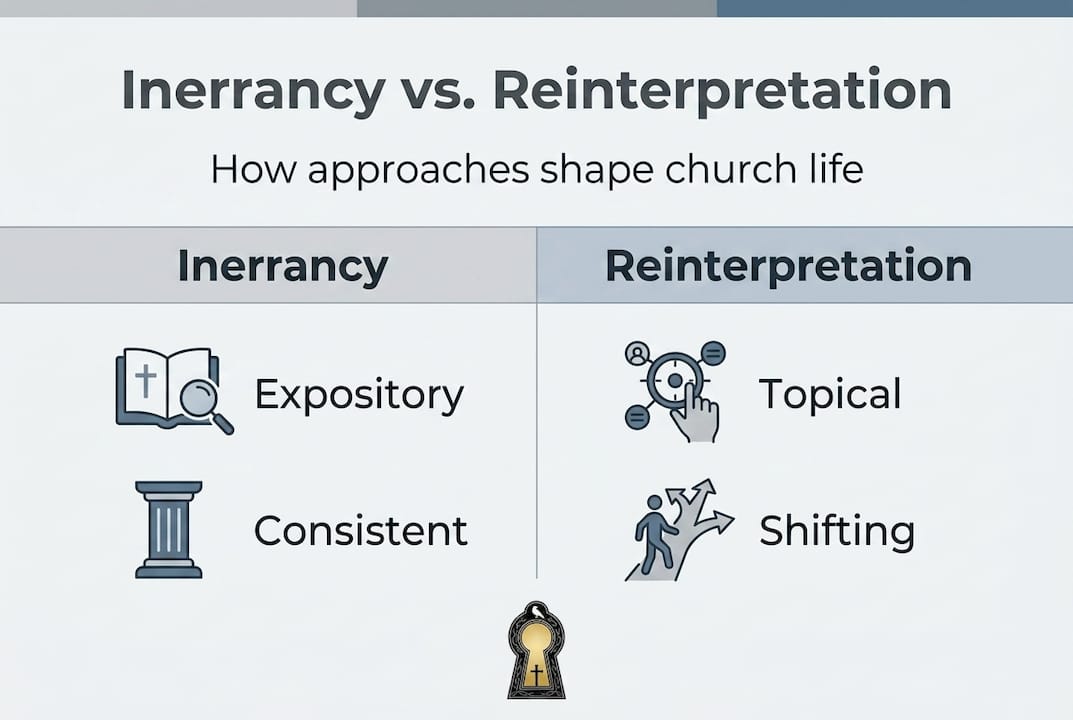
As the Chicago Statement on Biblical Inerrancy establishes, scripture's authority over all of life, including history, science, and doctrine, is what makes it a reliable foundation for missions and outreach. Anything less produces a shifting foundation.
For believers who are just beginning to engage seriously with these questions, starting Bible study in a structured, doctrinally sound way is essential. And for those equipping others, finding trusted resources that reinforce inerrancy rather than erode it is a non-negotiable priority. You might also consider gifting biblically grounded materials: Christian faith gifts can play a meaningful role in extending doctrinal clarity to others in your circle of influence.
Tools and resources for deepening your understanding of biblical truth
Knowledge of biblical truth does not happen passively. It requires intentional pursuit. Faithful believers in every generation have used structured tools and community resources to sharpen their understanding of scripture. Today, those resources are more accessible than ever, and choosing the right ones matters enormously.
The following tools have proven genuinely effective for serious Bible study:
- Essential Bible study checklist: A structured guide that ensures you cover the foundational elements of any passage, context, grammar, cross-references, and doctrinal application
- Bible study guides: In-depth, verse-by-verse resources that walk you through books of the Bible with doctrinal precision and practical commentary
- Biblical publications: Curated reading materials focused on conservative, dispensationalist theology, covering topics from the King James Version to spiritual warfare and prophetic doctrine
- Where to begin Bible study: A starting point for believers who feel overwhelmed by scripture and need a clear, sequential entry point into deep study
Each of these tools reflects a commitment to the same foundation: the inerrancy of scripture means that every word is worth studying carefully, and every passage has something authoritative to teach.
Beyond tools, the practice of study itself must be cultivated. That means setting aside dedicated time each day, not just for reading, but for reflection. It means using a concordance to trace the usage of key words across scripture. It means cross-referencing passages, comparing how the same theme appears in the Old and New Testaments, and letting scripture interpret scripture.
Hermeneutics is the technical term for the science of scriptural interpretation. You do not need a seminary degree to practice good hermeneutics. You need to ask the right questions: What does this passage say? What did it mean to its original audience? What does it teach about God, man, sin, or salvation? How does it apply to my life and community today?
Pro Tip: Add journaling to your Bible study routine. Write out what a passage says in your own words, what it reveals about God's character, and one specific way you will act on it. This practice builds both retention and conviction, two things that no amount of passive reading alone can produce.
Doctrinal clarity is also built through community. Engaging with other believers in structured study, whether in a small group, a discipleship relationship, or an online community committed to biblical orthodoxy, accelerates growth in ways that solitary study cannot fully replicate.
Our perspective: What most guides miss about biblical truth
Most guides on biblical truth stop at information. They explain inerrancy, map out interpretive methods, and recommend study tools. All of that is necessary. But it is not sufficient. Here is what is rarely said plainly: knowing about biblical truth and actually living under its authority are two entirely different things.
There is a category of Christian who can articulate the Chicago Statement on Biblical Inerrancy, explain dispensationalism, and cite Greek lexicons, but whose personal conduct, relational choices, and public witness are virtually indistinguishable from the surrounding culture. That is not biblical truth in action. That is intellectual religion. It is the Pharisee's error applied to a new context.
True biblical truth, genuinely received and applied, transforms. It produces what Hebrews 4:12 describes: the word of God is "quick, and powerful, and sharper than any two-edged sword." That kind of word does not leave you unchanged. It confronts pride, disciplines desire, corrects patterns of thought, and aligns the believer's entire life with God's revealed will.
What most guides also miss is the communal dimension of biblical truth. Scripture was not given solely for private edification. It was given to build up the Body of Christ (Ephesians 4:12-13). That means biblical truth must be contended for publicly, in the church, in the family, and in the broader culture. You cannot privatize your convictions and still fulfill your calling as a disciple.
The biblical truth blog at Dead Hidden regularly addresses this challenge: not just what biblical truth is, but what it demands of you in practice. That is the harder conversation. It is also the more important one.
The most urgent need in conservative evangelical circles today is not more information. It is more conviction. More willingness to say, publicly and consistently, "This is what scripture says, and this is where I stand." That kind of courage is built on a settled confidence in the inerrancy and authority of God's word. Study builds that confidence. Obedience sustains it.
Grow deeper: Ministries and study resources for biblical truth
If what you have read here has stirred a hunger for deeper doctrinal clarity, that hunger is meant to be fed. Biblical truth is not a destination you arrive at and then coast. It is a pursuit that demands daily engagement with scripture, consistent community accountability, and resources that sharpen rather than soften your convictions.
Dead Hidden Ministries provides exactly that kind of resource. The study Bible guide walks you through a structured, doctrinally grounded method for engaging scripture at a level most believers never reach. The teaching on contending for biblical truth equips you to stand firm under doctrinal pressure, not just in theory but in practice. And for those committed to a disciplined annual engagement with scripture, the 2026 Bible reading plan provides a curated, purposeful path through God's word for the year ahead. These are not passive resources. They are tools for serious believers ready to go deeper.
Frequently asked questions
How is biblical truth different from personal opinion?
Biblical truth claims objective validity grounded in the authoritative revelation of God through scripture, whereas personal opinion is subjective and shaped by individual experience, emotion, or cultural values.
Why do conservative evangelicals insist on inerrancy?
They hold that the original manuscripts are completely free from error in all they affirm, which ensures that doctrine, ethics, and church teaching all rest on a reliable, unshifting foundation.
Can biblical truth change with culture?
Conservative doctrine firmly asserts that biblical truth is fixed and unchanging, while progressive perspectives permit reinterpretation as cultural norms shift, a position conservatives regard as a departure from scriptural authority.
What tools help in understanding biblical truth?
Study guides, doctrinal checklists, verse-by-verse commentaries, and biblically grounded publications are the most effective tools for building consistent, accurate scriptural understanding.
How does biblical truth impact church outreach?
It anchors preaching, ethics, and mission strategy in inerrant scriptural standards, ensuring that outreach proclaims a consistent message rather than one shaped by the preferences of the culture being reached.