

You reach for a verse in the middle of prayer, and it slips away. You know it's in Psalms, somewhere, but the exact words won't come. That gap between knowing God's Word exists and having it ready in your heart is where too many believers live. Scripture memorization is not an academic exercise reserved for seminary students. It is a spiritual discipline commanded by God, modeled by Christ, and available to every believer willing to pursue it. This guide maps out biblical, proven methods that make God's Word stick, not just in your mind, but in your heart where it counts.
Table of Contents
- Why memorizing scripture matters
- What you need to get started: tools, time, and mindset
- Step-by-step methods for memorizing scripture
- Staying consistent and measuring your progress
- A biblical perspective on memorization: what truly matters
- Resources for deeper scripture memorization
- Frequently asked questions
Key Takeaways
| Point | Details |
|---|---|
| Biblical foundation | Scripture memorization is rooted in biblical commands and deepens your relationship with God. |
| Start small | One verse at a time, consistent practice, and the right tools build lasting memory. |
| Varied methods | Mix methods like repetition, writing, and teaching others to reinforce recall. |
| Consistency counts | Daily review, accountability, and progress tracking ensure lasting results and spiritual growth. |
Why memorizing scripture matters
Before a single method is introduced, you need to settle why this matters. The motivation must come from the Word itself, or the discipline will not last.
God was clear with Israel in Deuteronomy 6:6-9: "And these words, which I command thee this day, shall be in thine heart: And thou shalt teach them diligently unto thy children, and shalt talk of them when thou sittest in thine house, and when thou walkest by the way, and when thou liest down, and when thou risest up." This was not optional. This was the shape of a life ordered around God's commands.
The psalmist reinforces it personally: "Thy word have I hid in mine heart, that I might not sin against thee" (Psalm 119:11). Notice the purpose stated plainly. The Word hidden in the heart is a defense against sin. Not willpower. Not good intentions. The Word itself.
Consider what scripture memory actually does for you:
- Protects against temptation. When Satan tempted Christ in the wilderness, our Lord answered every assault with "It is written." That was not coincidence. That was preparation.
- Guards against false teaching. A believer saturated in the Word can detect error quickly. Doctrinal drift happens most easily when memory is weak.
- Equips you for ministry and prayer. You cannot counsel, encourage, or intercede effectively if you must guess at the references. Precision matters.
- Deepens your walk with God. Hidden scripture surfaces in quiet moments, in trial, in joy. That is communion with God through His own Word.
"Thy word is a lamp unto my feet, and a light unto my path." (Psalm 119:105)
As one faithful guide puts it, memorizing God's Word builds spiritual strength and helps you resist temptation. This is not motivation built on self-improvement language. It is a biblical reality. The benefits of Bible study are inseparable from the act of hiding that Word in your memory, not just reading it once and moving on. For those who want a deeper understanding of scripture, memorization is the foundation that makes every other study method more productive. The Navigators guide to memorization has served believers for decades precisely because it roots the practice in spiritual purpose first.
What you need to get started: tools, time, and mindset
With biblical motivation clear, the next step is gathering what you need for successful memorization. The right setup removes obstacles before they arise.
Tools that serve your memorization:
- A quality printed King James Bible for hand-referencing and reading aloud
- Verse cards or index cards written by hand, one verse per card
- A scripture memory app for digital review during travel or waiting
- Specialized verse packs organized by topic (temptation, faith, prayer, identity)
- A deep Bible study resource that pairs memorization with doctrinal context
| Tool | Best use | Time required |
|---|---|---|
| Printed Bible | Reading and reading aloud | 10-15 min/day |
| Verse cards | Portable daily review | 5-10 min/day |
| Memory app | Spaced repetition quizzing | 5-10 min/day |
| Verse packs | Topical, focused memorization | Weekly planning |
| Study guides | Doctrinal context and depth | Weekly deep study |
Time and place: Block a consistent slot daily. Morning, before the noise of the day fills your mind, is ideal for most believers. Choose a place without screens or distractions. Consistency of place trains your mind to shift into focused mode. Bible study guides note that environment matters as much as method when it comes to retention.
Mindset: Come to this practice in prayer. Romans 12:2 promises that the mind can be renewed. That renewal is not passive. It requires active, Spirit-dependent engagement with the Word. Trust God to do what He promised. You bring the discipline. He supplies the transformation.

For those ready to commit to memorizing books of the Bible, the same principles apply at a larger scale. Start with one verse. Build from there.
Pro Tip: Start with one short verse that already has personal meaning. Confidence built on one successful memorization fuels the next. Do not begin with a chapter. Begin with a verse.
Step-by-step methods for memorizing scripture
Equipped with the right tools, you are ready to apply the methods that make scripture truly stick. These are not guesses. These are time-tested, biblically consistent practices.
- Select your verse with intention. Do not memorize randomly. Choose a verse connected to a current spiritual need, a topic you are studying, or a passage your pastor is preaching through. Purpose-driven selection produces stronger recall.
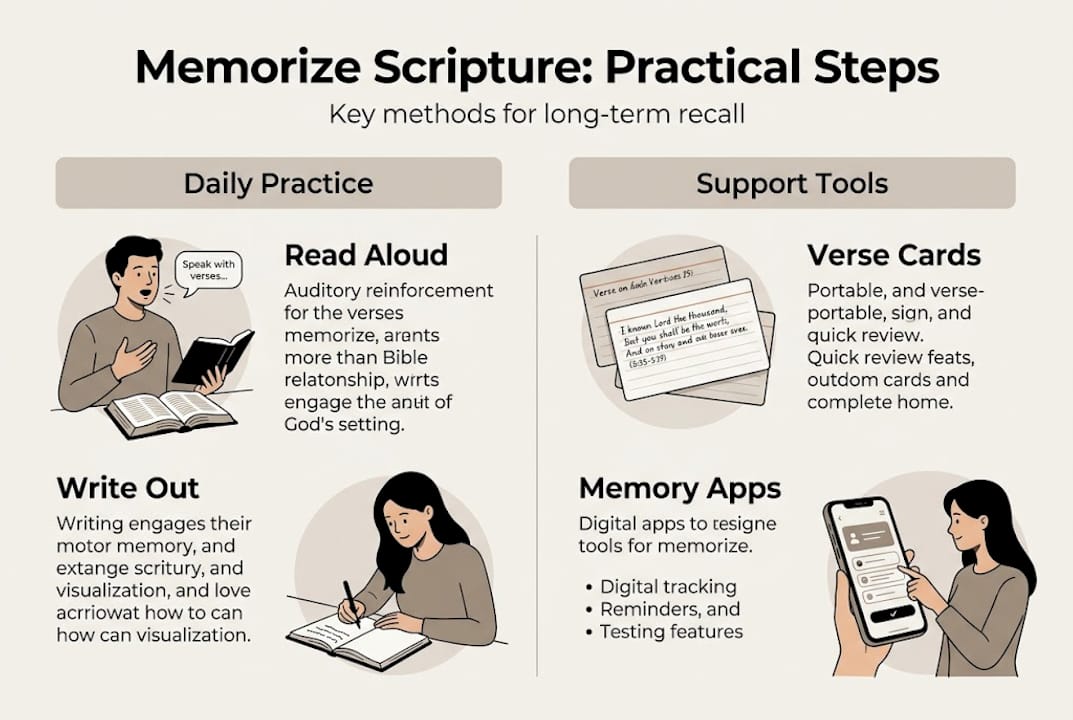
- Read it aloud repeatedly. Speak the reference before and after the verse every time. "Psalm 119:11. Thy word have I hid in mine heart... Psalm 119:11." Your brain encodes spoken language differently than silent reading.
- Write it by hand. Do not type it. Writing by hand creates a physical memory trace that typing bypasses entirely. Write it five to ten times in a session.
- Break it into phrases. Memorize the first phrase until it is automatic, then add the next. Never move forward until each piece is solid.
- Sing or rhythmize it. Musical memory is powerful. If a verse fits a simple tune, use it. Generations of believers have memorized Psalms this way for good reason.
- Teach it to someone. Explaining a verse to another person forces clarity and exposes gaps. This is the strongest test of whether you actually have it.
- Review with spaced repetition. Review new verses daily for one week, then every few days, then weekly. This spacing locks long-term retention in place.
| Method | Time needed | Best learning style | Retention strength |
|---|---|---|---|
| Reading aloud | 5 min | Auditory | Medium |
| Handwriting | 10 min | Kinesthetic | High |
| Singing/rhythm | 5 min | Musical | Very high |
| Teaching others | 15 min | Verbal/social | Very high |
| Spaced repetition | 10 min | Visual/structured | Highest |
As the Navigators resource makes plain, repetition, writing, and speaking aloud are key to memory retention. Combine them for maximum effect. Your study checklist can integrate memorization as a standing item, keeping it from being crowded out by other disciplines. Pair this with a structured reading protocol for a full approach to Word saturation. For additional techniques, 11 easy memorization methods offers practical variety.
Pro Tip: Rotate through writing, speaking, and singing across different sessions. What feels awkward at first often becomes the method that sticks best for you. Give each a fair trial before deciding.
Staying consistent and measuring your progress
Learning methods is key, but real transformation comes through consistent practice and monitoring your progress. Without a system, even the best intentions fade.
Practical tracking tools:
- A verse log notebook: date learned, verse reference, and date last reviewed
- A memory app with built-in spaced repetition and progress stats
- An accountability partner who quizzes you weekly on assigned verses
- A monthly milestone list where you record completed passages
Accountability is not optional for most believers. Accountability and review are essential to long-term retention, and a partner who shares this commitment changes the dynamic entirely. Community review transforms a private discipline into a shared pursuit of doctrinal clarity.
Studies show that regular review boosts memory retention by up to 80 percent. That is not a trivial gain. That is the difference between a verse recalled in crisis and a verse that slips away precisely when you need it most.
Use these checkpoint questions regularly to measure real growth:
- Can I recite this verse accurately without looking, including the reference?
- Have I applied this verse to a real situation this week?
- Am I reviewing old verses as I add new ones, or only moving forward?
- Has this verse changed how I responded to a trial or temptation?
- Can I explain the doctrinal context of this verse to another believer?
Celebrate genuine milestones. When you can recite a full chapter from memory, mark it. When a memorized verse comes to mind unbidden during prayer, record it. These are not small victories. These are the fruit of discipline honored by God. A structured 2026 Bible reading plan can serve as the backbone that keeps your memorization anchored to a larger encounter with the full counsel of God.
Pro Tip: Form or join a small group committed to scripture memory. Even two believers reviewing together weekly creates the accountability structure that keeps most people from quitting after the first month.
A biblical perspective on memorization: what truly matters
After the practical steps and tracking systems, step back. Ask the harder question. Why are you doing this?
Some believers pursue scripture memory the way others pursue trophies: for the appearance of deep spirituality, for recognition in a class or community, for the sense of accomplishment. Paul was direct about the limit of that motivation. First Corinthians 13:2 warns that even mountain-moving faith without love profits nothing. Knowledge without transformation is hollow.
True scripture memorization is not a performance. It is a war. The Word hidden in your heart is your weapon in spiritual combat, your compass in moral confusion, your comfort in grief. When a memorized verse rises in your spirit during a moment of temptation and you actually obey it, that is the point. Not the recitation. The obedience.
We have seen believers who can quote chapters yet whose character shows no mark of those chapters. That is a warning, not a model. Guard against the idol of comfort that makes memorization a devotional hobby rather than a discipline of war. Seek the Spirit's application. The goal is a life shaped by the Word, not merely a mind stocked with it.
Resources for deeper scripture memorization
For those who want to move beyond good intentions and into a structured, biblically grounded memorization practice, Dead Hidden has built resources specifically for this purpose.
Start with how to study the Bible, a field-tested guide that pairs doctrinal depth with practical memorization methods. Men who want to pursue scriptural strength with intentionality will find the biblical man field manual a direct and demanding tool. Women committed to biblical womanhood and spiritual growth will find equal depth in the biblical woman field manual. These are not devotional booklets. They are training resources for believers serious about carrying God's Word into every arena of life.
Frequently asked questions
What is the best method for memorizing Bible verses quickly?
The best method uses repetition: reading, writing, and speaking a verse out loud daily until recall is effortless. Combining all three approaches accelerates retention faster than any single method alone, as key memory techniques consistently confirm.
How much time should I spend daily on scripture memorization?
Just 10 to 15 focused minutes each day can lead to strong results if practiced consistently. Small daily investment in memorization, kept up over months, produces more lasting fruit than occasional long sessions.
Why is it hard to remember Bible verses long-term?
Lack of review and failure to connect verses to real-life situations are the primary causes of forgetting. Regular review boosts retention by up to 80 percent, making scheduled review non-negotiable for long-term recall.
Are there any tools or apps that make memorizing scripture easier?
Yes. Bible memory apps and structured verse packs help organize, track, and quiz you on verses for better retention. The right scripture memorization resources empower consistent daily practice without requiring elaborate systems.
Does memorizing scripture really make a difference in spiritual growth?
Absolutely. Scripture memory strengthens faith, equips for victory over temptation, and deepens your walk with God in tangible, measurable ways. Memorizing God's Word builds the kind of spiritual strength that shows up when it counts most, in trial, in ministry, and in the secret moments no one else sees.
Recommended
- How to Study the Bible in the KJV: A Step-by-Step Method That Actually Works | Dead Hidden | Dead Hidden Ministries
- Essential Bible study checklist: steps for deeper understanding
- How Scripture Strengthens and Guides Christian Marriage
- How to study the Bible for doctrinal clarity: 5 steps
- Living Like I Know God