

Many Christian couples enter marriage with sincere faith but genuine confusion about what God actually requires of them within the covenant. The roles of husband and wife, the meaning of submission, the call to headship — these truths are buried under decades of cultural compromise and pulpit silence. Scripture, however, is not silent. From Genesis to Ephesians, God mapped out a clear, purposeful design for marriage. This guide walks you through that design step by step, grounded in literal biblical interpretation and built for believers who are serious about obedience.
Table of Contents
- What you need to understand before applying biblical marriage principles
- Step-by-step: How to build a biblical marriage in your home
- Common mistakes to avoid and how to address challenges
- How to verify and sustain a truly biblical marriage
- A deeper look: Why biblical marriage is misunderstood — and how to reclaim God's original design
- Go further with Dead Hidden Ministries' biblical marriage resources
- Frequently asked questions
Key Takeaways
| Point | Details |
|---|---|
| Marriage is a covenant | Biblical marriage means a lifelong, God-established union with spiritual significance. |
| Distinct but equal roles | Scripture calls husbands to lead and love while wives respectfully support and partner. |
| Scriptural authority matters | Following biblical marriage roles begins with submitting to the authority of God’s word above cultural trends. |
| Growth requires accountability | Continual prayer, study, and honest evaluation are essential to staying faithful in marriage. |
What you need to understand before applying biblical marriage principles
Before any practical steps can take root, a foundational truth must be settled in your heart: marriage is not your arrangement to define. It belongs to God. He instituted it. He governs it. And He has revealed its structure in His word.
The covenant nature of marriage is the starting point. A covenant is not merely a legal agreement or an emotional commitment. It is a binding, solemn oath made before a holy God. When two believers enter marriage, they enter a spiritual covenant that mirrors the relationship between Christ and His church (Ephesians 5:32). That framework changes everything about how roles are understood.
"Biblical marriage is a covenant established by God, not simply a human agreement."
This means that the roles within marriage are not cultural assignments subject to revision. They carry spiritual weight. When a husband leads or fails to lead, something eternal is at stake. When a wife submits or refuses to submit, she is either honoring or resisting a divine order.
Key biblical texts on marriage roles
| Scripture | Key principle | Who it addresses |
|---|---|---|
| Genesis 2:18, 24 | Marriage established; wife as helpmeet | Both husband and wife |
| Ephesians 5:22-33 | Headship and submission modeled on Christ and church | Husband and wife |
| Colossians 3:18-19 | Wives submit; husbands love and be not bitter | Both spouses |
| 1 Peter 3:1-7 | Wife's conduct; husband honoring wife as weaker vessel | Both spouses |
| 1 Corinthians 11:3 | Headship order: God, Christ, man, woman | Both spouses |
Before the how-to steps will bear fruit in your home, you need two prerequisites firmly in place:
- Commitment to scriptural authority. You must accept the Bible as the final word, not as one opinion among many. This means Ephesians 5 is not optional or culturally outdated.
- A genuine desire for obedience. Information without obedience produces pride, not transformation. The goal is a God-honoring marriage, not a well-informed argument.
These are not minor details. Without them, you are building on sand.
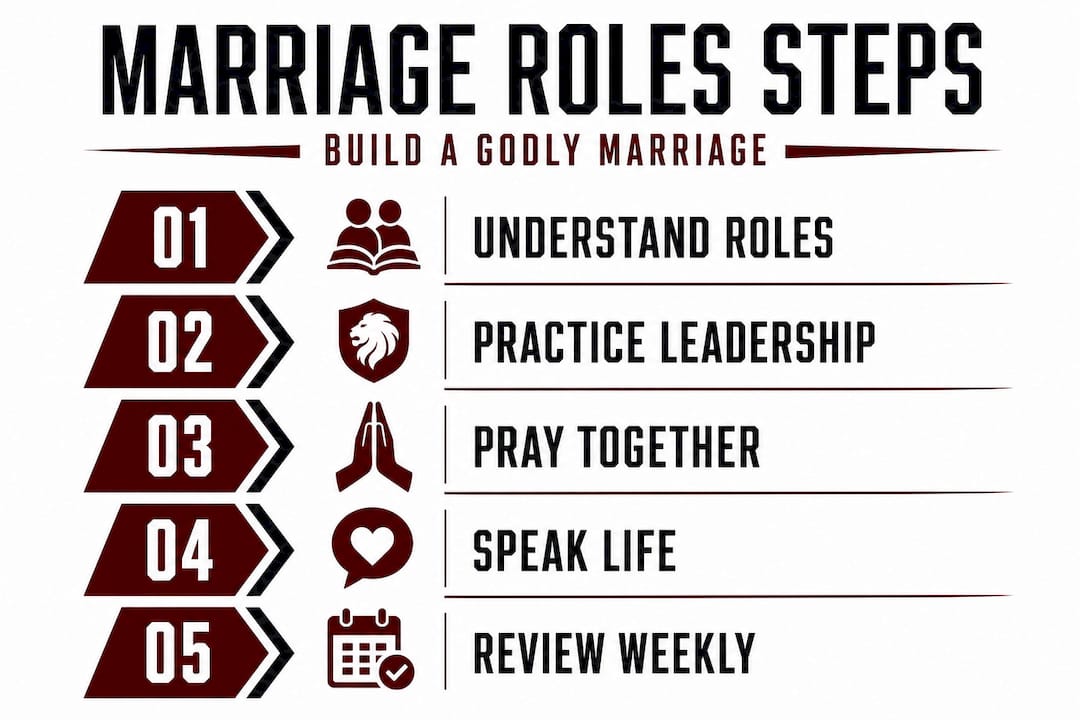
Step-by-step: How to build a biblical marriage in your home
With those foundations secured, you can now move into practical application. This is where many believers get stuck. They affirm the theology but have no roadmap for daily life. Here is a clear process rooted in literal scripture.
Step 1: Understand the husband's calling with precision.
Headship in marriage is not about domination. It is not a license for harshness or self-serving authority. Ephesians 5:25 commands husbands to love their wives "as Christ also loved the church, and gave himself for it." This is sacrificial, servant-oriented leadership. A husband provides for his household (1 Timothy 5:8), protects it spiritually and physically, initiates prayer, leads in worship, and models repentance when he fails.

Step 2: Understand the wife's calling with equal precision.
Ephesians 5:22 calls wives to submit to their husbands "as unto the Lord." Submission here is a voluntary, Spirit-led posture, not a forced compliance. The Proverbs 31 woman is industrious, wise, and deeply respected. Her submission does not diminish her. It establishes divine order that allows the household to flourish. She is a helpmeet, which in Genesis 2:18 carries the same Hebrew word used to describe God's help toward Israel. That is not a lesser calling.
Step 3: Establish spiritual leadership practices in your daily routine.
| Practice | Husband's role | Wife's role |
|---|---|---|
| Daily prayer together | Initiates and leads | Participates and agrees |
| Bible reading as a family | Teaches and explains | Receives, adds insight |
| Financial stewardship | Oversees decisions | Manages home economy |
| Conflict resolution | Pursues reconciliation first | Respectfully communicates |
| Child discipline | Sets standards and enforces | Reinforces and supports |
Step 4: Speak life over your roles, not resentment.
How you talk about your role in your home shapes how you live it. If a husband speaks about leadership with reluctance or embarrassment, he will lead poorly. If a wife speaks about submission with contempt or irony, she will resist it even when she intends to comply. The language of your home carries spiritual authority. Proverbs 18:21 declares that "death and life are in the power of the tongue." Align your words with your convictions.
Step 5: Review and recalibrate weekly.
Review the roles and foundations for godly homes regularly against scripture. A short weekly check-in between spouses, asking honest questions about how each is fulfilling their God-given role, creates accountability and tenderness. It is not an interrogation. It is a covenant conversation.
Pro Tip: Commit to reading one chapter of Proverbs together weekly. Proverbs 31 is not just for wives. Proverbs 5 is not just for husbands. The entire book builds wisdom for both.
Common mistakes to avoid and how to address challenges
Even couples who genuinely desire a biblical marriage will stumble. That is not failure. Persistent stumbling without correction is the problem. Here are the most common errors and how to address them squarely.
Legalism disguised as biblical leadership
Some husbands take the doctrine of headship and weaponize it. They demand compliance without offering love. They cite Ephesians 5:22 and skip Ephesians 5:25. That is selective reading, and it violates the whole counsel of God. True headship costs the husband something. It requires self-denial. A man who leads his wife through sacrifice earns her trust. A man who demands submission through force earns her fear, not her respect.
Equating submission with inferiority
This is one of the most damaging misreadings in contemporary Christianity. Misinterpreting submission and headship creates discord rather than harmony when biblical teaching is ignored or twisted. The Father, Son, and Holy Spirit operate in functional roles without any member of the Trinity being inferior in nature. The Son submits to the Father (1 Corinthians 11:3), yet they are co-equal. So too, a wife's submission is functional, not ontological. She is not less valuable. She is not less intelligent. She is filling a different role in the same covenant.
"There is neither Jew nor Greek, there is neither bond nor free, there is neither male nor female: for ye are all one in Christ Jesus." (Galatians 3:28) This verse speaks to spiritual standing before God, not the abolition of roles within marriage.
Prioritizing individuality over marital unity
Modern culture worships personal autonomy. Marriage requires its surrender. When two become one (Genesis 2:24), the decisions, priorities, and directions of that household are now shared. A husband who pursues his own ambitions without considering his wife is not leading. A wife who resents any shared accountability is not submitting. The purpose of marriage in Christianity is fundamentally about a unified witness before God and the world.
What if your spouse resists biblical roles?
This is a real and painful challenge. The answer is not coercion or ultimatum. Scripture addresses this directly. 1 Peter 3:1 instructs wives with unbelieving or resistant husbands to win them "without the word," meaning through godly conduct and reverent behavior. For a husband whose wife resists his leadership, the call is to love her more, not demand more. Consider sanctification in marriage as God's sovereign tool to grow both of you, even through resistance.
- Never use scripture as a weapon to demand compliance
- Pray specifically for your spouse's heart, not just their behavior
- Seek accountability from a godly, biblically literate mentor
- Model the role you are asking your spouse to accept
Pro Tip: Personal obedience to your own role, regardless of your spouse's compliance, is where transformation begins. God sees faithfulness to His design even when your household has not fully aligned yet.
How to verify and sustain a truly biblical marriage
Practical steps and initial correction are valuable. But a biblical marriage is not a project you complete. It is a covenant you steward for a lifetime. Ongoing engagement with the word of God and prayer is essential for nurturing and correcting Christian marriages, as guiding your marriage with Scripture demonstrates over time.
Measurable markers of a maturing biblical marriage
| Area | Healthy sign | Warning sign |
|---|---|---|
| Spiritual unity | Praying together regularly | Prayer is absent or one-sided |
| Role clarity | Each spouse knows their calling | Roles are contested or ignored |
| Conflict pattern | Resolved through forgiveness | Ongoing bitterness and unresolved wounds |
| Parenting alignment | United discipline and values | Children playing parents against each other |
| Mutual growth | Both growing in faith | One or both spiritually stagnant |
Steps for long-term sustaining
- Establish a marital covenant statement. Write out, together, what you believe God calls your marriage to be. Revisit it annually.
- Engage in consistent, structured Bible study. Not occasional reading, but deliberate study. Spiritual leadership in marriage demands that a husband know the word well enough to teach and apply it.
- Pursue outside accountability. A trusted pastor, elder, or mature couple who know the word and know you can help identify blind spots early.
- Evaluate the fruit. Jesus said you will know a tree by its fruit (Matthew 7:16). What is the fruit of your marriage? Godly children, increasing unity, mutual respect, and growing faith are signs that your covenant is functioning as God designed.
- Return to the word without shame when you fail. A biblical marriage is not a perfect one. It is a repentant one. The couples who endure and bear fruit are those who return quickly to the word of God when they drift.
A deeper look: Why biblical marriage is misunderstood — and how to reclaim God's original design
Here is the uncomfortable truth most Christian articles will not say plainly: the church has largely handed marriage over to the culture and dressed it up with scripture afterward. It has adopted the world's definitions of equality, autonomy, and compatibility and then searched for proof texts to justify them.
This is backwards. Entirely backwards.
The word of God does not flex to accommodate cultural comfort. It stands as the immovable standard. And what we are seeing in the body of Christ today, rising divorce rates, confused gender roles, hollow marriages sustained only by legal obligation, is the fruit of a generation that stopped taking biblical marriage seriously.
Modern pressures tempt believers to compromise, but scripture remains the standard for marriage, regardless of which direction the culture moves. The enemy hates covenant marriage specifically because it is a living picture of Christ and the church. Every marriage that reflects Ephesians 5 is a testimony. Every marriage that abandons God's design is a victory for the adversary.
Reclaiming God's original design is not about nostalgia. It is about obedience. It requires you to read Ephesians 5 and believe it without apology. It requires husbands to step into the weight of loving leadership and wives to embrace the dignity of Spirit-led submission. It demands that both spouses value the covenant above their own comfort. True transformation in marriage does not start with a seminar or a worksheet. It starts with your knees on the floor and your Bible open.
Do not let the fear of being called old-fashioned silence your obedience to God. The spiritual warfare in marriage is real, and the greatest weapon against it is a household fully committed to what the word says.
Go further with Dead Hidden Ministries' biblical marriage resources
You have walked through the theology and the practical steps. Now the question is: what equips you to stay the course?

Dead Hidden Ministries offers precisely the kind of doctrinally serious resources your marriage needs to grow. Whether you want to understand biblical femininity in greater depth, or you are ready to study the Bible deeply with structured guides and verse-by-verse manuals, the platform is built for believers who refuse to settle for shallow teaching. Every resource is built on a literal, conservative interpretation of scripture. Head over to Dead Hidden Ministries and start equipping your household with the doctrinal clarity your marriage deserves.
Frequently asked questions
What is the biblical definition of marriage?
Marriage is a covenant, not just a legal contract, instituted by God between one man and one woman for lifelong unity, partnership, and spiritual witness.
What are the roles of husband and wife according to the Bible?
Husbands are called to practice headship with love, providing sacrificial leadership; wives are called to respectful submission and active partnership within the covenant.
How can Christian couples resolve conflict according to the Bible?
Christian couples resolve conflict by applying forgiveness, humility, and mutual accountability; scripture provides guidance for both correction and encouragement to restore unity.
Is mutual submission biblical in marriage?
Yes, Ephesians 5:21 calls all believers to submit to one another in the fear of God, and mutual submission aligns with scriptural teaching when the distinct role differences of husband and wife are still honored alongside it.