

Every serious Bible believer has faced that moment: you open the Word, read a passage, and feel the weight of uncertainty pressing down. Two teachers say opposite things. A passage seems to contradict another. A doctrine you've held for years suddenly feels shaky. This is not weakness. This is the reality of engaging a text of supreme authority, written across millennia, in multiple genres, by human authors moved by the Holy Spirit. The stakes are high. Misread scripture and you risk building your life, your doctrine, and your ministry on a cracked foundation. This guide gives you a clear, faithful method to interpret scripture with precision and confidence.
Table of Contents
- Key principles for faithful interpretation
- Essential tools and guidelines before you begin
- Step-by-step: How to interpret scripture for doctrinal clarity
- How to handle edge cases and common pitfalls
- Testing and verifying your interpretation
- The real challenge: Why simple rules aren't enough
- Go deeper: Resources for serious Bible students
- Frequently asked questions
Key Takeaways
| Point | Details |
|---|---|
| Honor authorial intent | Seek the plain meaning of the text based on its original context and literary genre. |
| Use reliable tools | Equip your study with sound resources, parallel passages, and prayerful reliance on the Holy Spirit. |
| Apply a clear process | Follow a consistent step-by-step method for interpreting any Bible passage accurately. |
| Stay humble and accountable | Test every interpretation against the whole of Scripture and with trusted teachers. |
Key principles for faithful interpretation
Sound interpretation does not begin with a technique. It begins with a conviction. You must believe that scripture is inerrant, meaning without error in its original manuscripts, and that it carries divine authority over every area of doctrine and life. Without that conviction, even the best method becomes negotiable.
The evangelical literal method prioritizes authorial intent and inerrancy, contrasting sharply with historical-critical and allegorical approaches. This is not naive reading. It is disciplined reading. It asks: what did the human author mean to communicate, under the direction of the Holy Spirit, to his original audience?
Here is how these three major methods differ:
| Method | Core Assumption | Authority Source | Risk |
|---|---|---|---|
| Literal/grammatical | Text means what it plainly says | Scripture itself | None when applied correctly |
| Allegorical | Text has hidden spiritual layers | Interpreter's insight | Reads meaning INTO the text |
| Historical-critical | Text reflects its cultural moment | Academic scholarship | Undermines inerrancy |
For conservative evangelicals, the choice is clear. The literal method is not one option among equals. It is the only method that honors both the human and divine authorship of scripture. It preserves the biblical truth foundation upon which all doctrine rests.
Key convictions to hold before you begin:
- Scripture is inerrant: It does not contradict itself when rightly interpreted.
- Scripture is sufficient: It provides everything needed for faith and godly living (2 Timothy 3:16-17).
- Scripture interprets scripture: Unclear passages yield to clear ones.
- Context is king: No verse stands alone; every word belongs to a sentence, every sentence to a paragraph, every paragraph to a book, every book to the whole canon.
These are not preferences. They are the load-bearing walls of faithful interpretation.
Essential tools and guidelines before you begin
Method alone will not carry you. You need the right tools and the right posture. A prideful reader with the best study Bible in hand will still miss the point. A humble reader with a single-column KJV and a prayerful heart will often grasp what scholars overlook.
Genre awareness, parallel passages, and assuming harmony in scripture are foundational practices before you ever examine a single verse. You must know what kind of literature you are reading before you decide what it means.
Here are the essential tools every serious student needs:
| Tool | Purpose | Recommended Use |
|---|---|---|
| Study Bible (KJV preferred) | Cross-references, notes, introductions | Daily reading and study |
| Strong's Concordance | Word-level research in original languages | Doctrinal studies and word studies |
| Trusted commentaries | Historical and theological context | Cross-checking your conclusions |
| Scripture journal | Recording insights, themes, questions | Building a personal doctrinal record |
| Parallel Bible | Comparing translations for word choices | Clarifying ambiguous passages |
Beyond tools, your mental and spiritual readiness matters enormously:
- Pray before you open the Word. This is not ritual. It is recognition that the Holy Spirit is the ultimate Teacher (John 16:13). Approach scripture as a student before God, not an analyst before a document.
- Come with patience. Deep passages do not yield quickly. Some truths require months of sitting with a text.
- Bring teachability. If you are reading to confirm what you already believe rather than to discover what God has said, you will find confirmation of yourself, not revelation from God.
- Use Bible study accuracy tips to sharpen your process from the very start.
Pro Tip: Before beginning any serious passage study, write down your initial reading of the text and your existing assumptions about what it means. Then work through your method. At the end, compare. This practice reveals where your presuppositions are leading you rather than the text itself.
Step-by-step: How to interpret scripture for doctrinal clarity
You have your principles and your tools. Now apply them. Here is a repeatable process that works for any passage, whether it is a historical narrative, a psalm, a prophetic vision, or a New Testament epistle.
Step 1: Read the passage carefully in full context. Do not start at the verse. Start at least one chapter earlier. Read through several chapters past it. Understand the flow of the book. Ask: what is the author doing at this point in his argument or narrative?
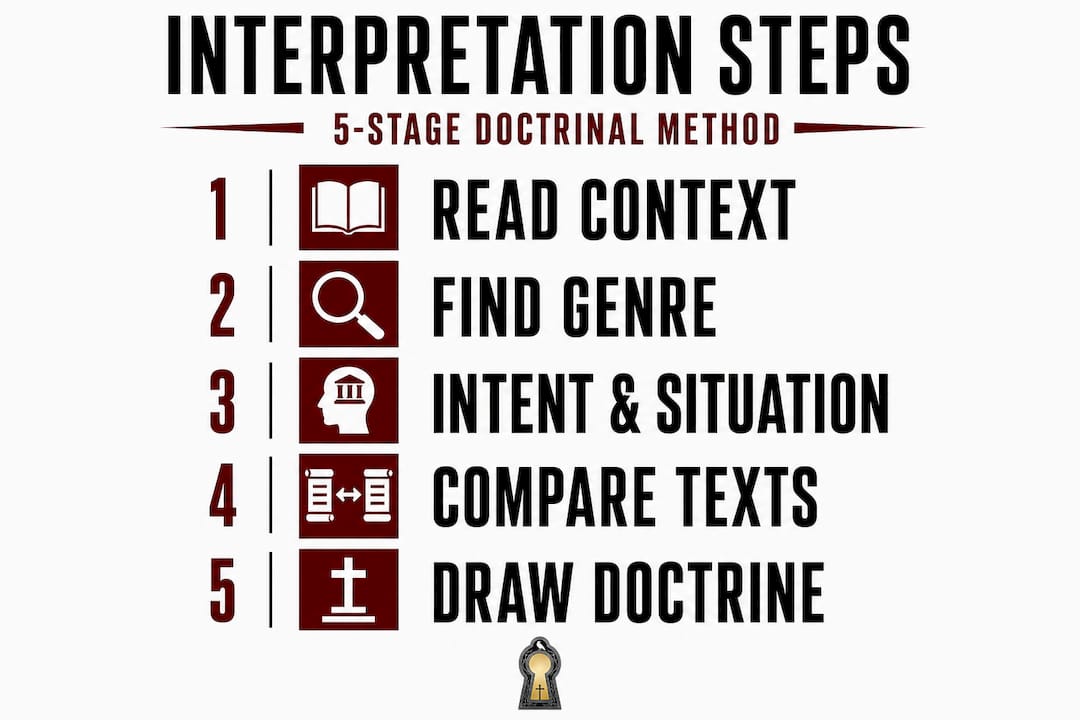
Step 2: Identify the literary genre. This is non-negotiable. Narratives focus on the theological point, not every detail as a normative command. Poetry uses figurative language by design. Prophecy contains symbolic imagery that must be interpreted by other prophetic passages and literal anchors. Epistles carry direct doctrinal instruction.
Step 3: Examine authorial intent and original context. Who wrote this? To whom? When? What was the immediate situation? Paul's letter to the Galatians addresses a specific crisis of Judaizers corrupting the gospel. Knowing that sharpens every verse. The discernment of scriptural truth depends on this kind of precise contextualization.

Step 4: Compare with clear passages and parallel texts. Never build a doctrine on a single, isolated verse, especially an obscure one. Scripture has a center of gravity: the clear passages weigh more than the ambiguous ones. Use your concordance to find parallel texts and let them illuminate each other.
Step 5: Draw doctrinal conclusions faithfully. At this point, you synthesize. What does this passage teach? How does it contribute to the larger body of biblical doctrine? Does it confirm, nuance, or expand what other passages teach? This is where studying the Bible for doctrinal clarity becomes genuinely transformative.
Pro Tip: Keep a dedicated scripture journal where you record recurring themes, doctrinal patterns, and unresolved questions. Over months and years, this journal becomes a personal theological notebook that traces your growth in understanding and identifies areas that still need work.
The five steps above are not a rigid algorithm. They are a discipline. Applied consistently, they transform scattered Bible reading into systematic, doctrinally grounded understanding.
How to handle edge cases and common pitfalls
The process described above handles most passages cleanly. But some passages resist easy interpretation. Edge cases like poetry, prophecy, narratives, and apparent contradictions require genre awareness and the firm assumption that scripture is ultimately harmonious.
Here is how the major edge case genres behave:
| Genre | Interpretive Challenge | Approach |
|---|---|---|
| Poetry (Psalms, Song of Solomon) | Rich figurative language can be taken too literally or too loosely | Identify the emotional/theological core; do not build doctrine on figures of speech |
| Prophecy (Daniel, Revelation) | Symbolic imagery; dual fulfillments; sequence debates | Anchor symbols in other prophetic scriptures; maintain a literal default where context permits |
| Narrative (Acts, Kings) | Descriptive vs. prescriptive confusion | Ask: does the rest of scripture command this pattern, or merely describe it? |
| Epistles with hard sayings | Cultural arguments vs. timeless commands | Determine if the command rests on creation order (timeless) or cultural circumstance (situational) |
"The Bible is not a flat text where every verse carries equal interpretive weight. Context, genre, and canonical position shape the meaning. To read every line as the same kind of statement is not reverence; it is confusion."
Mistakes that derail otherwise careful readers:
- Over-allegorizing: Taking a passage that is plainly historical and turning it into a spiritual symbol with no textual warrant. The Exodus is history, not just a metaphor for personal liberation.
- Ignoring context: Pulling a verse out of its literary and historical setting to make it say something the author never intended.
- Building doctrine from obscure or disputed passages. Always build doctrine on the clear passages and let the obscure ones be illuminated by them.
- Treating narrative as normative. Not everything described in scripture is prescribed for all believers in all times.
- Refusing harmonization. When two passages seem to contradict, the faithful response is to seek the harmony, not to declare a contradiction. Check the overlooked Bible truths that surface once you apply proper harmonization.
Handling these pitfalls takes practice. It also takes honest self-awareness about where your presuppositions are driving your reading.
Testing and verifying your interpretation
A responsible interpreter does not stop at reaching a conclusion. You test that conclusion. You subject it to scrutiny. This is not doubt. This is faithfulness.
Scripture should be interpreted in harmony, not in contradiction. Any interpretation that puts one passage at war with another must be re-examined. Here is a practical testing table you can apply to any conclusion you reach:
| Test Question | Pass | Fail |
|---|---|---|
| Does it agree with clear parallel passages? | Confirmed by other texts | Contradicts or ignores parallels |
| Does it align with core doctrines of the faith? | Consistent with orthodoxy | Undermines atonement, resurrection, inerrancy |
| Does it survive historical scrutiny? | Consistent with ancient, orthodox interpretation | Novel with no historical support |
| Does it bear fruit in accountability? | Trusted teachers affirm the direction | Rejected by faithful, knowledgeable believers |
| Does it honor the full counsel of God? | Balanced across the canon | Cherry-picked from limited texts |
Verification requires community. You were not designed to interpret scripture in isolation. Faithful pastors, trusted commentaries, and historical creeds such as the Apostles' Creed and the Nicene Creed represent centuries of tested doctrinal reflection. They are not infallible, but they are a powerful check against novelty and error.
The transformative benefits of Bible study are only realized when interpretation is accurate. Bad interpretation does not produce spiritual growth; it produces confusion, division, or worse, doctrinal corruption. Test your conclusions rigorously.
The real challenge: Why simple rules aren't enough
Here is something most guides on Bible interpretation will not tell you plainly. The method is necessary. It is not sufficient. You can master every step in this article and still arrive at a wrong or distorted interpretation. Why? Because interpretation is not merely an intellectual exercise. It is a spiritual act.
Pride is the greatest enemy of accurate interpretation. The man who approaches scripture to prove himself right rather than to discover what God has said will find exactly what he is looking for. Confirmation bias is not just a psychological problem; it is a spiritual one. It was, after all, the Pharisees who could quote scripture expertly and still miss the Son of God standing before them.
Echo chambers are a related danger. When every teacher you listen to, every community you belong to, and every resource you consult confirms only what you already believe, you have insulated yourself from correction. Faithful interpretation requires exposure to challenge, not for the sake of doubt, but for the sake of refinement.
Learning scripture is genuinely lifelong. It requires ongoing correction, even painful correction. The man who says he has nothing left to learn from the Word has, in that very statement, revealed how little he understands it. The depth of the canon is inexhaustible. Every year of serious study should humble you more, not less.
The answer is not to distrust your method. It is to hold your conclusions with humility and to maintain constant, prayerful dependence on the God who authored the text. Read more on establishing clarity on biblical truth from a foundation of genuine humility and doctrinal accountability.
None of this diminishes the necessity of careful method. It simply insists that method is a servant, not a savior. The Spirit of God and a humble heart remain indispensable.
Go deeper: Resources for serious Bible students
You have just walked through a complete framework for interpreting scripture with doctrinal precision. That is a strong beginning. But beginning is not finishing. Depth comes through consistent practice, access to excellent resources, and accountable community.
At Dead Hidden, we have built a growing library of verse-by-verse studies, downloadable guides, and doctrinal manuals built specifically for believers who refuse to settle for shallow Bible reading. Our resources cover Bible study methods, dispensational theology, spiritual warfare, prophetic interpretation, and much more. Whether you need a structured study on a specific book of the Bible or a doctrinal defense of the King James Version, we have tools designed to move you forward. Visit deadhidden.org and explore the materials that serious Bible students are using to sharpen their understanding and stand firm in an age of doctrinal confusion.
Frequently asked questions
What does it mean to interpret scripture literally?
It means understanding the text by seeking the plain authorial intent, unless the context clearly signals metaphor or symbolism. The evangelical literal method prioritizes authorial intent and inerrancy as the foundation for sound doctrine.
How should I approach difficult or confusing Bible passages?
Identify the genre, compare parallel passages, and assume harmony in scripture when seeking understanding. Edge cases are handled through genre awareness and the consistent assumption that scripture does not ultimately contradict itself.
What's the difference between literal and allegorical Bible interpretation?
Literal means following the plain, original meaning tied to the author's intent; allegorical seeks hidden, symbolic layers beyond the initial context. The allegorical method seeks multiple senses while the literal method holds the text accountable to its original, plainly stated meaning.
How do I test if my interpretation is sound?
Check if it agrees with parallel passages and core doctrines, and seek input from faithful teachers and historical creeds. Scripture should be interpreted in harmony, and any conclusion that creates irresolvable contradiction with other clear texts must be re-examined.