

Many Christians feel their faith waver. The pressure is real: a culture that ridicules the Word of God, spiritual attacks that come without warning, and a church landscape often more concerned with comfort than doctrine. You know something deeper is required. Not a motivational formula or a self-help routine, but a genuinely biblical approach that builds your trust in God on ground that cannot be shaken. This guide maps out four core steps: laying the right foundation, building daily disciplines, engaging in spiritual warfare, and measuring genuine growth. Follow these steps with the scriptures open before you.
Table of Contents
- Lay the foundation: Understanding true faith
- Daily habits that grow faith
- Engage in spiritual warfare
- Verify growth and avoid common pitfalls
- A fresh perspective: The overlooked power of weakness in faith
- Tools and resources to strengthen your faith journey
- Frequently asked questions
Key Takeaways
| Point | Details |
|---|---|
| Build faith daily | Daily habits like prayer, Bible reading, and fellowship are vital for real growth. |
| Fight spiritual battles | Recognizing and preparing for spiritual warfare protects and strengthens true faith. |
| Check your progress | Assess your spiritual growth regularly and correct common pitfalls. |
| Embrace Christ’s strength | True faith grows strongest in moments of weakness when you depend on God’s grace. |
Lay the foundation: Understanding true faith
Biblical faith is not a feeling. It is not the optimism you manufacture when circumstances look favorable. Hebrews 11:1 defines it with precision: "Now faith is the substance of things hoped for, the evidence of things not seen." Notice those words carefully. Substance. Evidence. These are not emotional categories. Faith, as the scripture defines it, is a conviction grounded in the character, promises, and works of the living God.
One of the most damaging misconceptions circulating in modern Christianity is the idea that faith is "blind belief," a leap into the dark with no rational footing. That idea belongs to secular philosophy, not scripture. Biblical faith is trust rooted in evidence: the evidence of creation (Romans 1:20), the evidence of fulfilled prophecy, the evidence of the resurrection. When you trust a person because you know their track record and their character, that is not blind belief. That is informed, reasoned confidence. That is the model of biblical faith.
Cultural Christianity distorts this further. It reduces faith to church attendance, moral living, or a vague spiritual feeling. But none of those things are faith in the scriptural sense. Faith is directed toward a specific object: the Lord Jesus Christ and His finished work. Doctrine, therefore, is not optional. It is the framework that tells you who you are trusting and why. Without sound doctrine, faith becomes directionless emotion.
"A faith-strengthening approach includes daily time in prayer and God's Word and surrounding oneself with other believers to maintain faithfulness and growth."
The benefits of Bible study extend far beyond personal comfort: they sharpen your doctrinal clarity and reinforce the very foundation of your faith. If you want to unlock deeper scripture understanding, you must treat the Word not as a devotional supplement but as the primary authority over your mind, your doctrine, and your daily walk.
| Scripture | Core doctrine reinforced |
|---|---|
| Hebrews 11:1 | Faith as substance and evidence, not feeling |
| Romans 10:17 | Faith comes by hearing the Word of God |
| James 2:17 | Faith without works is dead |
| 2 Timothy 3:16-17 | Scripture as the complete, sufficient guide |
| John 20:31 | Belief grounded in the works and identity of Christ |
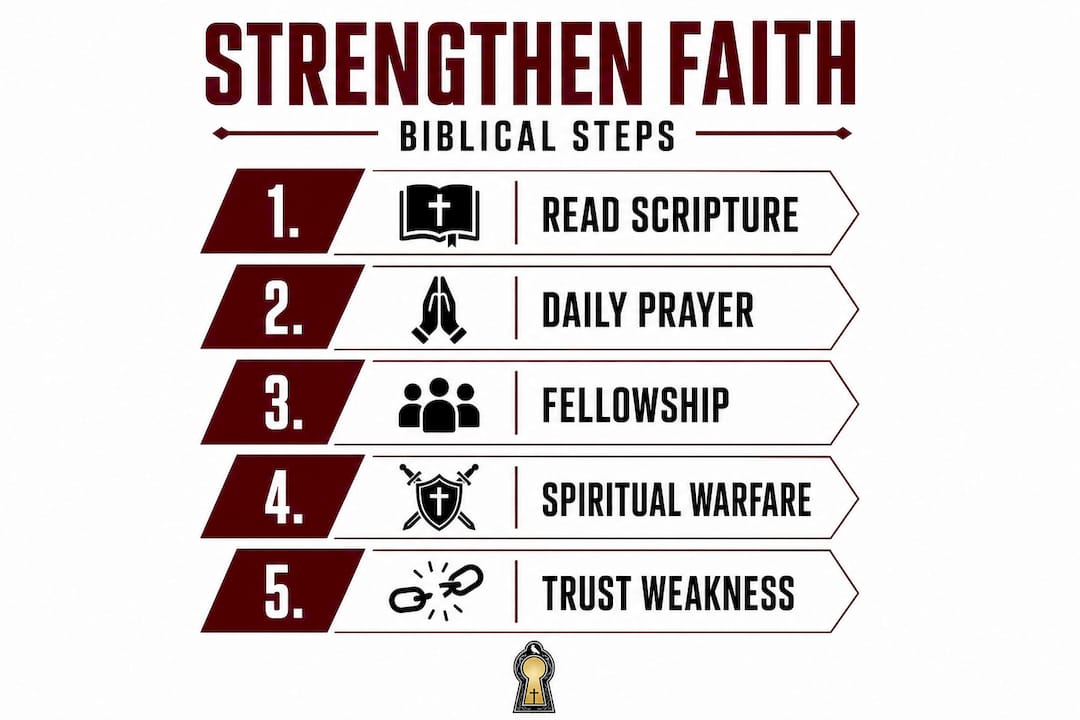
Every step that follows builds on this foundation. You cannot sustain daily spiritual habits if you do not know what you believe. You cannot stand in spiritual warfare if you have not settled the ground beneath your feet. Start here.
Daily habits that grow faith
With foundation in place, strong faith is built through intentional, consistent habits. Faith is not passive. Romans 10:17 says, "Faith cometh by hearing, and hearing by the word of God." Faith is cultivated through engagement with the Word. Here are four daily disciplines that produce measurable spiritual growth:
-
Prayer. Prayer is not a wish list directed at the ceiling. It is communion with the God who hears. Daniel prayed three times a day even under threat of death (Daniel 6:10). Jesus rose early to pray (Mark 1:35). Approach prayer with structure: adoration, confession, thanksgiving, and supplication. These are not rigid rules but a biblical pattern that keeps prayer from becoming self-centered rambling.
-
Bible intake. Reading scripture daily is non-negotiable. The Psalmist declared, "Thy word have I hid in mine heart, that I might not sin against thee" (Psalm 119:11). Read with purpose: study a book systematically, mark repeated themes, and ask what each passage reveals about the character of God. Engaging in personal Bible study with a structured method turns casual reading into genuine transformation.
-
Journaling. Writing down what God has revealed through His Word and through answered prayer creates a personal record of faithfulness. When doubt attacks, that record becomes a weapon. Reviewing past entries reminds you of God's concrete, documented interventions in your life. This is not a therapeutic exercise. It is a spiritual discipline.
-
Fellowship and accountability. Hebrews 10:24-25 commands believers not to forsake the assembling together. You need other believers around you who will speak truth into your life and hold you accountable to your commitments. The transformative benefits of Bible study are multiplied when you study with others who challenge your interpretation and sharpen your understanding.
Weekly self-check points to consider:
- Did I engage the Word every day this week?
- Did I bring my anxieties and decisions before God in prayer?
- Did I make contact with a fellow believer for accountability?
- Did I apply what I studied to a real situation I faced?
Pro Tip: Stack your spiritual habits with existing routines. Pray before your first meal. Listen to a scripture reading during your commute. Keep your Bible on the table where you drink your morning coffee. Habit stacking removes the friction of starting and makes consistency far more achievable.
The goal is not religious performance. The goal is an increasing knowledge of God and a growing dependency on Him. These habits are the channels through which that knowledge flows.
Engage in spiritual warfare
Beyond daily habits, believers must be equipped for spiritual opposition that threatens faith. Paul's command in Ephesians 6:10 is unambiguous: "Be strong in the Lord, and in the power of his might." Spiritual warfare is not metaphor. It is the daily reality of every believer who walks in faithfulness. The enemy targets your faith specifically, because a believer without faith is functionally neutralized.
Ephesians 6:11-18 outlines the full armor of God, which includes the belt of truth, the breastplate of righteousness, the gospel of peace, the shield of faith, the helmet of salvation, and the sword of the Spirit. Notice that faith is specifically identified as a shield, designed to quench the fiery darts of the wicked. This language is military, purposeful, and active. Faith is not a decoration. It is a battle instrument.

| Tool | Category | Function |
|---|---|---|
| Prayer | Defensive and offensive | Maintains communication with the Commander |
| Scripture memorization | Defensive | Immediate response to temptation and doubt |
| Church community | Defensive | Accountability and mutual encouragement |
| Evangelism | Offensive | Proclaiming truth advances the Kingdom |
| Speaking truth publicly | Offensive | Confronts false doctrine and deception |
| Fasting | Defensive and offensive | Sharpens spiritual sensitivity and focus |
Common spiritual attacks, and their biblical responses:
- Doubt: Counter with specific scriptural promises. Write them out. Speak them aloud.
- Fear: Apply 2 Timothy 1:7. God has not given a spirit of fear.
- Discouragement: Return to the record of God's faithfulness in scripture and in your own journal.
- False teaching: Test everything against the Word (Acts 17:11). Refuse to compromise on scripture's authority.
- Isolation: Resist the pull to withdraw. Contact your accountability partner immediately.
Pro Tip: Memorize short, specific passages that address your most frequent attack points. If fear is your battle, memorize Isaiah 41:10 and deploy it the moment fear rises. This is your "quick-draw" defense. The sword of the Spirit works only when you have it in hand and ready.
Learning to recognize spiritual battle and faith as inseparable realities equips you to stand. For a structured approach to putting on the armor, the practical guide to Christian warfare provides a detailed, verse-by-verse framework for every believer who refuses to be caught unprepared.
Verify growth and avoid common pitfalls
As you practice faith-building actions, regular self-examination and correction keep you on track toward lasting transformation. Paul's instruction in 2 Corinthians 13:5 is direct: "Examine yourselves, whether ye be in the faith; prove your own selves." This is not a call to morbid introspection. It is a call to honest, scripture-guided assessment.
Here is a practical framework for spiritual self-examination:
-
Examine your response to trials. James 1:2-4 frames trials as the proving ground of faith. Are you responding to difficulty with bitterness and withdrawal, or with a deepening reliance on God? Your response to suffering is one of the most accurate indicators of genuine faith growth.
-
Examine your love for the Word. Is your appetite for scripture increasing or decreasing? A believer who is growing in faith will find the Word more precious, not less, over time. Psalm 119:97 says, "O how love I thy law! it is my meditation all the day."
-
Examine your love for fellow believers. 1 John 3:14 connects love for the brethren with evidence of spiritual life: "We know that we have passed from death unto life, because we love the brethren." Growing faith produces a growing love for God's people.
-
Examine your Christlike character. Galatians 5:22-23 lists the fruit of the Spirit. Compare your character at the start of the year to your character now. Not as a basis for pride, but as evidence of the Spirit's genuine work in your life.
Discernment is essential here. Examining yourself is not the same as tormenting yourself. The goal is honest, compassionate assessment in light of grace, not a legalistic audit that produces despair rather than growth.
Common pitfalls to identify and correct:
- Spiritual pride: Measuring your faith by comparing yourself to other believers rather than to the standard of Christ. This is both dangerous and unbiblical.
- Isolation: Withdrawing from fellowship when you feel shame or discouragement. The enemy designs isolation precisely to cut believers off from accountability and encouragement.
- Neglecting doctrine: Allowing busyness or emotional satisfaction to replace the consistent study of sound teaching. Transformative Christian habits always center on the Word, not on feelings.
A simple journaling template for weekly faith tracking:
- Scripture studied this week: (list the passage)
- One truth God revealed: (one specific insight from that passage)
- One trial I faced: (briefly describe it)
- How I responded: (honest assessment)
- One area of growth: (evidence of the Spirit's work)
- One area to surrender: (where you still need God's grace)
If you have found yourself in a season where when church feels shallow is your honest experience, do not abandon the body of Christ. Identify what is shallow, test it against scripture, and seek a community that prioritizes the Word above all.
A fresh perspective: The overlooked power of weakness in faith
Here is the reality that most practical guides on faith completely miss. All of the steps above, the disciplines, the warfare strategies, the journaling templates, these are valuable tools. But they can also become a subtle trap. If you are not careful, a framework for strengthening faith can quietly become a program of self-improvement, where you measure your standing before God by how consistently you perform the disciplines.
Paul confronted this directly. In 2 Corinthians 12:9, God said to him: "My grace is sufficient for thee: for my strength is made perfect in weakness." Paul did not receive a technique for overcoming his thorn. He received a revelation. That God's power is most fully displayed not in your strongest moments, but in your most dependent ones.
The believers whose faith tends to be the deepest and most durable are rarely the ones who have engineered an impressive spiritual routine. They are the ones who have been broken: by grief, by failure, by profound doubt, by the collapse of everything they trusted that was not God. In those moments, they discovered what what true transformation looks like in the real fabric of a human life. It does not look like confidence. It often looks like surrender.
This does not mean you abandon the habits. It means you hold them rightly. The disciplines are means, not ends. The moment you trust the disciplines more than the God they are meant to draw you toward, you have shifted from faith to religious performance. Let your weakness remind you that this entire enterprise depends on grace. That is not discouragement. That is the deepest expression of biblical faith.
Tools and resources to strengthen your faith journey
The steps in this guide are only as powerful as the tools you use to implement them. Principles without practical resources can stall your momentum.
If you are serious about building a faith that stands, Dead Hidden has the resources to take you deeper. Whether you want to study the Bible deeply with a structured, verse-by-verse guide, or you need the Christian Soldier's Battle Notes to equip you for spiritual warfare with doctrinal precision, these tools were built specifically for believers who refuse to settle for surface-level Christianity. Explore the full range of biblical resources from Dead Hidden and commit to growing in the knowledge and power of God's Word today.
Frequently asked questions
What are effective daily practices to build Christian faith?
Consistent prayer, Bible reading, and surrounding yourself with other believers are the most effective daily practices, as faithful growth requires daily engagement with both the Word and the body of Christ.
How does spiritual warfare relate to faith?
Spiritual warfare is a reality every believer faces, and faith specifically functions as the shield against attacks from the enemy, activated through prayer and the application of God's Word.
How can I measure if my faith is actually growing?
Measure your growth by examining how you respond to trials, whether your love for scripture is increasing, and whether Christlike character, the fruit of the Spirit, is becoming more visible in your daily conduct.
What role does church community play in faith strengthening?
A church community provides the accountability and mutual support that scripture commands in Hebrews 10:24-25, making it essential for any believer committed to staying faithful over the long term.