

Most churchgoing Christians read the Bible far less often than they believe they should. The gap between conviction and practice is real, and it is growing. Studies consistently show that lack of time and not knowing where to start are the two most common reasons adults do not engage Scripture on their own outside of Sunday services. This article is written for the believer who knows the Word is essential but struggles to make it a daily reality. We are going to move from confusion to clarity, and from clarity to consistent, transformative application.
Table of Contents
- Why daily Bible engagement matters
- Common barriers to engaging the Bible daily
- Building a sustainable Bible routine
- Practical ways to apply biblical teaching every day
- Why most Bible reading methods fall short — and what actually works
- Resources to deepen your daily walk
- Frequently asked questions
Key Takeaways
| Point | Details |
|---|---|
| Bible transforms daily living | Consistent engagement with Scripture lays a foundation for wise choices, spiritual growth, and faith-filled actions. |
| Overcoming time barriers | Practical routines and structured reading plans enable even busy believers to integrate Bible reading into daily schedules. |
| Application is vital | Memorizing and reflecting on specific passages empowers Christians to apply biblical principles in real-life challenges. |
| Personal approach works best | Flexible, personalized Bible study methods are more sustainable and transformative than rigid routines. |
Why daily Bible engagement matters
Scripture is not a religious accessory. It is the living, breathing revelation of Almighty God, given so that His people would know how to think, speak, act, and decide at every level of life. Hebrews 4:12 declares that the Word of God is "quick, and powerful, and sharper than any twoedged sword," capable of discerning even the thoughts and intents of the heart. That is not poetic decoration. That is a doctrinal statement about the functional power of Scripture in a believer's daily experience.
Consider what regular engagement with the Bible actually does for you:
- It calibrates your moral compass when the world presses you toward compromise
- It builds intimacy with God by revealing His character, His promises, and His commands
- It renews your mind (Romans 12:2), reshaping how you interpret circumstances, relationships, and trials
- It equips you with the spiritual authority needed to resist temptation and stand firm in spiritual warfare
- It directs your family, your marriage, and your community toward godliness with clear, actionable instruction
The benefits of Bible study extend far beyond the devotional moment. They shape who you become over years and decades of faithful engagement. Psalm 119:105 puts it plainly: "Thy word is a lamp unto my feet, and a light unto my path." This is guidance for each step, not just the big decisions. Daily engagement is the mechanism through which that guidance becomes personal and practical.
"Man shall not live by bread alone, but by every word that proceedeth out of the mouth of God." — Matthew 4:4
That statement from the Lord Jesus Christ is not a suggestion. It is the doctrinal foundation for why daily Scripture engagement is not optional for the serious believer. Every word. Every day.
Common barriers to engaging the Bible daily
Understanding the importance of Scripture is one thing. Sitting down with it every morning is another. We need to be honest about why so many committed believers, people who genuinely love the Lord, still struggle to make Bible reading a daily habit.
The data is sobering. Research confirms that the most commonly cited barriers to personal Bible engagement are time constraints and not knowing where to begin. These are not excuses. They are real obstacles that deserve real solutions.
| Barrier | Why it stalls Bible engagement | Common response |
|---|---|---|
| Lack of time | Busy schedules leave Scripture as a low priority | Reading feels rushed or gets skipped entirely |
| Not knowing where to start | The Bible is 66 books; no clear entry point | Paralysis leads to avoidance |
| Shallow understanding | Hard passages create discouragement | Reader gives up after confusion |
| No accountability | Solo habits break easily without support | Inconsistency becomes the norm |
| Emotional disconnection | Reading feels mechanical rather than personal | Engagement fades over time |
Beyond the practical barriers, there is a spiritual dimension here that must be named plainly. The adversary does not want you in the Word. Resistance to Scripture is not always laziness or busyness. Sometimes it is a targeted attack. Ephesians 6:17 calls the Word of God "the sword of the Spirit." A soldier who neglects his weapon is a soldier in danger.
Common signs you are hitting a barrier rather than building a habit:
- You often intend to read but feel a sudden urgency to do something else first
- You begin a reading plan with enthusiasm but abandon it within two weeks
- You read the words but feel nothing is registering or changing
- Bible reading feels like obligation rather than communion
A solid Bible study checklist can give you the structure needed to move past these stalling points. And developing a consistent practice of personal Bible study begins with understanding what that actually looks like in your specific season of life.
Pro Tip: Do not begin with a high-volume reading plan. Five verses read slowly, prayed over, and reflected on will produce more transformation than three chapters read in a hurry. Start small. Stay consistent. Build momentum.
Building a sustainable Bible routine
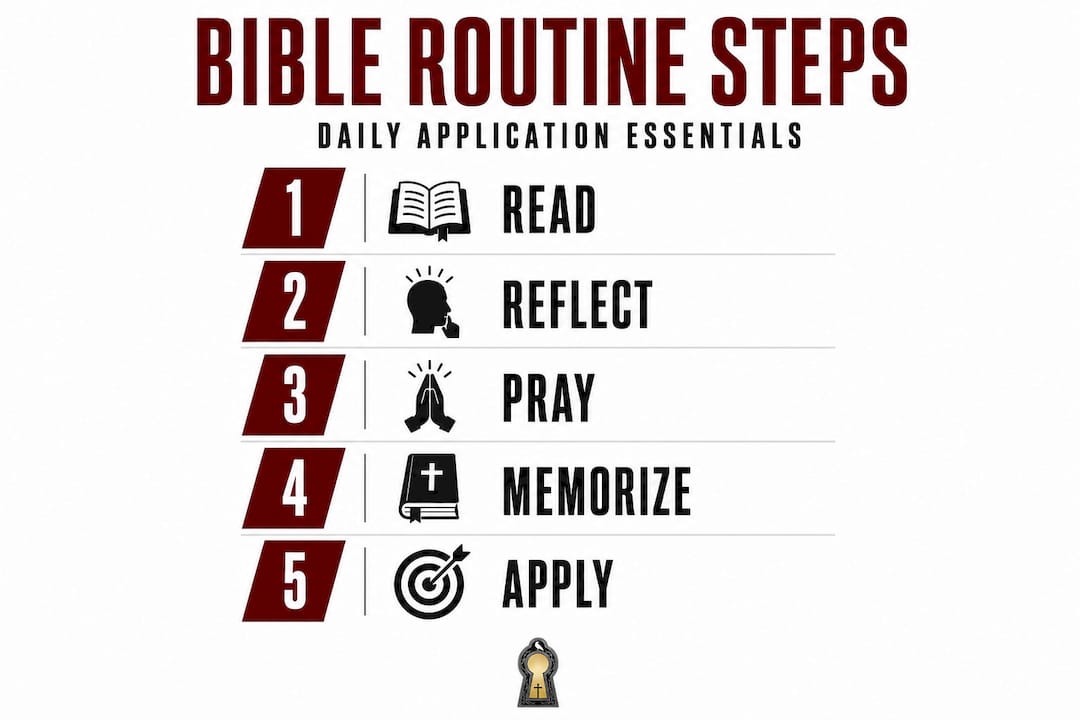
A sustainable routine is not the same as a perfect routine. You are not constructing a system that will never be interrupted. You are building a posture, a daily orientation toward the Word that survives holidays, hard weeks, and unexpected demands.
Here is a practical, four-step framework for building a routine that actually holds:
- Set a specific time. Morning is the most recommended because it positions Scripture before the noise of the day. Evening works for night owls. The key is consistency, not perfection. Schedule it like an appointment you do not cancel.
- Select your readings in advance. Do not sit down and then decide what to read. That decision fatigue is a barrier. Choose a reading plan or book of the Bible before the session begins.
- Reflect before you move on. After reading, pause. Ask: What does this say about God? What does this say about me? What does this require of me today? These three questions drive application, not just information.
- Close in prayer. Turn what you read into direct conversation with God. Pray the passage back to Him. This seals the Word into your spirit rather than letting it evaporate.
The 2026 Bible reading plan available through our store is built specifically for believers who want structured, doctrinally sound progression through Scripture. For those who want a clear method rather than just a list of chapters, the Bible reading protocol provides a systematic approach to daily engagement.
| Routine type | Best suited for | Key advantage |
|---|---|---|
| Morning devotional (15 min) | Busy professionals and parents | Sets spiritual tone early in the day |
| Extended study session (45+ min) | Students and those with flexible schedules | Allows for deeper verse-by-verse examination |
| Family reading time | Households with children | Builds shared biblical foundation |
| Lunch break reading | Those with constrained mornings | Uses an overlooked window of the day |
| Audio Bible | Commuters and active individuals | Keeps Scripture present during movement |
Research consistently shows that structure removes the decision burden that kills habits before they form. A reading plan answers the "where do I start?" question before the session begins.
Incorporating memorizing Scripture into your routine takes the Word off the page and deposits it into your heart, where it is accessible in every moment of trial, temptation, or decision.

Pro Tip: Pair your Bible reading with an existing daily habit, coffee, breakfast, or your commute. Habit stacking anchors new behaviors to established ones and dramatically increases consistency.
Practical ways to apply biblical teaching every day
A routine gets you into the Word. Application gets the Word into your life. These are two separate movements, and many believers master the first without ever truly engaging the second.
Biblical application means allowing Scripture to shape your actual responses in real situations: the argument with your spouse, the ethical pressure at work, the parenting decision you do not know how to make, the grief you do not know how to carry.
Here is a numbered framework for building application into your daily life:
- Pray Scripture into your circumstances. Take a verse directly relevant to what you are facing and pray it back to God by name, specifically, out loud. For example, if you are anxious, pray Philippians 4:6-7 word by word over your situation.
- Identify your current struggle and find the corresponding Scripture. Do not wait for Sunday to receive guidance. Open a concordance or use a topical Bible to locate what God has already said about your specific challenge.
- Share Scripture in conversation. When a friend or family member is struggling, bring a verse into the conversation. This is evangelism in its most natural form: meeting a real need with a real word from God.
- Apply biblical principles to work decisions. Proverbs, Colossians 3, and James are filled with practical wisdom about how to work with integrity, treat people rightly, and handle conflict. Read these books with your workplace in mind.
- Use biblical truth to govern your response to conflict. Matthew 18, Romans 12, and Ephesians 4 offer a complete framework for handling relational friction in a manner that honors God rather than escalating damage.
For those who want to sharpen the quality of their study so that application is grounded in accurate interpretation, accuracy in Bible study is an essential discipline. Getting the meaning right before you apply it matters enormously.
And for those who want to go deeper into understanding what Scripture actually means, not just what it seems to say on the surface, resources for deeper Scripture understanding will serve you well.
Practical application is not mystical. It is deliberate. It requires you to carry Scripture into the room, into the conversation, and into the choice. Consider keeping a small notebook or note on your phone with one verse per week that you are actively applying. Review it at the end of each day and ask honestly: Did I live this verse today?
Additional ways to live the Word daily:
- Post a key verse where you will see it repeatedly throughout the day
- Teach a passage to your children or spouse in casual conversation
- Reconsider a decision you already made in light of what Scripture says
- Read a passage before entering a challenging situation as a form of spiritual preparation
Consistent research confirms that when believers have both time and a clear starting point, engagement rises sharply. The practical tools exist. The question is whether we use them with intention.
Pro Tip: Memorize one verse per week that directly addresses your most pressing current struggle. In moments of temptation or crisis, the Holy Spirit will bring that verse to your remembrance, and it will function exactly as Hebrews 4:12 promises.
Why most Bible reading methods fall short — and what actually works
Here is the hard truth most teaching on Bible habits avoids: rigid reading plans work for some people and collapse for most. The believer who sets out to read through the entire Bible in one year with no prior study habit is not making a spiritual decision. He is setting up a performance goal that, when missed, produces guilt rather than growth.
The conventional wisdom says "read more." More chapters. More speed. More volume. But transformation is not a volume problem. It is a penetration problem. The Word must penetrate. Jeremiah 23:29 asks: "Is not my word like as a fire? and like a hammer that breaketh the rock in pieces?" A hammer applied with no force produces nothing. Slow, intentional, prayerful engagement with a few verses does more than a marathon chapter-race that deposits nothing into the soul.
What actually works is personalization. You need to connect Scripture to your specific roles and responsibilities. A father reading Ephesians 5-6 with his family in mind will encounter those chapters differently than someone reading them for information. A woman navigating a difficult marriage will extract something entirely different from Proverbs 31 than someone studying it academically.
The method we recommend is one that combines the KJV Bible study method with a willingness to linger, to ask hard questions of the text, and to apply with ruthless honesty. Not every approach will suit every believer, and that is not a failure. It is the reality of how God works through individual lives. Find the approach that keeps you returning to the Word. Then deepen it over time with structure, accountability, and sound doctrinal guidance.
Grace matters here. You will miss days. You will go through seasons of dryness. This is not abandonment; it is the human condition. The command is to return. Always return to the Word.
Resources to deepen your daily walk
You have walked through the why, the barriers, the routines, and the application strategies. Now the question is: what tools will actually support the daily walk you are trying to build?
Dead Hidden exists to equip believers who are serious about Scripture with resources that go beyond surface-level devotionals. Whether you are building a foundation in biblical femininity with the Biblical femininity guide, or you are just beginning to understand what orthodox, unfiltered biblical teaching looks like, the place to start is clear. Explore what it means to walk in the full counsel of God's Word by getting started with Hidden Truths. These resources are designed to move you from Sunday-only engagement to a life genuinely shaped by Scripture, doctrine, and daily application.
Frequently asked questions
How can I start reading the Bible daily if I am very busy?
Start with short passages and set a specific, consistent time each day that fits your existing schedule, because lack of time is the most commonly cited reason adults skip personal Scripture engagement. Even five focused minutes with one passage is a genuine beginning.
Why do many Christians struggle to engage with Scripture outside of Sunday services?
The two most common barriers are not having enough time and not knowing where to begin a personal reading habit, which research consistently identifies as the primary obstacles to daily Bible engagement outside of corporate worship settings.
What are practical ways to keep the Bible central in everyday decisions?
Apply biblical teachings directly to specific real-life situations as they arise, and memorize Scripture in advance for moments of choice or challenge, since daily personal engagement is what equips believers to respond with the Word rather than with emotion or cultural pressure.
Does it matter what translation of the Bible I use for daily reading?
Choose a translation that aligns with your doctrinal convictions and that you can understand and apply with clarity, because consistent, faithful reading and application matters more than which version sits open on your desk.